The "Economic Strategies" journal


Ways of Improving Russia’s Competitiveness in the Global Economy

DOI: 10.33917/es-1.205.2026.32-37

The article dwells on the problem of increasing competitiveness of the Russian economy against the backdrop of deteriorating relations between Russia and Western countries. The author analyzes the share of domestic production in various economic sectors. Proposals for increasing competitiveness of Russian goods through innovation are also provided.

References:

1. Afanas’eva O.G. Povyshenie konkurentosposobnosti — vazhneyshiy faktor obespecheniya ustoychivogo razvitiya molochnogo skotovodstva v sel’skokhozyaystvennykh organizatsiyakh: Monografiya [Improving Competitiveness is the Most Important Factor in Ensuring Sustainable Development of Dairy Farming in Agricultural Organizations: Monograph]. Moscow, INFRA, 2019, p. 118.

2. Top-menedzhery nazvali glavnye prepyatstviya dlya biznesa v Rossii [Top Managers Named the Main Obstacles to Business in Russia]. RBK, 2023, 7 dekabrya, available at: https://www.rbc.ru/economics/07/12/2023/6570223a9a7947cb95b143b5?ysclid=mdhsb47o73526509239

3. Mezhdunarodnyy institut upravlencheskogo razvitiya IMD [Website]. IMD, available at: https://www.imd.org/centers/wcc/world-competitiveness

4. Skobeleva O.A., Kutyashova E.V., Chirkova N.A. Konkurentosposobnost’ Rossii v mezhdunarodnom biznese [Russia’s Competitiveness in International Business]. Vestnik Udmurtskogo universiteta. Seriya: Ekonomika i pravo, 2022, no 2, available at: https://cyberleninka.ru/article/n/konkurentosposobnost-rossiiv-mezhdunarodnom-biznese

5. RBK [Website], available at: https://www.rbc.ru/economics/07/12/2023/6570223a9a7947cb95b143b5?ysclid=mdhsb47o73526509239

6. Vsemirnaya organizatsiya intellektual’noy sobstvennosti [Website], available at: https://www.wipo.int/web-publications/global-innovation-index-2024/en/

7. The Global Economy.com [Website], available at: https://www.theglobaleconomy.com/russia/gii_index/

8. PAO “Gazprom” [Website], available at: https://www.gazprom.ru/about/production/reserves/?ysclid=m4vogoulz1217508270

9. Tsentral’nyy bank Rossiyskoy Federatsii [Website], available at: https://cbr.ru/statistics/macro_itm/external_sector/pb/p_balance/

10. Zhurnal Tin’koff [Website], available at: https://journal.tinkoff.ru/list/7-glavnykh-stran-partnerov-rossii/?ysclid=m4vq179k6q641770003
The economic strategy of Poland and the Czech Republic as an example of the long-term effectiveness of state strategy

DOI: 10.33917/mic-2.127.2026.20-29

The author proceeds from the premise that for developing countries, the highest criterion of state effectiveness is the country’s transition to a new level, joining the ranks of developed countries. Of all the post-socialist bloc countries, Poland and the Czech Republic have achieved this. The author analyzes these cases. Poland implemented a standard set of macroeconomic reforms, and they proved successful thanks to a shift in public thinking: a focus on economic rather than political issues and, as a result, the widespread development of small and medium-sized businesses, which became the driving force of development. The Czech Republic had different starting conditions than Poland. The success of the Czech Republic’s economic breakthrough was determined by the correct actions taken with respect to industrial potential, which was preserved through prudent decisions during privatization and the development of international investment cooperation.

References:

1. Global Governance Indicators. URL: https://www.worldbank.org/en/publication/worldwide-governance-indicators/interactive-data-access

2. Kovaleva V., Elistratov A. Historical Review of Economic Transformations in Poland (1990-2020). Journal of Historical Research. 2022;7(1):9-12.

3. Capitalism without Capitalists. Why Poland Was Able to Build Functioning Democratic Institutions. URL: https://lenta.ru/articles/2016/05/19/poland_capitalism/

4. Sinitsina I., Chudakova N. The EU and the Polish Economy: From Adaptation to Integration. Modern Europe. 2006;3:108-123.

5. Gabarta A. Poland: 30 Years of Socioeconomic Transformations and 15 Years of EU Membership. Europe. 2019;7:82-92.

6. Mikhalev O.Yu. Results of the Law and Justice Party’s Stay in Power in Poland. Visegrad Europe. Central European Journal. 2023;4:75-90.

7. European Innovation Scoreboard 2024. Country Data. Poland. URL: https://ec.europa.eu/assets/rtd/eis/2024/

8. Mickiewicz B. Assessment and Directions of Innovative Development of the Polish Economy. Proceedings of the V International Scientific and Practical Conference «Modern Agrarian Economy: Science and Practice». Publisher: Belarusian State Agricultural Academy (Gorki), 2022. pp. 129-133.

9. Large-scale energy project: Poland allocates billions for first nuclear power plant. URL: https://hvylya.net/news/305243-masshtabnyy-energeticheskiy-proekt-polsha-vydelyaet-milliardy-na-pervuyu-aes

10. The Polish government intends to invest 70 billion zlotys in national energy grids. URL: https://www.polskieradio.pl/397/7830/Artykul/

11. Piatkowski Marcin. Poland has become Europe’s growth champion, but can this success continue? URL: https://blogs.lse.ac.uk/europpblog/2018/12/17/poland-has-become-europes-growth-champion-but-can-this-success-continue/

12. Alekhnovich A. Lessons from the Privatization of State-Owned Enterprises in Central and Eastern Europe. URL: https://isans.org/ru/articles/uroki-privatizaczii-gospredpriyatij-v-stranah-czve.html

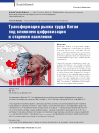
Transformation of China’s Labor Market Under the Impact of Digitalization and Population Aging

DOI: 10.33917/es-2.206.2026.52-57

China’s labour market is experiencing dual structural pressure caused by accelerated economy digitalization and the deepening population aging. On the one hand, technological progress is transforming professions, stimulating growth of the gig economy and changing work values. On the other hand, decline in the share of young workers and growing number of elderly citizens are creating staff shortage and increasing productivity requirements. The present article analyses combined impact of these trends, examines adaptation mechanisms at the enterprise and public policy levels and draws conclusions about transformation of the labour market towards greater flexibility, automation and increased human capital value.

References:

1. Mozias P.M. Ekonomika Kitaya: novye trevogi [China’s Economy: New Concerns]. *Obshchestvo i gosudarstvo v Kitae,* 2015, no 18-2, pp. 558—599.

2. Karnyushkova M.M. Transformatsiya rynka truda pod vozdeystviem tsifrovykh tekhnologiy: Aktual’nye voprosy ekonomiki i informatsionnykh tekhnologiy: Cb. materialov dokladov 61-y nauchnoy konferentsii aspirantov, magistrantov i studentov BGUIR. Minsk, 20—25 aprelya 2025 g. [Transformation of the Labor Market Under the Influence of Digital Technologies: Current Issues in Economics and Information Technology: Collection of Papers from the 61st Scientific Conference of Postgraduate, Master’s, and Undergraduate Students of BSUIR. Minsk, April 20—25, 2025.]. Belorusskiy gosudarstvennyy universitet informatiki i radioelektroniki. Minsk, 2025, pp. 536—540.

3. Dong-Jin Lee, Jae H. Pae, Y.H. Wong. A model of close business relationships in China (guanxi). *European Journal of Marketing,* 2001, vol. 35, iss. 1/2, pp. 51—69, DOI: https://doi.org/10.1108/03090560110363346

4. Belokrylova O.S., Situkho A.N. Strukturnye preobrazovaniya prekariata kak sledstvie Chetvertoy promyshlennoy revolyutsii: Proizvodstvo, nauka i obrazovanie v epokhu transformatsiy: Rossiya v [de]globaliziruyushchemsya mire (PNO-VI) [Structural Transformations of the Precariat as a Consequence of the Fourth Industrial Revolution: Production, Science and Education in the Era of Transformation: Russia in a [De]globalizing World (PNO-VI)]. Vol. 2, Pod obshch. red. S.D. Bodrunova, A.V. Buzgalina. Moscow, INIR imeni S.Yu. Vitte, 2020, pp. 103—110.

5. Egorushkina T.N. Problemy transformatsii rynka truda pod vliyaniem Chetvertoy promyshlennoy revolyutsii [Problems of Transformation of the Labor Market under the Influence of the Fourth Industrial Revolution]. *Sfera uslug: innovatsii i kachestvo,* 2021, no 54, pp. 23—36.

6. Veshkurova A.B., Terganov Ya.K. Tsifrovaya transformatsiya i bezrabotitsa: puti sovmeshcheniya tekhnologicheskogo progressa i obespecheniya zanyatosti naseleniya [Digital Transformation and Unemployment: Ways to Combine Technological Progress and Employment]. *Ekonomika truda,* 2023, vol. 10, no 5, pp. 665—684.

7. Lyu P., Belokrylova O.S. Perspektivy zanyatosti v usloviyakh perekhoda k Industrii 4.0 (na primere Kitaya) [Belokrylova O.S. Employment Prospects in the Context of the Transition to Industry 4.0 (using China as an Example)]. *Sotsial’nye novatsii i sotsial’nye nauki,* 2022, no 1(6), pp. 140—147.

Strategization of the Currency Policy and the Ruble’s Ultra-Short-Term Volatility

DOI: 10.33917/es-1.205.2026.38-45

The paradigm shift in international relations has caused significant changes in financial markets. The proposed author’s methodology for economic-mathematical modeling of the ruble exchange rate based on international flows makes it possible to include capital flows in the modeling orbit at a formal-logical level in an explicit form, taking into account their short-term volatility. Conducted during various crisis periods — formally based on results of mathematical modeling — analysis and assessment of short-term effects of the ruble exchange rate dynamics show the presence of preconditions for producing shortterm volatility in the national currency exchange rate under conditions of unfavorable geo-economic environment and a freefloating exchange rate regime. Based on the above, it is concluded that the Bank of Russia needs to make more serious efforts to implement a stabilization exchange rate policy, which is one of the key components of macroeconomic management.

References:

1. Glaz’ev S.Yu. Problemy i perspektivy rossiyskogo finansovogo rynka v usloviyakh strukturnykh izmeneniy mirovoy ekonomiki [Problems and Prospects of the Russian Financial Market in the Context of Structural Changes in the World Economy]. Finansy: teoriya i praktika, 2020, no 24(3), pp. 6–29, available at: https://cyberleninka.ru/article/n/problemy-i-perspektivy-rossiyskogo finansovogo-rynka-v-usloviyah-strukturnyh-izmeneniy-mirovoy-ekonomiki

2. Ishkhanov A., Linkevich E.F. Mezhdunarodnye valyutno-kreditnye i finansovye otnosheniya [International Monetary, Credit and Financial Relations]. Krasnodar, 2022, 149 p.

3. Ageev A.I., Loginov E.L. Izmenenie strategii operirovaniya dollarom: zapusk SShA novogo kreditno-investitsionnogo tsikla vo vzaimosvyazi s valyutnymi voynami [Changing the Strategy of Dollar Handling: US Launch of New Credit-Investment Cycle in Association with the Currency Wars]. Ekonomicheskie strategii, 2015, no 3(129), pp. 20–35.

4. Pechalova M.Yu. Transformatsiya rossiyskoy valyutnoy politiki na fone obostreniya geopoliticheskoy napryazhennosti [Transformation of the Russian Monetary Policy Against the Background of Aggravation of Geopolitical Tensions]. Ekonomika. Nalogi. Pravo, 2023, no 16(1), pp. 48–57.

5. Chernov V.A. Uregulirovanie krizisa mezhdunarodnykh finansov instrumentami monetarnoy politiki [Settlement of the Crisis of International Finance by Monetary Policy Instruments]. Innovatsionnaya ekonomika i obshchestvo, 2023, no 3(41), pp. 48–64.

6. Kulikov N.I., Kulikova M.A., Parkhomenko V.L. Slabyy rubl’ kak odno iz glavnykh prepyatstviy dlya razvitiya i rosta rossiyskoy ekonomiki [Weak Ruble as a Main Obstacle to the Russian Economy’s Development and Growth]. Finansy i kredit, 2024, no 30(5), pp. 988–1016, DOI: https://doi.org/10.24891/fc.30.5.988

7. Eremin V.V. Obespechennost’ denezhnoy massy zolotovalyutnymi rezervami kak operezhayushchiy indikator kursa rublya [Provision of the Money Supply with Gold and Foreign Exchange Reserves as a Leading Indicator of the Ruble Exchange Rate]. Finansy: teoriya i praktika, 2023, no 27(3), pp. 43–55.

Corporate social responsibility and sustainable development management of an organization based on Russian traditional values

DOI: 10.33917/mic-2.127.2025.30-43

In the context of the growing importance of sustainable development and increasing societal expectations toward business, Russian companies face the need to integrate corporate social responsibility into management processes based on the traditional values of national culture. This article presents theoretical and methodological approaches to developing a value-based model for managing organizational sustainable development. Key elements of the model, including principles of fairness, dignity, and solidarity, are explored, as well as their role in enhancing organizational resilience and adaptability. A conceptual foundation has been formed for the subsequent development of a functional model and tools for its implementation.

References:

1. Declaration of Principles of Russian Corporate Culture and Corporate Social Responsibility: Dignity. Trust. Action. Moscow: Coalition of Creators, 2023. 28 p. URL: https:///coalition-contributions/

2. Vishnyakova D.A. Traditional Values in the Russian Management System: Development History and Relevance in Modern Conditions. Scientific Notes of Young Researchers. 2023;11(3):65-72. URL: https://cyberleninka.ru/article/n/traditsionnye-tsennosti-v-rossiyskoy-sisteme-menedzhmenta

3. Civic Chamber of the Russian Federation. Report on the State of Civil Society in the Russian Federation — 2022: Traditional Values. Section 3.1. Moscow: Civic Chamber of the Russian Federation, 2022. URL: https://report2022.oprf.ru/ru-RU/traditional-values.html

4. Agafonova A.N., Yakhneeva I.V., Nikitina I.N. Corporate Social Responsibility in Russia: Motives and Features // In: Mantulenko V. (ed.) Global Challenges and Prospects of the Modern Economic Development. European Proceedings of Social and Behavioural Sciences, 57. pp. 1055-1068. 2019. DOI: 10.15405/epsbs.2019.03.105.

5. Cameron K. Responsible Leadership as Virtuous Leadership. Journal of Business Ethics. 2011;98(1):25-35. DOI: 10.1007/s10551-011-1023-6.

6. Grachev M.V., Bobina M.A. Russian Organizational Leadership: Lessons from the GLOBE Study. International Journal of Leadership Studies. 2006;1(2):98-116.

7. Zavyalova E., Ostrovskaya E. Corporate Social Responsibility in Russia. SHS Web of Conferences. 2020. Vol. 89. Art. 06008. DOI: 10.1051/shsconf/20208906008.

Culture as a Code in the National Economy’s Digital Twin

DOI: 10.33917/es-2.206.2026.58-61

The article explains the “Culture as a Code” concept as an evolutionarily necessary stage in development of the complex organizations’ management systems and significant expansion in interpreting the “as-a-Code” concepts used in the IT industry: “management as a code” and “architecture as a code”. The author substantiates an assumption that formalization of management culture opens up the possibility of creating effective digital twins not only for corporations, but also at the industry and national level, as it is being done in China, in order to overcome institutional and social disunity.

References:

1. Podymov P.V. Tsifrovoy dvoynik predpriyatiya: karty biznes-sposobnostey i iskusstvennyy intellekt v upravlenii mnogootraslevymi ekosistemami [Digital Twin of an Enterprise: Business Capability Maps and Artificial Intelligence in Managing Multi-Industry Ecosystems]. *Ekonomicheskie strategii*, 2025, vol. 27, no 3(201), pp. 98–101, DOI: https://doi.org/10.33917/es-3.201.2025.98-101

2. Nort D. Instituty, institutsional’nye izmeneniya i funktsionirovanie ekonomiki [Institutions, Institutional Change and the Functioning of the Economy]. Moscow, Fond ekonomicheskoy knigi “Nachala”, 1997.

3. Popov E.V., Semyachkin A.V. Upravlenie kak kod: evolyutsiya podkhodov k avtomatizatsii upravleniya IT-infrastrukturoy [Management as Code: The Evolution of Approaches to Automating IT Infrastructure Management]. *Biznes-informatika*, 2021.

4. Eom S.J. The Emerging Digital Twin Bureaucracy in the 21st Century. *Perspectives on Public Management and Governance*, 2022.

5. Kranenburg, R. van. Statecraft and Policymaking in the Age of Digital Twins. Cham, Springer Nature, 2024.

Overlapping long-term demographic trends with geopolitical shocks in a challenging economic environment

DOI: 10.33917/mic-1.126.2026.5-11

The article examines the problems of configuring long-term demographic trends in the context of geopolitical shocks with a focus on increasing the operational array of human (bio-social) and resource-consumption (material and non-material) factors as elements of a socio-economic supersystem with a significant component of difficult-to-predict development. The paper analyses the problems of maintaining viability of the state as a supersystem. The authors substantiate a direction of the regulatory vector for the developed profiles of operational indicators depending on different population structures as a predictable phenomenon – a baseline from which to build on the factors stimulating demographic basis for the state’s viability. The main objective is to support transition of the human resource provision for the armed forces (in the context of the Special Military Operation) and production structures in various sectors of the economy from a cluster of difficult-to-predict development (instability) into a cluster with confirmed available opportunities for replenishing military personnel and key industries workers (primarily defence and critical infrastructure) as a computation solution in relation to the macro-space of operated indicators.

References:

1. Ageev A.I., Bakhtizin A.R., Makarov V.L., Loginov E.L. [et al.]. The economic foundation of victory: a strategic forecast of the stability of the Russian economy in the face of sanctions attacks. Economic strategies. 2023;25(3(189)):6-15.

2. Ageev A.I., Bochkarev O.I., Grabchak E.P., Loginov E.L. Network-centric system of increased survivability of Russian energy management in difficult-to-predict critical conditions. Economic strategies. 2021;23(3(177)):6-17.

3. Ageev A.I., Loginov E.L. The world community in conditions of supercritical bifurcation / Management of complex organizational and technical systems in conditions of supercritical situations: Proceedings of the international scientific and practical conference, Moscow, April 21-22, 2022. Moscow: Institute of Economic Strategies, 2022. pp. 9-12.

4. Ageev A.I. The role of sanctions, conflicts and special operations: reflections on the future. Part 1. Scientific Bulletin of the Russian Military-industrial complex. 2023;4:66-74.

5. Ageev A.I., Grabchak E.P., Loginov E.L. Russia in a supercritical situation: managing the restoration of life support functions to overcome the consequences of a natural disaster. Economic strategies. 2021;23(5(179)):28-35.

6. Ageev A.I., Loginov E.L. Strategic predestination of special military operations in the global supersystem. Economic strategies. 2023;25(4(190)):6-19.

7. Ageev A.I., Grabchak E.P., Loginov E.L. The use of artificial intelligence in the implementation of military command and control of civilian facilities as a single hybrid battlefield / Neurocomputers and their application: Abstracts of the XX All-Russian Scientific Conference, Moscow, March 22, 2022. Moscow: MGPPU, 2022. pp. 31-33.

Monetary Policy of Russia and the Republic of Belarus: Current Trends and Challenges

DOI: 10.33917/es-1.205.2026.46-53

The author examines peculiarities of the monetary policy of the Bank of Russia and the National Bank of the Republic of Belarus in the context of modern challenges.

References:

1. Konstitutsiya Rossiyskoy Federatsii (prinyata vsenarodnym golosovaniem 12 dekabrya 1993 g. s izmeneniyami, odobrennymi v khode obshcherossiyskogo golosovaniya 1 iyulya 2020 g.) [Constitution of the Russian Federation (adopted by popular vote on December 12, 1993, with amendments approved during the all-Russian vote on July 1, 2020)]. Dostup iz SPS “Konsul’tant Plyus”.

2. Federal’nyy zakon ot 10 iyulya 2002 g. N 86-FZ “O Tsentral’nom banke Rossiyskoy Federatsii (Banke Rossii)” [Federal Law of July 10, 2002 No. 86-FZ “On the Central Bank of the Russian Federation (Bank of Russia)”]. Rossiyskaya gazeta, 2002, no 127.

3. Postanovlenie Konstitutsionnogo suda RF ot 3 iyulya 2001 g. N 10-P [Resolution of the Constitutional Court of the Russian Federation of July 3, 2001 No. 10-P]. Vestnik Konstitutsionnogo suda RF, 2001, no 6.

4. Postanovlenie Prezidiuma VAS RF ot 19 aprelya 2002 g. N 5697/01 [Resolution of the Presidium of the Supreme Arbitration Court of the Russian Federation of April 19, 2002 No. 5697/01]. Vestnik VAS RF, 2002, no 8.

5. Postanovlenie Prezidiuma Verkhovnogo suda RF ot 7 avgusta 2002 g. N 100pv-02 [Resolution of the Presidium of the Supreme Court of the Russian Federation of August 7, 2002 No. 100пв-02]. Byulleten’ Verkhovnogo suda RF, 2003, no 2.

6. Osnovnye napravleniya edinoy gosudarstvennoy denezhno-kreditnoy politiki na 2025 god i period 2026 i 2027 godov (utv. Bankom Rossii) [Main Directions of the Unified State Monetary Policy for 2025 and the Period 2026 and 2027 (approved by the Bank of Russia)]. Dostup iz SPS “Konsul’tant Plyus”.

7. Dzhonson S., Kvak D. 13 Bankov, kotorye pravyat mirom [13 Banks That Rule the World]. Moscow, Kar’era Press, 2013, 384 p.

8. MVF nazval targetirovanie inflyatsii i gibkiy obmennyy kurs odnimi iz klyuchevykh predposylok dlya povysheniya potentsiala rosta rossiyskoy ekonomiki: Informatsiya Banka Rossii ot 24 maya 2019 g. [IMF Identified Inflation Targeting and a Flexible Exchange Rate as Key Prerequisites for Increasing the Growth Potential of the Russian Economy: Information from the Bank of Russia Dated May 24, 2019]. Dostup iz SPS “Konsul’tant Plyus”.

9. Missiya MVF zayavila o vazhnosti sokhraneniya v Rossii prochnoy makroekonomicheskoy osnovy: Informatsionnoe soobshchenie Banka Rossii ot 21 noyabrya 2019 g. [IMF Mission Stated the Importance of Maintaining a Strong Macroeconomic Framework in Russia: Information Statement of the Bank of Russia Dated November 21, 2019]. Dostup iz SPS “Konsul’tant Plyus”.

10. Mery Banka Rossii sposobstvuyut vosstanovleniyu rossiyskoy ekonomiki — MVF: Informatsionnoe soobshchenie Banka Rossii ot 24 noyabrya 2020 g. [Bank of Russia’s Measures Contribute to the Recovery of the Russian Economy — IMF: Information Statement of the Bank of Russia Dated November 24, 2020]. Dostup iz SPS “Konsul’tant Plyus”.

Challenges to the economic security of enterprises in the context of digital transformation and the transition from static protection to dynamic adaptability. Part 2

DOI: 10.33917/mic-2.127.2026.44-52

The article is devoted to substantiating the importance of the concept of dynamic economic security of an enterprise in the context of digital transformation and high turbulence of the external environment. The limitations of traditional static models of «perimeter» protection, which lose their effectiveness due to information overload and non-linearity of economic processes, are analyzed. The hypothesis is substantiated that the level of security of modern business is determined by the quality and speed of management decisions. A dynamic security architecture based on a symbiosis of artificial intelligence (for 24/7 operational response) and collective intelligence (for strategic thinking) is proposed. The necessity of transition from extrapolation forecasting to scenario modeling and management of a multi-criteria choice is argued. The principles of business resilience are formulated as the ability to maintain a development trajectory through controlled changes and cognitive convergence of heterogeneous data.

References:

[1-21] See in no. 1/2026, p. 50-52.

22. Rittel H.W.J., Webber M.M. Dilemmas in a General Theory of Planning. Policy Sciences. 1973;4(2):155-169.

23. Keeney R.L., Raiffa H., Rajala D.W. Decisions with Multiple Objectives: Preferences and Value Trade-Offs. IEEE Transactions on Systems, Man, and Cybernetics. 1977. p. 403 URL: https://www.researchgate.net/publication/3116639_Decisions_with_Multiple_Objectives_Preferences_and_Value_Trade-Offs

24. Taleb N.N. The Black Swan. Under the Sign of Unpredictability. Moscow: KoLibri, Azbuka-Atticus, 2012. 736 p.

25. Robinson J.B. Futures Under Glass: A Recipe for People Who Hate to Predict. Futures. 1990;22(9):820-842. DOI: 10.1016/0016-3287(90)90018-D

26. Gordeev V.V., Abramov V.I. Business Process Forecasting as a Decision-Making Tool within a Proactive Management Approach. Economics and Management. 2025;31(7):893-902. DOI 10.18334/evp.6.4.123876

27. Nikogosyan A.Z., Abramov V.I. Remote Dynamic Control in Transport Logistics: The Role and Benefits of the Internet of Things. Economics and Management: Problems, Solutions. 2025;5(4(157)):183-195. DOI 10.36871/ek.up.p.r.2025.04.05.022.

28. Godet M. Creating Futures: Scenario Planning as a Strategic Management Tool. London: Economica, 2001. 269 p.

29. Ageev A.I., Grabchak E.P., Loginov E.L. A New Model of Managing the Russian Economy in the Context of Hybrid Risks and Threats. Economic Strategies. 2025;5(203): 6-19. DOI: https://doi.org/10.33917/es-5.203.2025.6-19

30. McGrath R.G. The End of Competitive Advantage (translated from English by V.N. Egorova). Moscow: Binom. Lab. of Knowledge, 2013. 248 p.

31. Abramov V.I., Gordeev V.V., Stolyarov A.D. Digital Transformation of Industrial Enterprises into Digital Business Ecosystems: Structural Components and Practical Aspects of Implementation. Fundamental Research. 2024;9:78-85. DOI 10.17513/fr.43680

32. Abramov V.I., Stolyarov A.D. Digital Business Ecosystems: Typology and Design. Modern Economy Success. 2025;6:370-379. DOI 10.18334/vinec.15.4.124210

A systems approach to management in the era of artificial intelligence

DOI: 10.33917/es-2.206.2026.62-67

The article examines the problems of using a systems approach in modern management. Despite its recognized value, its widespread use is constrained by a key problem — the difficulty of developing systems thinking in managers. The authors note that only a small part of the developed strategies is implemented in practice, which is directly related to the deficit of this type of thinking. As a solution, it is proposed to use artificial intelligence (AI) tools that do not replace, but significantly enhance human cognitive abilities. The article contains a specific proposal for creating an ecosystem of AI assistants consisting of five interconnected modules. It is concluded that AI acts as the very “lever” that allows us to overcome the elitism of the systems approach and realize its potential in mass management practice.

References:

1. Pitersen V. Strategiya kak obuchenie: Novyy vzglyad na protsess sozdaniya tsennosti i bor’by za konkurentnoe preimushchestvo [Strategy as Learning: A New Look at Value Creation and Competitive Advantage]. Moscow, Intellektual’naya Literatura, 2020.

2. Senge P. Pyataya distsiplina: Iskusstvo i praktika samoobuchayushcheysya organizatsii [The Fifth Discipline: The Art and Practice of the Learning Organization]. Moscow, Olimp-Biznes, 2003, 406 p.

3. Ageev A.I., Loginov E.L., Shkuta A.A. Primenenie neyrotekhnologiy v global’nykh sotsial’nykh kommunikatsiyakh, mezhdunarodnom biznese, nauke i gosupravlenii. Mirovye tendentsii i opyt Kitaya: Ucheb. posobie [Application of Neurotechnology in Global Social Communications, International Business, Science and Public Administration. Global Trends and China’s Experience: A Textbook]. Moscow, INES, 2021.

4. Mamardashvili M.K. Protsessy analiza i sinteza v knige “Kak ya ponimayu filosofiyu” [The Processes of Analysis and Synthesis in My Philosophy]. Moscow, 1992.

5. Gvishiani D.M. Organizatsiya i upravlenie [Organization and Management]. Moscow, Izd-vo MGTU, 1998.

6. Ageev A.I. Rossiya v prostranstve i vremeni: strategii i tsikly [Russia in Space and Time: Strategies and Cycles]. Saint Petersburg, SPbGUP, 2005, 32 p.

7. Trubnikov N.N. O kategoriyakh “tsel'”, “sredstvo”, “rezul’tat” [About the Categories “Goal”, “Means”, “Result”]. Moscow, 1968.

8. Yudin E.G. Metodologiya nauki. Sistemnost’. Deyatel’nost’ [Methodology of Science. Systematicity. Activity]. Moscow, Editorial URSS, 1997.

9. Druker P. Praktika menedzhmenta [Management Practice]. Moscow, Mann, Ivanov i Ferber, 2015, 416 p.

10. Akoff R. Planirovanie budushchego korporatsii [Planning the Future of the Corporation]. Moscow, Sirin, 2002, 256 p.

11. Mintsberg G., Al’strand B., Lampel’ Zh. Strategicheskoe safari: Ekskursiya po debryam strategicheskogo menedzhmenta [Strategic Safari: A Journey Through the Wilds of Strategic Management]. Moscow, Al’pina Pablisher, 2013, 367 p.