The "Economic Strategies" journal


The universal principles of Leonardo da Vinci’s competitive strategies and their adaptability to modern business in the context of digitalization
DOI: 10.33917/mic-2.127.2026.61-72

It has been established that Leonardo da Vinci’s competitive strategies have universal principles that can be adapted to modern business. His methods of creating unique products, such as the «sfumato» technique and an individual approach to customers, correspond to modern differentiation strategies. The approach to personal brand formation and artificial scarcity anticipates modern luxury marketing practices. Leonardo’s flexible pricing strategies contain elements relevant to the digital economy. And the combination of art, engineering, and science in his work serves as a model for modern multidisciplinary strategies.

As the conducted research has shown, the basic principles of Leonardo’s competitive strategies demonstrate amazing stability over time and can serve as a valuable guideline for modern companies. This is especially true for: companies in the creative industries (design, architecture, advertising); luxury segment enterprises; innovative start-ups; premium professional services.

References:

1. Anikieva V.A. Digital assets as a reputation formation tool. In the collection: Youth Science Week of the Institute of Industrial Management, Economics and Trade. Saint Petersburg, 2025. pp. 162-164.

2. Astratova G.V. Fundamentals of marketing: a textbook. Yekaterinburg: Ural Publishing House. University, 2024. 232 p.

3. Veretennikova O.V. Consumer value as the basis of sustainable enterprise development. Trade and the market. 2022;2(3-1 (63)):94-102.

4. Kondakova Yu.A. Application of price competition methods in the digital economy (using the randomized pricing method as an example). Bulletin of Economic and Sociological Research. 2024;2:19-26.

5. Kornienko N.N. Non-price competition in a market and mixed economy. In the collection: Fundamental foundations of science. Anapa, 2021. pp. 112-114.

6. Kuzmina E.S. Personal branding in the digital age of metamodernity. Scientific papers of the North-Western Institute of Management of the Russian Academy of Sciences. 2025;16(1(68)):168-170.

7. Kuzminova T.N., Makeeva E.Z. Determination of indicators of the functioning of intangible assets to be improved and the list of works that lead to the improvement of intangible assets. In the collection: Modern financial accounting and reporting: problems and prospects of development. Moscow, 2024. pp. 53-60.

8. Laryanovsky I.S. Axiological analysis of post-non-classical scientific and technical knowledge based on the integral concept of values. Gilea: scientific bulletin. 2016;108(5):151-155.

9. Mavlyutova D.F., Sakhbieva A.I. Non-price competition as a tool for influencing consumer behavior. In the collection: Fundamental and applied research: concepts, techniques, innovations. Rostov-on-Don, 2022. pp. 358-362.

10. Novikova E.N., Martynova O.V., Antonchenko N.G. Marketing. Lecture notes. Kazan: KGEU, 2014. 100 p.

11. Odinaev F.B., Yelshin L.A. Spheres of realization of price and non-price competition in an unstable conjunctural environment. In the collection: XI International Youth Symposium on Management, Economics and Finance. Kazan, 2022. pp. 620-623.

Challenges to the economic security of enterprises in the context of digital transformation and the transition from static protection to dynamic adaptability. Part 1

DOI: 10.33917/mic-1.126.2026.42-52

The article is devoted to substantiating the importance of the concept of dynamic economic security of an enterprise in the context of digital transformation and high turbulence of the external environment. The limitations of traditional static models of «perimeter» protection, which lose their effectiveness due to information overload and non-linearity of economic processes, are analyzed. The hypothesis is substantiated that the level of security of modern business is determined by the quality and speed of management decisions. A dynamic security architecture based on a symbiosis of artificial intelligence (for 24/7 operational response) and collective intelligence (for strategic thinking) is proposed. The necessity of transition from extrapolation forecasting to scenario modeling and management of a multi-criteria choice is argued. The principles of business resilience are formulated as the ability to maintain a development trajectory through controlled changes and cognitive convergence of heterogeneous data.

References:

1. Glazyev S.Yu. State and Prospects of the Sixth Technological Wave in the Russian Economy. Economics of Science. 2024;10(2):11-29. DOI 10.22394/2410-132X-2024-10-2-11-29

2. Schwab K. The Fourth Industrial Revolution. Moscow: Eksmo, 2021. 208 p.

3. Cascio J. Facing the Age of Chaos. Medium. 2020. URL: https://medium.com/@cascio/facing-the-age-of-chaos-b00687b1f51d

4. Gantz J., Reinsel D. The Digital Universe in 2020: Big Data, Bigger Digital Shadows, and Biggest Growth in the Far East. IDC Analyze the Future. 2012. pp. 1-16. URL: https://www.cs.princeton.edu/courses/archive/spring13/cos598C/idc-the-digital-universe-in-2020.pdf

5. Simon H.A. Designing Organizations for an Information-Rich World. Computers, Communications, and the Public Interest (ed. by M. Greenberger) Baltimore: The Johns Hopkins Press, 1971. pp. 37-72.

6. Abramov V.I., Arefyev D.V. Ecosystem Development of Enterprises: Opportunities, Risks, and Features of Assessing Their Digital Maturity. New in Economic Cybernetics. 2025;1:70-84. DOI 10.5281/zenodo.15165454

7. Teece D.J. Business models and dynamic capabilities. Long Range Planning. 2018;51:1. DOI: 10.1016/j.lrp.2017.06.007

8. Knight F.H. Risk, Uncertainty, and Profit. Moscow: DELO Publishing House, 2003. 360 p.

9. Ackoff R.L. Management Misinformation Systems. Management Science. 1967;14(4). URL: http://dx.doi.org/10.1287/mnsc.14.4.B147

10. Kahneman D. Thinking, Fast and Slow. Moscow: AST, 2011. 656 p.

11. McAfee A., Brynjolfsson E. The Second Machine Age. Work, Progress, and Prosperity in the Age of New Technologies. Moscow: AST, 2017. 384 p.

12. Senge P. The Fifth Discipline: The Art and Practice of the Learning Organization. Moscow: MIF. Business, 2018. 496 p.

13. Tett D. The Curse of Efficiency: The Mine Shaft Syndrome. How to Overcome Disunity in Life and Business. Moscow: Olimp-Business, 2017. 336 p.

14. Page S.E. The Difference: How the Power of Diversity Creates Better Groups, Firms, Schools, and Societies. Princeton: Princeton University Press, 2007. 456 p.

Methodological Problems of Assessing the Standard and Quality of Life in the Context of Harmonizing Socio-Economic Development

DOI: 10.33917/es-1.205.2026.68-75

At the current stage of socio-economic development, it is becoming increasingly evident that assessing the quality and standard of living plays a key role in the process of forming public policy aimed at improving the population well-being. At the same time, the multitude of existing methodological approaches to such assessment, differing both in the composition of indicators applied and in the methods of their aggregation, indicates the absence of universal standards and generally accepted system of indicators.

References:

1. Otchety OON (Human Development Reports) [UN Reports (Human Development Reports)]. UN, available at: https://hdr.undp.org

2. Better Life Index. Organization for Economic Cooperation and Development, available at: https://www.oecdbetterlifeindex.org

3. Rosstat [Website], available at: https://rosstat.gov.ru

4. Andreeva O.N. Uroven’ i kachestvo zhizni: soderzhanie ponyatiy i ikh sostavlyayushchie [Standard and Quality of Life: the Content of Concepts and their Components]. Regionovedcheskie issledovaniya, 2020, no 4(23), pp. 68–77.

5. Izmaylova A.S., Shershneva O.I. Pokazateli urovnya zhizni naseleniya Rossii [Standard of Living Indicators of the Population of Russia]. Tendentsii razvitiya nauki i obrazovaniya, 2021, no 50-4, pp. 73–75.

6. Tukhuzheva L.A. Kachestvo i uroven’ zhizni naseleniya [Quality and Standard of Living of the Population]. Voprosy nauki i obrazovaniya, 2020, no 29(41), pp. 52–54.

7. Belyaeva L.A. Kachestvo zhizni v sub”ektivnykh otsenkakh naseleniya: Rossiya v evropeyskom kontekste [Quality of Life in Subjective Assessments of the Population: Russia in the European Context]. Vestnik Rossiyskogo universiteta druzhby narodov, 2020, vol. 18, no 4, pp. 680–694.

8. Zagoruyko A.Yu. Uroven’ i kachestvo zhizni naseleniya kak osnovnoy kriteriy ustoychivogo sotsial’no-ekonomicheskogo razvitiya obshchestva [Standard and Quality of Life of the Population as the Main Criterion for Sustainable Socio-Economic Development of Society]. Izd-vo Kurganskoy GSKhA, 2017, 89 p.

9. Petrenko P.V. Mnogofaktornye modeli otsenki blagosostoyaniya: opyt mezhdunarodnykh issledovaniy [Multifactor Models of Welfare Assessment: Experience of International Research]. Ekonomicheskie nauki, 2019, no 12, pp. 12–20.

10. Shumilin E.V. Metodologicheskie problemy formirovaniya integral’nykh indeksov urovnya zhizni v RF [Methodological Problems of Forming Integral Indices of the Standard of Living in the Russian Federation]. Voprosy statistiki, 2022, no 2, pp. 45–59.

From 5S to Innovation days: Lean approach to supplier and supply chain development

DOI: 10.33917/mic-2.127.2026.73-83

The article examines Lean as a platform for supplier development, analyzing key tools — 5S, VSM, Kaizen, SMED, TPM, and Kanban — and their role in enhancing discipline, transparency, and a culture of continuous improvement. It describes a phased implementation of programs: diagnosis, training, execution, and standardization. Special attention is given to Lean as a mindset that fosters engagement, trust, and sustainable development of partnership relationships within the supply chain.

References:

1. Ohno T. Toyota Production System: Beyond Large-Scale Production New York: Productivity Press, 1988. pp. 16-27.

2. Monczka R.M., Handfield R.B., Giunipero L.C., Patterson J.L. Purchasing and Supply Chain Management (7th ed.). Boston: Cengage Learning, 2020.

3. Trent R.J. Strategic Supply Management: Creating the Next Source of Competitive Advantage. Florida: J. Ross Publishing, 2007.

4. Hirano H. 5 Pillars of the Visual Workplace: The Sourcebook for 5S Implementation Portland, OR: Productivity Press, 1995. pp. 8-23.

5. Bicheno J., Holweg M. The Lean Toolbox: The Essential Guide to Lean Transformation (4th ed.). Buckingham: PICSIE Books, 2009. pp. 112-117.

6. Lean Enterprise Institute & McKinsey & Company. Why 5S remains the first step in Lean transformation. Joint Study, 2018. pp. 3-4.

7. Rother M., Shook J. Learning to See: Value Stream Mapping to Add Value and Eliminate Muda. Lean Enterprise Institute, 2003.

8. Bhasin S. Lean management beyond manufacturing: A holistic approach. Springer, 2015.

9. Jüttner U., Peck H., Christopher M. Supply chain risk management: Outlining an agenda for future research. International Journal of Logistics Management. 2007;18(2):197-210.

10. Womack J.P., Jones, D.T. Lean Thinking: Banish Waste and Create Wealth in Your Corporation New York: Simon & Schuster. 1996. pp. 3-27.

11. Liker J.K. The Toyota Way: 14 Management Principles from the World’s Greatest Manufacturer. New York: McGraw-Hill, 2004. p. 23.

12. Netland T.H., Ferdows K. The S-curve effect of lean implementation: A context perspective. International Journal of Operations & Production Management. 2016;36(11):1435-1457.

13. Imai M. Kaizen: The Key to Japan’s Competitive Success. New York: McGraw-Hill. 1986. pp. 1-12.

14. Shingo S. A Revolution in Manufacturing: The SMED System. Portland, OR: Productivity Press. 1985. pp. 9-14.

15. Nakajima S. Introduction to TPM: Total Productive Maintenance. Portland, OR: Productivity Press. 1988. pp. 17-30.

16. Krause D.R., Handfield R.B., Scannell T.V. An empirical investigation of supplier development: Reactive and strategic processes. Journal of Operations Management. 1998;17(1):39-58.

17. Bhamu J., Sangwan K.S. Lean manufacturing: Literature review and research issues. International Journal of Operations & Production Management. 2014;34(7):876-940.

18. Chesbrough H.W. Open Innovation: The New Imperative for Creating and Profiting from Technology. Boston: Harvard Business Press. 2003. pp. 1-25.

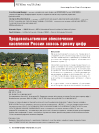
Food Provision of the Russian Population through the Prism of Numbers

DOI: 10.33917/es-2.206.2026.86-97

Current state of the food security is ambiguous. On the one hand, physical availability of domestically produced food is obvious, but on the other — limited economic accessibility of this food, primarily due to inflation, is equally obvious. Today, Russia is rightfully considered a global grain superpower and is the world’s leading wheat supplier. However, Russian citizens face steadily rising prices for bread and baked goods made of wheat flour, exceeding the average inflation rate. In this regard, a detailed analysis of the actual data on provision of the Russian population with basic food products is required.

References:

1. Prudius E.V. Prodovol’stvennaya bezopasnost’ — fundament ekonomicheskoy bezopasnosti strany [Food Security is the Foundation of the Country’s Economic Security]. *Problemy rynochnoy ekonomiki,* 2023, no 2, pp. 112–124, DOI: https://doi.org/10.33051/2500-2325-2023-2-112-124

2. Ukaz Prezidenta RF ot 21 yanvarya 2020 g. N 20 “Ob utverzhdenii Doktriny prodovol’stvennoy bezopasnosti Rossiyskoy Federatsii” [Decree of the President of the Russian Federation of January 21, 2020 No. 20 “On Approval of the Doctrine of Food Security of the Russian Federation”]. URL: https://mcx.gov.ru/upload/iblock/3e5/3e5941f295a77fdcfed2014f82ecf37f.pdf

3. Bayandin N.I., Zolotareva O.A. Informatsionnoe protivoborstvo v prodovol’stvennoy bezopasnosti gosudarstva [Information Warfare in the State’s Food Security]. *Nauchnyy vestnik oboronno-promyshlennogo kompleksa Rossii,* 2022, no 4, pp. 38–49, DOI: 10.52135/2410-4124_2022_4_38

4. Ageev A.I., Zolotareva O.A. Effektivnost’ edinoy agropromyshlennoy politiki EAES — zalog uspekha [The Effectiveness of the EAEU’s Unified Agroindustrial Policy is the Key to Success]. *Evraziyskaya integratsiya: ekonomika, pravo, politika,* 2024, no 18(3), pp. 26–39, DOI: https://doi.org/10.22394/2073-2929-2024-03-26-39

5. Leushkina V.V. Tsifrovizatsiya agropromyshlennogo kompleksa: osnovnoy element povysheniya konkurentosposobnogo innovatsionnogo razvitiya [Digitalization of the Agro-industrial Complex: a Key Element in Enhancing Competitive Innovative Development]. *Voprosy innovatsionnoy ekonomiki,* 2022, vol. 12, no 4, pp. 2329–2340.

6. Korolev M.I., Khorev A.I., Gorkovenko E.V., Nuzhdin R.V. Nauchno-obrazovatel’noe obespechenie prodovol’stvennoy bezopasnosti na global’nom, natsional’nom i regional’nom urovnyakh [Scientific and Educational Support for Food Security at the Global, National and Regional Levels]. *Vestnik Voronezhskogo gosudarstvennogo universiteta inzhenernykh tekhnologiy,* 2022, no 84(3), pp. 386–397, DOI: https://doi.org/10.20914/2310-1202-2022-3-386-397

7. Urozhay v ekstremal’nykh usloviyakh: kak proshel 2024 god dlya APK [Harvesting Under Extreme Conditions: How 2024 went for the Agricultural Sector]. Vedomosti. Analitika, 2024, 24 dekabrya, available at: https://www.vedomosti.ru/analytics/krupnyy_plan/articles/2024/12/23/1083309-urozhai-v-ekstremalnih-usloviyah-kak-proshel-2024-god-dlya-apk

A study of the effectiveness of investments in an innovative model for processing and managing data in the tourism industry (based on Chinese and Russian tourism companies)

DOI: 10.33917/mic-1.126.2026.53-66

This article examines the effectiveness of investments in an innovative digital model for processing customer preference data for enterprises in the tourism industry in China and Russia, based on an innovative modification of the Cobb-Douglas production function. The hypotheses were empirically confirmed during the validation of the obtained data. The study’s results are presented in conclusions and recommendations for various groups of large, small, and medium-sized enterprises, for government policy on digitalization of the industry, and for international cooperation.

References:

1. Zavyalova E.B. The 4th industrial revolution and digital transformation: changes and challenges / E.B. Zavyalova, M.V. Safronchuk, A.E. Burzhinkaya. International Journal of Economic Policy in Emerging Economies. 2022;16(2/3/4):417.

2. Hong Yunmiao, Shi Jiuling. Data Elements and the Data Economy. Economic Theory and Economic Management. 2024;44(8):1-16.

3. Ghasemaghaei M., Calic G. Does Big Data Enhance Firm Innovation Competency? The Mediating Role of Data-Driven Insights. Journal of Business Research. 2019;104:69-84.

4. Badmus O., Rajput S.A., Arogundade J.B., Williams M. AI-driven business analytics and decision making. World Journal of Advanced Research and Reviews. 2024;24(01):616-633. URL: https://wjarr.com/sites/default/files/WJARR-2024-3093.pdf

5. Luca G., Rosciano M. Google Trends Data and Transfer Function Models to Predict Tourism Demand in Italy. Journal of Tourism Futures. 2013. URL: (PDF) Google Trends data and transfer function models to predict tourism demand in Italy

6. Mankiw N.G. Macroeconomics. 7th edition, USA: Harvard University, Worth Publishers, Macmillan Learning, 2010. 641 p.

7. Pranevich A., Khatskevich G. Technological Progress and Neutrality by Hicks, Harrod, and Solow: Genesis, Construction, and Generalizations. Belarusian Economic Journal. 2020;3:87-105.

From Webinars to Acceleration: How Rosatom has Learned to Cultivate Strong Social Projects

DOI: 10.33917/es-1.205.2026.76-83

The article analyzes the history and results of Rosatom State Corporation’s overcoming the crisis of quantitative growth and grant applications for social projects despite their insufficiently high initial quality. The authors prove that classic webinars don’t solve this problem. They only create the illusion of learning, but don’t change the structure of applicants’ actions.

The relevance of the present material lies in demonstrating a new management approach. Rosatom has transformed a competition from a passive selection procedure into a tool for “cultivating” urban communities. In 2024–2025 the State Corporation abandoned the training approach in favour of accelerated support.

The new model included a step-by-step process of project refinement under expert guidance. Public case studies and workshops were held. Participants didn’t just listen to lectures; they immediately applied the knowledge to their applications.

Effectiveness of this approach was confirmed by results of the “80 Good Deeds” competition (2025). 487 teams from 32 nuclear cities participated in the contest. The main outcome was not only the grant support for applicants, but also harmonization of the project culture across the territories. Participants acquired sustainable competencies, enabling them to effectively develop social initiatives in the future.

Global economic development trends: energy efficiency and energy intensity

DOI: 10.33917/mic-2.127.2026.84-88

This scientific article presents a comprehensive analysis of global economic growth dynamics in the fuel and energy sector and examines the concepts of energy efficiency and energy intensity across global macroregions. It advances the idea of energy engineering aimed at improving the energy efficiency of production and proposes implementing a fuel and energy resource conservation strategy with an energy management focus.

References:

1. Gorfinkel V.Ya. Economics of Innovation: Textbook / Ed., T. G. Popadyuk. 2nd ed. revised and enlarged. Moscow: University textbook: NITs INFRA-M, 2023. 336 p.

2. Galimulina F.F., Zhukovskaya I.V., Komissarova I.P., Shinkevich A.I., Mayorova A.N., Astafyeva I.A., Klimova N.V., Nabiullina K.R. Technology Platforms as an Efficient Tool to Modernize Russia’s Economy. International Journal of Economics and Financial Issues. 2016;6(1):163-168.

3. Khusainov R.R., Zhukovskaya I.V. Theoretical aspects of the formation of innovative infrastructure in the service sector taking into account engineering and reengineering at the mesolevel. Microeconomics. 2017;5:12-17.

Food Market in Russia: Choosing a New Path

DOI: 10.33917/es-2.206.2026.98-107

This paper analyzes structural changes in the Russian food market in the context of transformation of modern business models. It puts forward the concept of alpha business — a type of corporate organization based on control over high-quality resources and the entire value chain, as well as access to consumers. It is shown that the current stage of economic development is characterized by competitive struggle’s shift from mechanisms based primarily on property institutions and market exchange to control over the infrastructure, logistics and information resources. Using the example of food retail, the author examines formation of integrated corporate systems that allow to coordinate production, distribution and consumer demand. It is concluded that development of such structures tends to form a new development trajectory of the consumer market and transforms the institutional architecture of the food industry.

References:

1. Blokhin A.A., Lomakin-Rumyantsev I.V., Naumov S.A. Al’fa-biznes na rossiyskom prodovol’stvennom rynke [Alfa-Business in the Russian Food Market]. *Ekonomicheskie strategii*, 2019, vol. 21, no 6, pp. 68–77, DOI: 10.33917/es-6.164.2019.68-77

2. Glaz’ev S.Yu. Global’naya transformatsiya cherez prizmu smeny tekhnologicheskikh i mirokhozyaystvennykh ukladov [Global Transformations from the Perspective of Technological and Economic World Order Change]. *AlterEconomics*, 2022, vol. 19, no 1, pp. 93–115.

3. Yaremenko Yu.V. Teoriya i metodologiya issledovaniya mnogourovnevoy ekonomiki [Theory and Methodology of Multilevel Economy Research]. Moscow, Nauka, 2000, pp. 29–57.

4. Blokhin A.A. Ekonomicheskoe dominirovanie: bazovye polozheniya teorii i podkhody k izmereniyu [Economic Dominance: Basic Theoretical Provisions and Measurement Approaches]. Nauchnye trudy, Institut narodnokhozyaystvennogo prognozirovaniya RAN, 2023, no 1, pp. 6–30.

5. Shchelokova S.V., Vertogradov V.A. Analiz nalichiya i struktury dominiruyushchikh grupp na rynke sel’skokhozyaystvennykh predpriyatiy Rossii po itogam 2020 goda [Analysis of the Presence and Structure of Dominant Groups in the Market of Agricultural Organizations in Russia According to the Results of 2020]. *APK: ekonomika, upravlenie*, 2022, no 1, pp. 41–52.

6. Radaev V.V. Komu prinadlezhit vlast’ na potrebitel’skikh rynkakh [Who Holds Power in Consumer Markets]. Moscow, Izdatel’skiy dom Vysshey shkoly ekonomiki, 2011.

7. Lomakin-Rumyantsev I.V., Shamuzova L.A., Spektor S.V., Cho E.G., Markov A.R. Potrebitel’skiy rynok Rossii: uroki antikrizisnogo regulirovaniya [Russian Consumer Market: Lessons of Anti-Crisis Regulation]. Istina, 2024, available at: https://istina.msu.ru/reports/671261205/

8. Ksenofontov M.Yu., Polzikov D.A., Gol’denberg I.A., Sitnikov P.V. Metodologicheskie problemy formirovaniya kontseptsii prodovol’stvennoy bezopasnosti v Rossii [Methodological Problems of the Formation of the Concept of Food Security in Russia]. *Problemy prognozirovaniya*, 2018, no 5(170), pp. 127–135.