Author page: Olga Zolotareva

Food Provision of the Russian Population through the Prism of Numbers

DOI: 10.33917/es-2.206.2026.86-97

Current state of the food security is ambiguous. On the one hand, physical availability of domestically produced food is obvious, but on the other — limited economic accessibility of this food, primarily due to inflation, is equally obvious. Today, Russia is rightfully considered a global grain superpower and is the world’s leading wheat supplier. However, Russian citizens face steadily rising prices for bread and baked goods made of wheat flour, exceeding the average inflation rate. In this regard, a detailed analysis of the actual data on provision of the Russian population with basic food products is required.

References:

1. Prudius E.V. Prodovol’stvennaya bezopasnost’ — fundament ekonomicheskoy bezopasnosti strany [Food Security is the Foundation of the Country’s Economic Security]. *Problemy rynochnoy ekonomiki,* 2023, no 2, pp. 112–124, DOI: https://doi.org/10.33051/2500-2325-2023-2-112-124

2. Ukaz Prezidenta RF ot 21 yanvarya 2020 g. N 20 “Ob utverzhdenii Doktriny prodovol’stvennoy bezopasnosti Rossiyskoy Federatsii” [Decree of the President of the Russian Federation of January 21, 2020 No. 20 “On Approval of the Doctrine of Food Security of the Russian Federation”]. URL: https://mcx.gov.ru/upload/iblock/3e5/3e5941f295a77fdcfed2014f82ecf37f.pdf

3. Bayandin N.I., Zolotareva O.A. Informatsionnoe protivoborstvo v prodovol’stvennoy bezopasnosti gosudarstva [Information Warfare in the State’s Food Security]. *Nauchnyy vestnik oboronno-promyshlennogo kompleksa Rossii,* 2022, no 4, pp. 38–49, DOI: 10.52135/2410-4124_2022_4_38

4. Ageev A.I., Zolotareva O.A. Effektivnost’ edinoy agropromyshlennoy politiki EAES — zalog uspekha [The Effectiveness of the EAEU’s Unified Agroindustrial Policy is the Key to Success]. *Evraziyskaya integratsiya: ekonomika, pravo, politika,* 2024, no 18(3), pp. 26–39, DOI: https://doi.org/10.22394/2073-2929-2024-03-26-39

5. Leushkina V.V. Tsifrovizatsiya agropromyshlennogo kompleksa: osnovnoy element povysheniya konkurentosposobnogo innovatsionnogo razvitiya [Digitalization of the Agro-industrial Complex: a Key Element in Enhancing Competitive Innovative Development]. *Voprosy innovatsionnoy ekonomiki,* 2022, vol. 12, no 4, pp. 2329–2340.

6. Korolev M.I., Khorev A.I., Gorkovenko E.V., Nuzhdin R.V. Nauchno-obrazovatel’noe obespechenie prodovol’stvennoy bezopasnosti na global’nom, natsional’nom i regional’nom urovnyakh [Scientific and Educational Support for Food Security at the Global, National and Regional Levels]. *Vestnik Voronezhskogo gosudarstvennogo universiteta inzhenernykh tekhnologiy,* 2022, no 84(3), pp. 386–397, DOI: https://doi.org/10.20914/2310-1202-2022-3-386-397

7. Urozhay v ekstremal’nykh usloviyakh: kak proshel 2024 god dlya APK [Harvesting Under Extreme Conditions: How 2024 went for the Agricultural Sector]. Vedomosti. Analitika, 2024, 24 dekabrya, available at: https://www.vedomosti.ru/analytics/krupnyy_plan/articles/2024/12/23/1083309-urozhai-v-ekstremalnih-usloviyah-kak-proshel-2024-god-dlya-apk

Measuring Effectiveness of Demographic Policy Measures (By the Example of Federal Maternity Capital for the First Child)

DOI: 10.33917/es-3.201.2025.128-135

According to Rosstat, in 2024, the total fer tility rate decreased by 2.3% compared to the previous year — from 8.6‰ in 2023 to 8.4‰ in 2024. Operational data for January-March 2025 also record a decrease in the bir th rate: the rate for the first three months was 8.0‰, which is 3.6% less than the same period in the previous year (for reference: January-March 2024 — 8.3‰). State authorities are actively developing and implementing new measures for providing full reproduction of the country’s population. In this regard, close attention is paid to the issues of the ef fectiveness of the demographic policy being implemented in the area of birth rate, which determines the usefulness and high practical significance of the proposed approach to measuring the impact of federal maternal (family) capital for the first child on bir th rate.

References:

1. Ukaz Prezidenta RF ot 7 maya 2024 g. N 309 “O natsional’nykh tselyakh razvitiya Rossiyskoy Federatsii na period do 2030 goda i na perspektivu do 2036 goda” [Decree of the President of the Russian Federation of May 7, 2024 No. 309 “On the National Development Goals of the Russian Federation for the Period up to 2030 and for the Perspective up to 2036”]. Ofitsial’nyy sayt Prezidenta RF, available at: ht tp://www.kremlin.ru/acts/bank/50542

2. Ukaz Prezidenta RF ot 2 iyulya 2021 g. N 400 “O Strategii natsional’noy bezopasnosti Rossiyskoy Federatsii” [Decree of the President of the Russian Federation of July 2, 2021 No. 400 “On the National Security Strategy of the Russian Federation”]. Garant, available at: https://www.garant.ru/products/ipo/prime/doc/401325792/

3. Ukaz Prezidenta RF ot 9 noyabrya 2022 g. N 809 “Ob utverzhdenii Osnov gosudarstvennoy politiki po sokhraneniyu i ukrepleniyu traditsionnykh rossiyskikh dukhovno-nravstvennykh tsennostey” [Decree of the President of the Russian Federation of November 9, 2022 No. 809 “On Approval of the Fundamentals of State Policy for the Preservation and Strengthening of Traditional Russian Spiritual and Moral Values”]. Garant, available at: https://www.garant.ru/products/ipo/prime/doc/405579061/?ysclid=m58csbjseu924993873

4. Ukaz Prezidenta RF ot 23 yanvarya 2024 g. N 63 “O merakh sotsial’noy podderzhki mnogodetnykh semey” [Decree of the President of the Russian Federation of January 23, 2024 No. 63 “On Measures of Social Support for Large Families”]. Konsul’tantPlyus, available at: https://www.consultant.ru/document/cons_doc_LAW_467710/?ysclid=m58ctrze32536168260

5. Strategiya deystviy po realizatsii semeynoy i demograficheskoy politiki, podderzhke mnogodetnosti v Rossiyskoy Federatsii do 2036 goda (proekt) [Strategy of Actions for the Implementation of Family and Demographic Policy, Support for Large Families in the Russian Federation until 2036 (draft)]. Ministerstvo truda i sotsial’noy zashchity RF, available at: https://mintrud.gov.ru/ministry/programms/11?ysclid=m58cvzb6bg388401477

On the Issue of Identifying a Campaign of Disparate Impact on an Ethnic Group in the Region

DOI: 10.33917/es-6.192.2023.104-119

Currently, there is no a single methodology that allows us to present substantiated evidence-based statistics on the presence or absence of a “campaign” of racial or ethnic discrimination. Identification or confirmation of the absence of disparate impact that Russia has on Ukrainians and Crimean Tatars as a result of an allegedly ongoing “campaign of racial discrimination” [1] in the field of education was carried out on the basis of an assessment of population census data. The author presents the use of a complex methodology, including analysis of statistical cross-tabulations (contingency tables), variation indicators, testing hypotheses using the Chi-square test (chi-square statistic-χ2), assessing the relationship closeness with the help of the Pearson and Chuprov mutual contingency coefficients, as well as Spearman’s rank correlation coefficient. Assessment of differences in structures by ethnicity is based on calculations and comparison of specific weights and a generalizing/integral indicator of structural shifts/differences (V.M. Ryabtsev index). Testing of this approach resulted in a conclusion that there was no racial/ethnic discrimination as a “campaign” carried out in the territory of the Republic of Crimea in the period from 2014 to the present.

References:

1. MID Rossii. O vystuplenii rossiyskikh predstaviteley v khode ustnykh slushaniy v Mezhdunarodnom Sude OON po delu Ukraina protiv Rossii [Russian Ministry of Foreign Affairs. On the Speech of Russian Representatives During the Oral Hearings at the International Court of Justice in the Case of Ukraine v. Russia]. Ofitsial’nyy sayt Ministerstva inostrannykh del RF, 2023, 10 iyunya, available at: https://www.mid.ru/ru/foreign_policy/news/1886510/

2. The advanced theory of statistics. Vol. I. Distribution theory. Maurice G. Kendall, M.A., sc.D., & Alan Stuart, B.Sc. (Econ.). Charles griffin & Company limited. London. 1958.

3. Tractenberg R. Ethical practice of statistics and data science. Ethics International Press Limited, 2022.

4. Surinov A., Dianov M. (red.). Itogi perepisi naseleniya v Krymskom federal’nom okruge. Federal’naya sluzhba gosudarstvennoy statistiki (IITs “Statistika Rossii”, Moskva, 2015) [Results of the Population Census in the Crimean Federal District. Federal State Statistics Service (IRC “Statistics of Russia”, Moscow, 2015)]. URL: https://rosstat.gov.ru/storage/mediabank/KRUM_2015.pdf

5. Federal’naya sluzhba gosudarstvennoy statistiki, Vserossiyskaya perepis’ naseleniya 2020 goda [Federal State Statistics Service, All-Russian Population Census 2020]. Ofitsial’nyy sayt Federal’noy sluzhby gosudarstvennoy statistiki, available at: https://rosstat.gov.ru/vpn_popul

6. UNECE. Conference of European Statisticians Recommendations for the 2020 Censuses of Population and Housing. UNECE, available at: https://unece.org/statistics/publications/conference-european-statisticians-recommendations-2020-censuses-population

Some Aspects of Compiling Ratings and Assessing their Quality

DOI: 10.33917/es-5.191.2023.126-131

In the modern world, ratings have become an instrumental component that provides analysis, forecast and support for management decisions at both the macro, micro and meso-levels. The increasing intensity of flows and volumes of information, its multidimensional nature, the variety of formats for its presentation and communication for transmission in the context of increasing complexity of economic and social phenomena and processes, have created a powerful demand for ratings in business, in the financial and investment sphere and in strategic management, as well as at the state level. This is explained by the fact that ratings are independent, impartial, methodologically sound and allow, based on a wide range of metrics, to assess the competitiveness of countries, regions, industries and companies. Taking into account the ratings, subsequent investment decisions of the key economic players are formed.

References:

1. Sovetskii entsiklopedicheskii slovar’ [Soviet Encyclopedic Dictionary]. Pod red. A.M. Prokhorova, 4-e izd. Moscow, Sovetskaya entsiklopediya, 1989, 1632 p.

2. Tekhnologii reitingov [Rating Technologies]. Konsaltingovaya gruppa MD, available at: http://md-consulting.ru/articles/html/article19.html

3. Handbook on Constructing Composite Indicators: Methodology and User Guide, available at: https://www.oecd.org/sdd/42495745.pdf

4. 2023 Index of Economic Freedom, available at: https://www.heritage.org/index/

5. Economic Freedom. Fraser Institute, available at: https://www.fraserinstitute.org/studies/economic-freedom

6. The Global AI Index. Tortoise, available at: https://www.tortoisemedia.com/intelligence/global-ai/

7. AI Index. Stanford University, available at: https://aiindex.stanford.edu/report/

8. Ageev A.I., Zolotareva O.A., Zolotarev V.A. Rossiya v global’nom mire iskusstvennogo intellekta: otsenka po mirovym reitingam [Russia in the Global World of Artificial

Intelligence: Assessment by World Rankings]. Ekonomicheskie strategii, 2022, no 2(182), pp. 20–31, available at: DOI: https://doi.org/10.33917/es-2.182.2022.20-31

9. Doklady o razvitii chelovecheskogo potentsiala [Human Development Reports]. UNDP, available at: http://hdr.undp.org/en

10. Doklady o global’nom gendernom razryve [Reports on the Global Gender Gap]. World Economic Forum, available at: https://www.weforum.org/reports/

ab6795a1-960c-42b2-b3d5-587eccda6023

11. Ramki kachestva statisticheskoi deyatel’nosti OESR [OECD Statistical Quality Framework]. OECD, available at: https://www.oecd.org/sdd/

qualityframeworkforoecdstatisticalactivities.htm

12. Data Quality Assessment Framework-Generic Framework. IMF, available at: https://www.imf.org/external/np/sta/dsbb/2003/eng/dqaf.htm#P50_2523

13. Evropeiskaya komissiya. Evrostat. Kachestvo. Evropeiskie standarty kachestva. Kodeks praktiki evropeiskoi statistiki [European Commission. Eurostat.

Quality. European quality standards. European Statistics Code of Practice]. Eurostat, available at: https://ec.europa.eu/eurostat/web/quality/european-qualitystandards/european-statistics-code-of-practice.

Building a Model for Forecasting the Exchange Rate on the Long-term and Short-term Horizons

DOI: 10.33917/es-1.187.2023.16-25

Forecasting the ruble exchange dynamics appears objectively necessary for shaping both the medium-term financial strategy of industry corporations and the general strategic course for occupying leading positions in sectors of business interest, including through the use of new financial instruments, new markets and, in general, a system of strategic planning of socio-economic development of Russia. However, in today’s realities, according to most experts, with whom we cannot but agree, the task of forecasting seems extremely difficult and appears complicated by the fact that the launched crises are unpredictable and are characterized by a diverse nature (pandemic and geopolitical crises, expansion of trade wars and sanctions). In such conditions, when uncertainty grows excessively, it is important to turn to the accumulated experience: to analyze to what extent the available models can be suitable for prospective assessments in the current environment.

References:

[1–15] see No. 6 (186)/2022, p. 25.

16. Ageev A.I., Glaz’ev S.Yu., Mityaev D.A., Zolotareva O.A., Pereslegin S.B. Postroenie modeli prognoza kursa valyut na dolgosrochnom i kratkosrochnom gorizontakh [Building a Model for Forecasting the Exchange Rate on the Long-term and Short-term Horizons]. Ekonomicheskie strategii, 2022, no 6 (186), pp. 16–25, available at: DOI: https://doi.org/10.33917/es-6.186.2022.16-25.

17. Dubrova T.A. Analiz vremennykh dannykh [Time Data Analysis]. Analiz dannykh. Moscow, Yurait, 2019, pp. 397–459.

18. Boks Dzh, Dzhenkins G. Analiz vremennyh ryadov [Time Series Analysis]. Prognozirovanie i upravlenie. Moscow, Mir, 1974, 406 p.

19. Alzheev A.V., Kochkarov R.A. Sravnitel’nyi analiz prognoznykh modelei ARIMA i LSTM na primere aktsii rossiiskikh kompanii [Comparative Analysis of ARIMA and LSTM Forecasting Models on the Example of Russian Companies’ Stocks]. Finansy: teoriya i praktika, 2020, no 24(1), pp. 14–23,
DOI: 10.26794/2587-5671-2020-24-1-14-23.

20. Mhitaryan S.V., Danchenok L.A. Prognozirovanie prodazh s pomoshch’yu adaptivnyh statisticheskih metodov [Sales Forecasting with the Help of Adaptive Statistical Methods]. Fundamental’nye issledovaniya, 2014, no 9-4, pp. 818–822.

21. Pilyugina A.V., Bojko A.A. Ispol’zovanie modelej ARIMA dlya prognozirovaniya valyutnogo kursa [Using ARIMA Models for Exchange Rate Forecasting]. Prikaspijskij zhurnal: upravlenie i vysokie tekhnologii, 2015, no 4, pp. 249-267.

22. Ruppert D., Matteson D.S. Statistics and Data Analysis for Financial Engineering. Springer, 2015, available at: https://link.springer.com/book/10.1007%2F978-1-4939-2614-5.

23. Garcia F., Guijarro F., Moya I., Oliver J. Estimating returns and conditional volatility: A comparison between the ARMA-GARCH-M models and the backpropagation neural network. International Journal of Complex Systems in Science, 2012, no 1(2), pp. 21–26.

24. Maniatis P. Forecasting the Exchange Rate Between Euro And USD: Probabilistic Approach Versus ARIMA And Exponential Smoothing Techniques. Journal of Applied Business Research (JABR), 2012, no 28(2), pp. 171–192, available at: https://doi.org/10.19030/jabr.v28i2.6840.

Building a Model for Forecasting the Exchange Rate on the Long-term and Short-term Horizons

DOI: https://doi.org/10.33917/es-6.186.2022.16-25

Forecasting the ruble exchange dynamics appears objectively necessary for shaping both the medium-term financial strategy of industry corporations and the general strategic course for occupying leading positions in sectors of business interest, including through the use of new financial instruments, new markets and, in general, a system of strategic planning of socio-economic development of Russia. However, in today’s realities, according to most experts, with whom we cannot but agree, the task of forecasting seems extremely difficult and appears complicated by the fact that the launched crises are unpredictable and are characterized by a diverse nature (pandemic and geopolitical crises, expansion of trade wars and sanctions). In such conditions, when uncertainty grows excessively, it is important to turn to the accumulated experience: to analyze to what extent the available models can be suitable for prospective assessments in the current environment.

References:

1. Kuranov G.O. Metodicheskie voprosy kratkosrochnoi otsenki i prognoza makroekonomicheskikh pokazatelei [Methodological Issues of Short-Term Assessment and Forecast of Macroeconomic Indicators]. Voprosy statistiki, 2018, no 25(2), pp. 3–24.

2. Frenkel’ A.A., Volkova N.N., Surkov A.A., Romanyuk E.I. Sravnitel’nyi analiz modifitsirovannykh metodov Greindzhera — Ramanatkhana i Beitsa — Greindzhera dlya postroeniya ob”edinennogo prognoza dinamiki ekonomicheskikh pokazatelei [Comparative Analysis of Modified Granger-Ramanathan and Bates-Granger Methods for Developing a Combined Forecast of Economic Indicators Dynamics]. Voprosy statistiki, 2019, no 26(8), pp. 14–27.

3. Shirov A.A. Makrostrukturnyi analiz i prognozirovanie v sovremennykh usloviyakh razvitiya ekonomiki [Macrostructural Analysis and Forecasting under Current Conditions of Economic Development]. Problemy prognozirovaniya, 2022, no 5, pp. 43–57.

4. Dmitrieva M.V., Suetin S.N. Modelirovanie dinamiki ravnovesnykh valyutnykh kursov [Simulating the Dynamics of Equilibrium Exchange Rates]. Vestnik KIGIT, 2012, no 12–2(30), pp. 061–064.

5. Linkevich E.F. Mirovaya valyutnaya sistema: poliinstrumental’nyi standart [World Monetary System: Polyinstrumental Standard]. Krasnodar, 2014, pp. 82–91.

6. Ageev A.I., Loginov E.L. Izmenenie strategii operirovaniya dollarom: zapusk SShA novogo kreditno-investitsionnogo tsikla vo vzaimosvyazi s valyutnymi voinami [Changing the Strategy of Dollar Handling: US Launch of New Credit-Investment Cycle in Association with the Currency Wars]. Ekonomicheskie strategii, 2015, no 3(129), pp. 20–35.

7. Fedorova E.A., Lazarev M.P. Vliyanie tseny na neft’ na finansovyi rynok Rossii v krizisnyi period [Impact of Oil Prices on the Financial Market of Russia During the Crisis]. Finansy i kredit, 2014, № 20(596), pp. 14–22.

8. Kuz’min A.Yu. Valyutnye kursy: v poiskakh strategicheskogo ravnovesiya [Exchange Rates: in Search of Strategic Equilibrium]. Ekonomicheskie strategii, 2018, no 1, pp. 82–91.

Russia in the Global World of Artificial Intelligence: Assessment by World Rankings

DOI: https://doi.org/10.33917/es-2.182.2022.20-31

Artificial intelligence systems (AI) are rapidly becoming a competitive tool, an important factor in improving the efficiency of socioeconomic reproduction, and even an attribute of the development of human civilization, the core of global and national development projects. Comparative assessments of the degree of development of AIS have also become a tool for influencing the economic strategies of states and companies and supporting their implementation. Determining a country’s place in the global “table of ranks” makes it possible not only to clarify its real status in global competition in AIS but also to identify unaccounted for elements to increase the effectiveness of government initiatives in the field of AIS development

Источники:

1. Glava VEF zayavil, chto kovid sleduet rassmatrivat’ kak dolgosrochnyi vyzov dlya chelovechestva [The Head of the WEF Said That Covid Should be Seen as a Long-Term Challenge for Humanity]. TASS, available at: https://tass.ru/obschestvo/13273357.

2. Krichevskii G.E. NBIKS-tekhnologii dlya Mira i Voiny [NBICS Technologies for Peace and War]. Saarbryukken, Germaniya, Lambert, 2017, 634 p.

3. Ovchinnikov V.V. Doroga v mir iskusstvennogo intellekta [Road to the World of Artificial Intelligence]. Moscow, Institut ekonomicheskikh strategii, RUBIN, 2017, 536 p. (Ceriya: Strategicheskaya analitika)

4. Gonka za tsifrovym prizrakom [Chasing the Digital Ghost]. Kommersant, 2019, June, 24, available at: https://www.kommersant.ru/doc/4003879.

5. Kalyaev I.A. Iskusstvennyi intellekt: kamo gryadeshi? [Artificial Intelligence: Whither Goest Thou?]. Ekonomicheskie strategii, 2019, no 5, pp. 6–15, available at: DOI: https://doi.org/10.33917/es-5.163.2019.6-15.

6. Markoff J. A learning advance in artificial intelligence rivals human abilities. The New York Times, 2015, available at: https://www.nytimes.com/2015/12/11/science/an-advance-in-artificial-intelligence-rivals-human-vision-abilities.html.

7. Ageev A.I., Loginov E.L., Shkuta A.A. Kitai kak neiroinformatsionnaya megamatritsa: tsifrovye tekhnologii strukturirovaniya kognitivnykh ansamblei poryadka [China as a Neural-Information Megamatrix: Digital Technologies for Structuring Cognitive Ensembles of Order]. Ekonomicheskie strategii, 2021, no 1, pp. 50–61, available at: DOI: https://doi.org/10.33917/es-1.175.2021.50-61.

8. European approach to artificial intelligence. European Commission, available at: https://digital-strategy.ec.europa.eu/en/policies/european-approach-artificialintelligence.

9. Proposal for a Regulation of the European parliament and of the Council laying down harmonised rules on artificial intelligence (artificial intelligence act) and amending certain union legislative acts. EUR-lex, available at: https://eur-lex.europa.eu/legal-content/EN/TXT/?qid=1623335154975&uri=CELEX%3A52021PC0206.

10. Artificial Intelligence: A European Perspective. European Commission. URL: https://publications.jrc.ec.europa.eu/repository/handle/JRC113826.

The EAEU Demography and Human Capital: Trends and Losses in the Context of a Pandemic

DOI: https://doi.org/10.33917/es-6.180.2021.20-29

Demographic dynamics becomes crucially important for successful scenario of the future for both Eurasian integration and each EAEU member state. The “pandemic crisis” caused an increase in excess mortality, reduced social well-being and created serious legal and managerial conflicts. Within the EAEU new barriers to mobility and migration have emerged and social tension has increased. In the existing realities the current supranational solutions are insufficient, they are poorly focused on achieving the demographic security of the EAEU member states. Coordinated actions are needed to significantly improve the demographic situation in the EAEU.

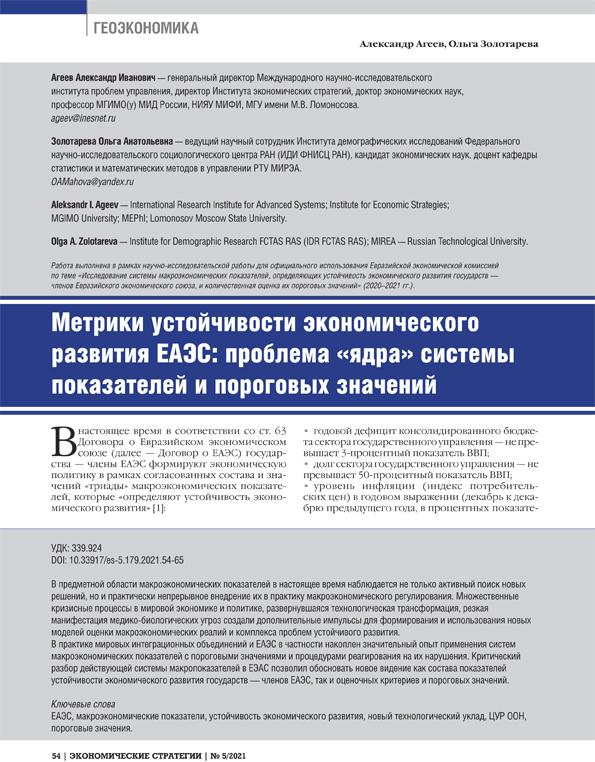
Sustainability Metrics of the EAEU Economic Development: Problem of the “Core” of the Indicators and Thresholds System

DOI: https://doi.org/10.33917/es-5.179.2021.54-65

In the subject area of macroeconomic indicators there is currently not only an active search for new solutions, but also their almost continuous implementation in the practice of macroeconomic regulation. Multiple crisis processes in the world economy and politics, unfolding technological transformation, sharp manifestation of medical and biological threats have created additional impulses for forming and applying new models for assessing macroeconomic realities and a set of sustainable development problems. In the practice of world integration associations and the EAEU in particular, considerable experience has been accumulated in applying the systems of macroeconomic indicators with threshold values and procedures for responding to their violations. Critical analysis of the current system of macroeconomic indicators in the EAEU made it possible to substantiate a new vision of both the composition of indicators of sustainable economic development of the EAEU member states and assessment criteria as well as threshold values.

On the Question of Monitoring the National Project “Demography” and Assessment of the Demographic Security of the Russian Federation

DOI: https://doi.org/10.33917/es-2.176.2021.45-51

The last five years in the Russian Federation have again been marked by serious concern in the context of the development of demographic processes. Today, leading demographers are talking about a second wave of depopulation. Despite all the efforts made by the government, it is not possible in the foreseeable future to eradicate the negative impact of the retrospective state of the landscape, established by historical changes, which affected, first of all, the age-sex structure of the population (regressive type for women).