Author page: Aleksander Ageev

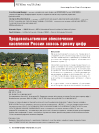
Food Provision of the Russian Population through the Prism of Numbers

DOI: 10.33917/es-2.206.2026.86-97

Current state of the food security is ambiguous. On the one hand, physical availability of domestically produced food is obvious, but on the other — limited economic accessibility of this food, primarily due to inflation, is equally obvious. Today, Russia is rightfully considered a global grain superpower and is the world’s leading wheat supplier. However, Russian citizens face steadily rising prices for bread and baked goods made of wheat flour, exceeding the average inflation rate. In this regard, a detailed analysis of the actual data on provision of the Russian population with basic food products is required.

References:

1. Prudius E.V. Prodovol’stvennaya bezopasnost’ — fundament ekonomicheskoy bezopasnosti strany [Food Security is the Foundation of the Country’s Economic Security]. *Problemy rynochnoy ekonomiki,* 2023, no 2, pp. 112–124, DOI: https://doi.org/10.33051/2500-2325-2023-2-112-124

2. Ukaz Prezidenta RF ot 21 yanvarya 2020 g. N 20 “Ob utverzhdenii Doktriny prodovol’stvennoy bezopasnosti Rossiyskoy Federatsii” [Decree of the President of the Russian Federation of January 21, 2020 No. 20 “On Approval of the Doctrine of Food Security of the Russian Federation”]. URL: https://mcx.gov.ru/upload/iblock/3e5/3e5941f295a77fdcfed2014f82ecf37f.pdf

3. Bayandin N.I., Zolotareva O.A. Informatsionnoe protivoborstvo v prodovol’stvennoy bezopasnosti gosudarstva [Information Warfare in the State’s Food Security]. *Nauchnyy vestnik oboronno-promyshlennogo kompleksa Rossii,* 2022, no 4, pp. 38–49, DOI: 10.52135/2410-4124_2022_4_38

4. Ageev A.I., Zolotareva O.A. Effektivnost’ edinoy agropromyshlennoy politiki EAES — zalog uspekha [The Effectiveness of the EAEU’s Unified Agroindustrial Policy is the Key to Success]. *Evraziyskaya integratsiya: ekonomika, pravo, politika,* 2024, no 18(3), pp. 26–39, DOI: https://doi.org/10.22394/2073-2929-2024-03-26-39

5. Leushkina V.V. Tsifrovizatsiya agropromyshlennogo kompleksa: osnovnoy element povysheniya konkurentosposobnogo innovatsionnogo razvitiya [Digitalization of the Agro-industrial Complex: a Key Element in Enhancing Competitive Innovative Development]. *Voprosy innovatsionnoy ekonomiki,* 2022, vol. 12, no 4, pp. 2329–2340.

6. Korolev M.I., Khorev A.I., Gorkovenko E.V., Nuzhdin R.V. Nauchno-obrazovatel’noe obespechenie prodovol’stvennoy bezopasnosti na global’nom, natsional’nom i regional’nom urovnyakh [Scientific and Educational Support for Food Security at the Global, National and Regional Levels]. *Vestnik Voronezhskogo gosudarstvennogo universiteta inzhenernykh tekhnologiy,* 2022, no 84(3), pp. 386–397, DOI: https://doi.org/10.20914/2310-1202-2022-3-386-397

7. Urozhay v ekstremal’nykh usloviyakh: kak proshel 2024 god dlya APK [Harvesting Under Extreme Conditions: How 2024 went for the Agricultural Sector]. Vedomosti. Analitika, 2024, 24 dekabrya, available at: https://www.vedomosti.ru/analytics/krupnyy_plan/articles/2024/12/23/1083309-urozhai-v-ekstremalnih-usloviyah-kak-proshel-2024-god-dlya-apk
Sustainability of the Power Institutions under Conditions of the Counteraction Centers Activity

DOI: 10.33917/es-2.206.2026.6-13

Strengthening of the vertical structure of federal governance in our country in recent years has encountered resistance in a number of Russian regions, which still remains latent. The article, based on general systems theory, proposes measures to maintain stability of the political regime’s power institutions in the face of active counteraction centers: control of financial and commodity flows, transport and communication channels that allows to cut off supply of resources to destructive forces, block their interaction within a region, between regions and with foreign control and support centers, preserving the possibility of the federal center to operate on sentiments of the local elites and large groups of population.

References:

1. Ageev A.I., Bakhtizin A.R., Makarov V.L., Loginov E.L., Khabriev B.R. Ekonomicheskiy fundament pobedy: strategicheskiy prognoz ustoychivosti ekonomiki Rossii v usloviyakh sanktsionnykh atak [Economic Foundation of Victory: a Strategic Forecast for the Russian Economy Stability in the Face of Sanctions]. *Ekonomicheskie strategii,* 2023, vol. 25, no 3(189), pp. 6—15, DOI: https://doi.org/10.33917/es-3.189.2023.6-15

2. Ageev A.I., Grabchak E.P., Loginov E.L. Novaya model’ upravleniya ekonomikoy Rossii v usloviyakh gibridnykh riskov i ugroz [New Model of the Russian Economy Management in the Context of Hybrid Risks and Threats]. *Ekonomicheskie strategii,* 2025, vol. 27, no 5(203), pp. 6—19, DOI: https://doi.org/10.33917/es-5.203.2025.6-19

3. Loginov E.L., Matveev A.G., Shkuta A.A. Opredelenie parametrov lokalizovannykh sostoyaniy neyavnykh grupp s sobstvennoy komponentoy aktivnogo povedeniya, ne sovpadayushchego s vektorom deystviy gosudarstvennoy supersistemy [Determination of the Parameters of Localized States of Implicit Groups with Their Own Component of Active Behavior That does not Coincide with the Vector of Actions of the State Supersystem]. *Iskusstvennye obshchestva,* 2019, vol. 14, no 1, p. 5.

4. Loginov E.L. Ispol’zovanie tekhnologiy Big Data dlya protivodeystviya massovym besporyadkam v usloviyakh nedostatka informatsii i neopredelennosti razvitiya situatsii: Iskusstvennyy intellekt (bol’shie dannye) na sluzhbe politsii: Sb. statey Mezhdunarodnoy nauchno-prakticheskoy konferentsii [Using Big Data Technologies to Counter Mass Unrest in Conditions of Information Shortage and Uncertainty of the Situation Development: Artificial Intelligence (Big Data) in the Service of the Police: Collection of Articles from the International Scientific and Practical Conference]. M.: Akademiya upravleniya Ministerstva vnutrennikh del Rossiyskoy Federatsii, 2020. S. 145—150.

5. Loginov E.L. Perekhvat upravleniya slozhnymi organizatsionnymi sistemami v usloviyakh razmyvaniya granits mezhdu fizicheskimi, kognitivnymi i tsifrovymi prostranstvami deyatel’nosti i sredami upravleniya [Taking Control of Complex Organizational Systems in the Context of Blurring Boundaries between Physical, Cognitive, and Digital Activity Spaces and Management Environments]. *Ekonomika: teoriya i praktika,* 2024, no 1(73), pp. 3—10.

Countering Coups D’etat and Attempts to Forcefully Seize the Power in the Russian Federation

DOI: 10.33917/es-1.205.2026.14-23

Attempts to violently seize the power in post-Soviet states can be reduced to operation of complex organizational systems, which means that adaptive application of general principles and tools for managing such systems is possible. It is necessary to analyze such processes from scientific point of view and proactively plan measures or better yet, systemic mechanisms, to counter these processes, which will ensure the stability of public administration at various levels of hierarchy and administrative infrastructure of the Russian Federation.

References:

1. Ageev A.I. Rol’ sanktsiy, konfliktov i spetsoperatsiy: razmyshleniya o budushchem. Chast’ 2 [The Role of Sanctions, Conflicts, and Special Operations: Reflections on the Future. Part 2]. Nauchnyy vestnik oboronno-promyshlennogo kompleksa Rossii, 2024, no 1, pp. 33–42.

2. Ageev A.I., Grigor’ev V.V., Loginov E.L. Kvantovye simulyatory kak instrument nablyudaemosti tsifrovoy supersistemy s sushchestvennoy komponentoy nepredskazuemogo povedeniya ee elementov [Quantum Simulators as a Tool for Observability of a Digital Supersystem with a Significant Component of Unpredictable Behavior of its Elements]. Mikroekonomika, 2024, no 5, pp. 5–13.

3. Lyuttvak E. Gosudarstvennyy perevorot: Prakticheskoe posobie [Coup d’État: A Practical Handbook]. Moscow, Russkiy fond sodeystviya obrazovaniyu i nauke, 2015, 326 p.

4. Abramov V.I., Loginov E.L. Agentno-orientirovannye podkhody k analizu i prognozu politicheskikh nastroeniy v obshchestve i postroeniyu mekhanizmov korrektirovki polozhitel’nykh i otritsatel’nykh reaktsiy na sotsial’no-politicheskie situatsii: Rossiya v XXI veke: global’nye vyzovy i perspektivy razvitiya: Materialy Sed’mogo Mezhdunarodnogo foruma [Agent-based Approaches to the Analysis and Forecasting of Political Sentiment in Society and the Development of Mechanisms for Adjusting Positive and Negative Reactions to Socio-political Situations: Russia in the 21st Century: Global Challenges and Development Prospects: Proceedings of the Seventh International Forum]. Moscow, IPR RAN, 2018, pp. 373–376.

5. Ageev A.I., Loginov E.L. Modelirovanie protsessov obespecheniya ustoychivosti gosudarstvennykh organizatsionnykh sistem k popytkam zakhvata vlasti identifitsirovannym i neidentifitsirovannym protivnikom [Modeling the Processes of Ensuring the Resilience of State Organizational Systems to Attempts to Seize Power by an Identified and Unidentified Enemy]. Mikroekonomika, 2025, no 3, pp. 5–14.

6. Loginov E.L. Perekhvat upravleniya slozhnymi organizatsionnymi sistemami v usloviyakh razmyvaniya granits mezhdu fizicheskimi, kognitivnymi i tsifrovymi prostranstvami deyatel’nosti i sredami upravleniya [Taking Control of Complex Organizational Systems in the Context of Blurring Boundaries between Physical, Cognitive, and Digital Activity Spaces and Management Environments]. Ekonomika: teoriya i praktika, 2024, no 1(73), pp. 3–10.

7. Loginov E.L., Matveev A.G., Shkuta A.A. Opredelenie parametrov lokalizovannykh sostoyaniy neyavnykh grupp s sobstvennoy komponentoy aktivnogo povedeniya, ne sovpadayushchego s vektorom deystviy gosudarstvennoy supersistemy [Determination of the Parameters of Localized States of Implicit Groups with Their own Component of Active Behavior That does not Coincide with the Vector of Actions of the State Supersystem]. Iskusstvennye obshchestva, 2019, vol. 14, no 1, p. 5.

Requiem for Cybernetics. The Genesis of Digital

DOI: 10.33917/es-6.204.2025.16-25

In the present work the authors practically present a requiem for cybernetics — a classical management science that has fulfilled its historical role, but is now giving way to new approaches emerging at the junction of the philosophy of knowledge, complexity theory, the cognitive and social sciences. The article gives a historical and philosophical overview of cybernetics — from Plato, Ampere and Wiener to the present day. It is demonstrated that classical cybernetic paradigm — a mechanistic control model with feedback loops and representation of the world as a set of “finite state machines” — has proven insufficient in the era of dynamically changing, weakly deterministic, self-organizing living systems. Analysis of the causes of the methodological crisis in cybernetics at the turn of the 20th and 21st centuries is provided and it is argued that its resources are exhausted — further progress requires transition to new conceptual ideas. The authors propose a new engineering approach to understanding the World (K3-Engineering) and an original concept for Genesis of the digital — “Digital Genesis” — as a promising replacement.

References:

1. Wiener N. Cybernetics: or Control and Communication in the Animal and the Machine. 1948.

2. Beer S. Brain of the Firm. London, Allen Lane, 1972. 320 p.

3. Sobolev S.L., Kitov A.I., Lyapunov A.A. Osnovnye cherty kibernetiki [The Main Features of Cybernetics]. Voprosy filosofii, 1955, no 4, pp. 136–148.

4. Thiel P., Douthat R. Peter Thiel and the Antichrist. The New York Times, June 26, 2025.

5. Karp A., Zamiska N. The technological republic: hard power, soft belief, and the future of the West. Crown Publishing Group, 2025.

6. Budanov V.G. Metodologiya sinergetiki v postneklassicheskoy nauke i v obrazovanii [Methodology of Synergetics in Post-Non-Classical Science and Education]. Izd. 4-e dop. Moscow, Lenand, 2017, 272 p.

7. Budanov V.G., Kutin V.N., Khokhlova M.N. Kognitivnyy kollektivnyy konvergentnyy inzhiniring. Chast’ I [Cognitive Collective Convergent Engineering. Part I]. Ekonomicheskie strategii, 2023, no 5, pp. 100–109, DOI: https://doi.org/10.33917/es-5.191.2023.100-109

8. Budanov V.G., Kutin V.N., Khokhlova M.N. Kognitivnyy kollektivnyy konvergentnyy inzhiniring. Chast’ II [Cognitive Collective Convergent Engineering. Part II]. Ekonomicheskie strategii, 2023, no 6, pp. 52–61, DOI: https://doi.org/10.33917/es-6.192.2023.52-61

9. Kutin V.N., Khokhlova M.N. Kak aytishniki “obuvayut” promyshlennikov. A u vas kakaya kollektsiya PPO? O problemakh tsifrovoy transformatsii na primere sistem upravleniya proizvodstvom i promyshlennogo programmnogo obespecheniya (PPO) [How IT Professionals “Shoe” Industrialists. What’s Your Software Collection Like? On the Challenges of Digital Transformation Using Production Management Systems and Industrial Software (IS) as Examples]. OOO “GiperGrafGrupp”, 2022, available at: https://www.gipergraf.ru/kak-ajtishniki-obuvayut-promyshlenniko

New Model of the Russian Economy Management in the Context of Hybrid Risks and Threats

DOI: 10.33917/es-5.203.2025.6-19

The article examines the problems of transforming the system for economic management of the Russian Federation, which could make it function in conditions of hybrid risks and critical threats. A set of measures for transforming management systems is structured, a number of functional stages is identified. The article substantiates the need to develop both general management and specific technical measures aimed at ensuring that the controlled contour of the system of state and corporate management centers within the resource supply infrastructure should be prepared for these types of risks and threats. The author concludes that the most appropriate management tool is adoption of a digital “twin” model of an economic entity (organizational agent). Obtained results will enable authorities to address organizational challenges in the event of the “drop-out of control centers at various levels” in order to operate with industry (regional) control centers and to work in a dialogue mode with structures of the Russian Federation Government and infrastructure organizations.

References:

1. Ageev A.I., Loginov E.L. SShA, Kitay, Rossiya: konfliktnye uyazvimosti v usloviyakh tranzita k novoy geostrategicheskoy paradigm [USA, China, Russia: Conflict Vulnerabilities in the Context of Transition to a New Geostrategic Paradigm]. Ekonomicheskie strategii, 2024, vol. 26, no 6(198), pp. 16–25, DOI: https://doi.org/10.33917/es-6.198.2024.16-25

2. Ageev A.I., Grabchak E.P., Loginov E.L. Ustoychivost’ ekonomicheskoy supersistemy Rossii i Belorussii v usloviyakh yadernoy ataki [Stability of the Economic Supersystem of Russia and Belarus in the Event of a Nuclear Attack]. Mikroekonomika, 2025, no 2, pp. 5–13. DOI: 10.33917/mic-2.121.2025. 5-13.

3. Perevooruzhenie Evropy [Rearmament of Europe]. Livejournal, 2025, 7 marta, available at: https://spydell.livejournal.com/802118.html

4. Pavel Shpidel’: Raskhody federal’nogo byudzheta Rossii [Expenditures of the Federal Budget of Russia]. Dzen, 2024, 1 oktyabrya, available at: https://dzen.ru/a/ZvwlBD2apwzl2Nap

5. Byudzhet Rossii [Budget of Russia]. TADVISER, 2025, 22 yanvarya, available at: https://www.tadviser.ru/index.php/Статья:Бюджет_России

6. Kak izmenyatsya gosudarstvennye raskhody v Rossii v 2025? [How will Government Spending Change in Russia in 2025?]. Livejournal, 2024, 3 oktyabrya, available at: https://spydell.livejournal.com/789883.html

7. Baza dannykh voennykh raskhodov SIPRI [SIPRI Military Expenditure Database]. SIPRI. Stockholm International Peace Research Institute, available at: https://www.sipri.org/databases/milex

8. Dinamika oboronnykh raskhodov Rossii [Dynamics of Russia’s Defense Expenditures], available at: https://yandex.ru/images/

9. Ivanter V.V., Budanov I.A., Korovkin A.G., Sutyagin V.S. Prikladnoe prognozirovanie natsional’noy ekonomiki: Ucheb. posobie dlya vuzov. Gl. 29. Voenno-promyshlennyy kompleks [Applied Forecasting of the National Economy: Textbook for Universities. Chapter 29. Military-Industrial Complex]. Moscow, Ekonomist, 2007, 896 p. P. 711–736, available at: https://ecfor.ru/wp-content/uploads/books/uch/29.pdf

Accounting Reorganization as a Source of Economic Development Based on Scientific Achievements and Mass Innovation

DOI: 10.33917/es-4.202.2025.98-107

The article dwells on the problems of financing fixed assets in industry and scientific developments. A new financial technology for financing non-current assets at the expense of current assets and funds of targeted financing is proposed. The authors have developed fundamentally new sources of investment financing through restoring the depreciation fund and creating a new Innovative Development Fund, taking into account new financial technologies for accounting operations. The problem of dividing financial flows into working capital and investment assets according to balance sheet accounting objects is solved by creating new balance sheet accounts reflecting various sources of financing and by registering certificates of market value assessment of rights to the intellectual activity results. New forms of reporting on the use of intellectual property objects are proposed.

References:

1. Ukaz Prezidenta RF ot 28 fevralya 2024 g. N 145 “O Strategii nauchno-tekhnologicheskogo razvitiya Rossiyskoy Federatsii” [Decree of the President of the Russian Federation of February 28, 2024 No. 145 “On the Strategy for Scientific and Technological Development of the Russian Federation”]. Kodeks, available at: https://docs.cntd.ru/document/1305071057/titles/64U0IK

2. Ageev A.I., Radina V.A. Tainstvennyy virus v sisteme bukhgalterskogo ucheta [Mysterious Virus in Accounting System]. Ekonomicheskie strategii, 2024, no 6, pp. 72–83, DOI: https://doi.org/10.33917/es-6.198.2024.72-83

3. Radina V.A., Yakutin Yu.V. Novye finansovye tekhnologii sistemy upravleniya ekonomicheskoy deyatel’nost’yu [New Financial Technologies of the Economic Activity Management System]. Finansovaya zhizn’, 2024, no 2, pp. 108–146.

4. Khanin G.I. Ekonomicheskaya istoriya Rossii v noveyshee vremya [Economic History of Russia in Modern Times]. Monografiya: V 2 t. Novosibirsk, Izd-vo NGTU, 2010.

5. Buyvis T.A. Sovershenstvovanie amortizatsionnoy politiki predpriyatiya [Improving the Depreciation Policy of the Enterprise]. Uchet, 2018, no 6, pp. 165–169