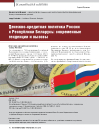
Monetary Policy of Russia and the Republic of Belarus: Current Trends and Challenges

DOI: 10.33917/es-1.205.2026.46-53

The author examines peculiarities of the monetary policy of the Bank of Russia and the National Bank of the Republic of Belarus in the context of modern challenges.

References:

1. Konstitutsiya Rossiyskoy Federatsii (prinyata vsenarodnym golosovaniem 12 dekabrya 1993 g. s izmeneniyami, odobrennymi v khode obshcherossiyskogo golosovaniya 1 iyulya 2020 g.) [Constitution of the Russian Federation (adopted by popular vote on December 12, 1993, with amendments approved during the all-Russian vote on July 1, 2020)]. Dostup iz SPS “Konsul’tant Plyus”.

2. Federal’nyy zakon ot 10 iyulya 2002 g. N 86-FZ “O Tsentral’nom banke Rossiyskoy Federatsii (Banke Rossii)” [Federal Law of July 10, 2002 No. 86-FZ “On the Central Bank of the Russian Federation (Bank of Russia)”]. Rossiyskaya gazeta, 2002, no 127.

3. Postanovlenie Konstitutsionnogo suda RF ot 3 iyulya 2001 g. N 10-P [Resolution of the Constitutional Court of the Russian Federation of July 3, 2001 No. 10-P]. Vestnik Konstitutsionnogo suda RF, 2001, no 6.

4. Postanovlenie Prezidiuma VAS RF ot 19 aprelya 2002 g. N 5697/01 [Resolution of the Presidium of the Supreme Arbitration Court of the Russian Federation of April 19, 2002 No. 5697/01]. Vestnik VAS RF, 2002, no 8.

5. Postanovlenie Prezidiuma Verkhovnogo suda RF ot 7 avgusta 2002 g. N 100pv-02 [Resolution of the Presidium of the Supreme Court of the Russian Federation of August 7, 2002 No. 100пв-02]. Byulleten’ Verkhovnogo suda RF, 2003, no 2.

6. Osnovnye napravleniya edinoy gosudarstvennoy denezhno-kreditnoy politiki na 2025 god i period 2026 i 2027 godov (utv. Bankom Rossii) [Main Directions of the Unified State Monetary Policy for 2025 and the Period 2026 and 2027 (approved by the Bank of Russia)]. Dostup iz SPS “Konsul’tant Plyus”.

7. Dzhonson S., Kvak D. 13 Bankov, kotorye pravyat mirom [13 Banks That Rule the World]. Moscow, Kar’era Press, 2013, 384 p.

8. MVF nazval targetirovanie inflyatsii i gibkiy obmennyy kurs odnimi iz klyuchevykh predposylok dlya povysheniya potentsiala rosta rossiyskoy ekonomiki: Informatsiya Banka Rossii ot 24 maya 2019 g. [IMF Identified Inflation Targeting and a Flexible Exchange Rate as Key Prerequisites for Increasing the Growth Potential of the Russian Economy: Information from the Bank of Russia Dated May 24, 2019]. Dostup iz SPS “Konsul’tant Plyus”.

9. Missiya MVF zayavila o vazhnosti sokhraneniya v Rossii prochnoy makroekonomicheskoy osnovy: Informatsionnoe soobshchenie Banka Rossii ot 21 noyabrya 2019 g. [IMF Mission Stated the Importance of Maintaining a Strong Macroeconomic Framework in Russia: Information Statement of the Bank of Russia Dated November 21, 2019]. Dostup iz SPS “Konsul’tant Plyus”.

10. Mery Banka Rossii sposobstvuyut vosstanovleniyu rossiyskoy ekonomiki — MVF: Informatsionnoe soobshchenie Banka Rossii ot 24 noyabrya 2020 g. [Bank of Russia’s Measures Contribute to the Recovery of the Russian Economy — IMF: Information Statement of the Bank of Russia Dated November 24, 2020]. Dostup iz SPS “Konsul’tant Plyus”.
Strategization of the Currency Policy and the Ruble’s Ultra-Short-Term Volatility

DOI: 10.33917/es-1.205.2026.38-45

The paradigm shift in international relations has caused significant changes in financial markets. The proposed author’s methodology for economic-mathematical modeling of the ruble exchange rate based on international flows makes it possible to include capital flows in the modeling orbit at a formal-logical level in an explicit form, taking into account their short-term volatility. Conducted during various crisis periods — formally based on results of mathematical modeling — analysis and assessment of short-term effects of the ruble exchange rate dynamics show the presence of preconditions for producing shortterm volatility in the national currency exchange rate under conditions of unfavorable geo-economic environment and a freefloating exchange rate regime. Based on the above, it is concluded that the Bank of Russia needs to make more serious efforts to implement a stabilization exchange rate policy, which is one of the key components of macroeconomic management.

References:

1. Glaz’ev S.Yu. Problemy i perspektivy rossiyskogo finansovogo rynka v usloviyakh strukturnykh izmeneniy mirovoy ekonomiki [Problems and Prospects of the Russian Financial Market in the Context of Structural Changes in the World Economy]. Finansy: teoriya i praktika, 2020, no 24(3), pp. 6–29, available at: https://cyberleninka.ru/article/n/problemy-i-perspektivy-rossiyskogo finansovogo-rynka-v-usloviyah-strukturnyh-izmeneniy-mirovoy-ekonomiki

2. Ishkhanov A., Linkevich E.F. Mezhdunarodnye valyutno-kreditnye i finansovye otnosheniya [International Monetary, Credit and Financial Relations]. Krasnodar, 2022, 149 p.

3. Ageev A.I., Loginov E.L. Izmenenie strategii operirovaniya dollarom: zapusk SShA novogo kreditno-investitsionnogo tsikla vo vzaimosvyazi s valyutnymi voynami [Changing the Strategy of Dollar Handling: US Launch of New Credit-Investment Cycle in Association with the Currency Wars]. Ekonomicheskie strategii, 2015, no 3(129), pp. 20–35.

4. Pechalova M.Yu. Transformatsiya rossiyskoy valyutnoy politiki na fone obostreniya geopoliticheskoy napryazhennosti [Transformation of the Russian Monetary Policy Against the Background of Aggravation of Geopolitical Tensions]. Ekonomika. Nalogi. Pravo, 2023, no 16(1), pp. 48–57.

5. Chernov V.A. Uregulirovanie krizisa mezhdunarodnykh finansov instrumentami monetarnoy politiki [Settlement of the Crisis of International Finance by Monetary Policy Instruments]. Innovatsionnaya ekonomika i obshchestvo, 2023, no 3(41), pp. 48–64.

6. Kulikov N.I., Kulikova M.A., Parkhomenko V.L. Slabyy rubl’ kak odno iz glavnykh prepyatstviy dlya razvitiya i rosta rossiyskoy ekonomiki [Weak Ruble as a Main Obstacle to the Russian Economy’s Development and Growth]. Finansy i kredit, 2024, no 30(5), pp. 988–1016, DOI: https://doi.org/10.24891/fc.30.5.988

7. Eremin V.V. Obespechennost’ denezhnoy massy zolotovalyutnymi rezervami kak operezhayushchiy indikator kursa rublya [Provision of the Money Supply with Gold and Foreign Exchange Reserves as a Leading Indicator of the Ruble Exchange Rate]. Finansy: teoriya i praktika, 2023, no 27(3), pp. 43–55.

Monetary Policy in Russia Reduces Economic Activity during the Period of its Growth – isn’t this a Success?

DOI: 10.33917/es-6.198.2024.48-55

The article dwells on the policy of the Central Bank of Russia to suppress inflation and ensure stable economic growth. The purpose of the study is to identify the impact of the key interest rate on inflation and economic growth in Russia, to specify the negative consequences of its increase. Methodology is based on the theory of monetary policy and economic growth. The overall result obtained is that the current policy of increasing the k ey interest rate in Russia has a negative impact on economic development and is less successful in suppressing inflation than some economists and analysts expect. Moreover, it slows down economic growth, reproduces the growth of inequalit y over a long period, revealing a weakly positive effect in influencing inflation and a negative cumulative ef fect on the rate of economic growth. The approach from the perspective of “distributed control” and the cumulative ef fect, used in the article, makes it possible to reveal the joint dynamics of a number of relevant parameters that characterize and reflect the content and ef fectiveness of monetary policy in Russia. The proposal is that various policy instruments should be subordinated to the task of the real economy growth, supplying it with financial capital, against which the policy of a debt economy with a high interest rate works.

References:

1. Aganbegyan A.G. Tri glavnykh sotsial’no-ekonomicheskikh vyzova, stoyashchikh pered Rossiey, i 15 otvetnykh shagov [Three Major Socio-economic Challenges Facing Russia and 15 Steps to Take in Response]. Ekonomicheskie strategii, 2023, no 1, pp. 6–15.

2. L’vov D.S. Ekonomika razvitiya [Development Economics]. Moscow, Ekzamen, 2022, 512 p.

3. Glazyev S.Yu. Kak denezhno-kreditnaya politika ugnetaet ekonomicheskiy rost v Rossii i Evraziyskom ekonomicheskom soyuze [How Monetary Policy Is Suppressing Economic Growth in Russia and the Eurasian Economic Union]. Rossiyskiy ekonomicheskiy zhurnal, 2022, no 2, pp. 4–20.

4. Bank Rossii ne isklyuchil “bolee znachitel’nogo” povysheniya klyuchevoy stavki [The Bank of Russia did not Rule Out a “More Significant” Increase in the Key Rate]. Banki.ru, 2024, 29 avgusta, available at: https://www.banki.ru/news/lenta/?id=11006234

5. Analitiki TsB zayavili o predposylkakh dlya umen’sheniya peregreva v ekonomike [Central Bank Analysts have Announced Preconditions for Reducing Overheating in the Economy]. Interfax, 2024, 3 sentyabrya, available at: https://www.interfax.ru/business/979396

6. Tseny, inflyatsiya. Potrebitel’skie tseny [Prices, Inflation. Consumer Prices]. Federal’naya sluzhba gosudarstvennoy statistiki, available at: https://rosstat.gov.ru/statistics/price

7. Klyuchevaya stavka i stavka refinansirovaniya [Key Rate and Refinancing Rate]. Garant, available at: https://base.garant.ru/10180094/

8. Denezhnaya massa M2 (natsional’noe opredelenie) [Money Supply M2 (National Definition)]. EMISS. Gosudarstvennaya statistika, available at: https://www.fedstat.ru/indicator/37697

Current Issues of Russian Foreign Direct Investment Exports: Monetary Mechanisms

DOI: 10.33917/es-5.197.2024.50-55

The article dwells on some current aspects of foreign direct investment (FDI) migration in Russia and abroad. The aim of the study is an attempt to theoretically reassess the role of monetary and credit mechanisms of FDI. The article provides information on the trends and pressing development problems of Russian FDI exports into the countries of Eurasian region and BRICS. According to the research, restrictive monetary policy in Russia is a significant obstacle to economic growth, foreign economic relations and FDI exports. Many economic indicators of the Russian Federation are negatively affected by the high key rate of the Bank of Russia. However, due to monopolistic structure of the Russian economy and many other factors, the restrictive monetary policy of the Central Bank of the Russian Federation often causes not only suppression of inflation and the increase in the production competitiveness, but excessive enrichment of a number of companies, banks and individuals at the expense of the economy as a whole. In the long term, in order to stimulate foreign direct investment, it seems feasible for the Bank of Russia to gradually shift from a restrictive monetary policy to a stimulating one, including for the purpose of optimal development of Russian FDI exports into the countries of the Eurasian region and BRICS.

References:

1. UNCTAD. World Investment Report. 2023. New York, United Nations, available at: https://unctad.org/system/files/official-document/wir2023_keymessages_en.pdfRRR

2. IMF. World Economic Outlook. Washington, DC. April, 2024, available at: https://www.imf.org/en/Publications/WEO/Issues/2024/04/16/world-economicoutlook-april-2024

3. Tatuzov V. Contemporary global economic crisis: Some conclusions for Russia and BRICS (taking into account Kondratieff long waves). BRICS Journal of Economics, 2020, no 1, pp. 25–40, available at: https://doi.org/10.38050/2712-7508-2020-8

4. Stiglitz J., Regmi I. The Causes and Responses to Today’s Inflation. Roosevelt Institute, 2022, available at: https://rooseveltinstitute.org/wp-content/ uploads/2022/12/RI_CausesofandResponsestoTodaysInflation_Report_202212.pdf

5. Key Rate Statistics. 2024. CBR, available at: https://www.cbr.ru/eng/hd_base/KeyRate/

6. СBR: Inflation and Consumer Sentiment. Inflation and Consumer Sentiment, 2024, no 4(88), available at: https://www.cbr.ru/Collection/Collection/ File/49132/Infl_exp_24-04_e.pdf

7. Macroeconomic survey of the Bank of Russia. October, 2024. CBR, available at: https://www.cbr.ru/eng/statistics/ddkp/mo_br/

8. FDI Database. 2024. New York, UNCTAD, available at: https://unctadstat.unctad.org/datacentre/dataviewer/US.FdiFlowsStock

9. The State Council on further optimizing the environment for foreign investment. Opinions on increasing efforts to attract foreign investment. Guo Fa, 2023, no 11, available at: https://www.gov.cn/zhengce/content/202308/content_6898048.htm

10. FDI database. Paris, OECD, 2024, available at: https://data.oecd.org/fdi/fdi-flows.htm

Debates Around the Monetary Policy of the Bank of Russia

DOI: 10.33917/es-2.188.2023.50-55

Examines the monetary policy features in the context of the investment agenda. Current policy of the Bank of Russia is analyzed. Business profitability accounting in the monetary policy of the financial regulator contribute to the growth of Russian companies’ investment activity.

References:

1. Lutsenko S.I. Dokhodnost’ biznesa i denezhno-kreditnaya politika [Profitability of Business and Monetary Policy]. Strategicheskie resheniya i riskmenedzhment, 2022, no 4, pp. 326–332.

2. Konstitutsiya Rossiiskoi Federatsii (prinyata vsenarodnym golosovaniem 12 dekabrya 1993 g. s izmeneniyami, odobrennymi v khode obshcherossiiskogo golosovaniya 1 iyulya 2020 g.) [The Constitution of the Russian Federation (adopted by popular vote on 12/12/1993 with amendments approved during the all-Russian vote on 07/01/2020)]. Ofitsial’nyi sait Prezidenta RF, available at: http://www.kremlin.ru/acts/constitution.

3. Opredelenie Konstitutsionnogo suda RF ot 14 dekabrya 2000 g. no 268-O [Determination of the Constitutional Court of the Russian Federation of December 14, 2000 No. 268-O]. Vestnik Konstitutsionnogo suda RF, 2001, no 2.

4. Opredelenie Konstitutsionnogo suda RF ot 15 yanvarya 2003 g. no 45-O [Determination of the Constitutional Court of the Russian Federation of January 15, 2003 No. 45-O]. Vestnik Konstitutsionnogo suda RF, 2003, no 3.

5. Federal’nyi zakon ot 10 iyulya 2002 g. no 86-FZ “O Tsentral’nom banke Rossiiskoi Federatsii (Banke Rossii)” [Federal Law of July 10, 2002 No. 86-FZ “On the Central Bank of the Russian Federation (Bank of Russia)”]. Sobranie zakonodatel’stva RF, 2002, no 28.

6. Osnovnye napravleniya edinoi gosudarstvennoi denezhno-kreditnoi politiki na 2023 god i period 2024 i 2025 godov (utv. Bankom Rossii) [The main directions of the unified state monetary policy for 2023 and the period of 2024 and 2025 (approved by the Bank of Russia)]. Konsul’tantPlyus, available at: https://www.consultant.ru/document/cons_doc_LAW_430425.

7. Informatsiya Banka Rossii ot 24 maya 2019 g. “MVF nazval targetirovanie inflyatsii i gibkii obmennyi kurs odnimi iz klyuchevykh predposylok dlya povysheniya potentsiala rosta rossiiskoi ekonomiki” [Information from the Bank of Russia dated May 24, 2019 “The IMF called inflation targeting and a flexible exchange rate one of the key prerequisites for increasing the growth potential of the Russian economy”]. Vestnik Banka Rossii, 2019, no 34.

8. Informatsionnoe soobshchenie Banka Rossii ot 21 noyabrya 2019 g. “Missiya MVF zayavila o vazhnosti sokhraneniya v Rossii prochnoi makroekonomicheskoi osnovy” [Information message of the Bank of Russia dated November 21, 2019 “The IMF mission declared the importance of maintaining a solid macroeconomic foundation in Russia”]. Vestnik Banka Rossii, 2019, no 74.

9. Prikaz Minsel’khoza Rossii ot 19 marta 2014 g. no 83 “Ob utverzhdenii otraslevoi tselevoi programmy “Razvitie khlebopekarnoi promyshlennosti Rossiiskoi Federatsii na 2014–2016 gody” [Order of the Ministry of Agriculture of Russia dated March 19, 2014 no. 83 “On approval of the sectoral target program “Development of the baking industry of the Russian Federation for 2014-2016”]. Konsul’tantPlyus, available at: https://www.consultant.ru/cons/cgi/online.cgi?req=doc&base=EXP&n=582610#8c8RoZTUXZLWGs3n.

Monetary policy in Russia: negative cumulative effect in the framework of the neoclassical model and its overcoming

DOI: 10.33917/mic-2.103.2022.5-38

Monetary policy is the most important instrument of economic growth policy, but the influence of any instrument may weaken or strengthen over time. We will designate this state as the cumulative effect of monetary policy. The purpose of the study is to determine the cumulative effect of monetary policy, with the identification of the effectiveness of its measures in ensuring the growth of the Russian economy. The methodology of the study consists of monetary theory, structural analysis of the money supply, the principle of «goals-tools» of economic policy and correlation and regression analysis, which allow to identify the presence of the cumulative effect of monetary policy, to determine its impact on relevant macroeconomic goals: GDP growth and inflation.

The result of the study is the application of the introduced indicators of the sensitivity of macro-policy goals to monetary policy instruments, representing a picture of the weakening of the influence of monetary policy on the growth of the Russian economy. The increasing monetization was accompanied, in particular, by a decrease in the growth rate of the Russian economy, the unfolding of a recession, the consequences of which affect the dynamics of economic development, while maintaining a tight monetary policy option – with an increase in the key interest rate. The structural analysis of the money supply for the M2 aggregate made it possible to identify those components that, with an increase, slow down growth and reduce inflation, as well as to determine the closeness of the relationship of the interest rate with the changing components of the money supply. The assessment of the cumulative effect of monetary policy on two goals of macroeconomic development – growth and inflation, and two monetary policy instruments – the M2 money supply and the key interest rate, confirmed the existence of a negative cumulative effect of the policy for the growth goal and a positive cumulative effect on the inflation rate. For two purposes at once, the positive cumulative effect of monetary policy is confirmed only for the period 2016-2018 in the interval 2001-2020. Thus, monetary policy, firstly, ensured the containment of inflation out of connection with growth, and secondly, provided different cumulative effects for different purposes – due to the different sensitivity of the target to the instruments.

The prospect of the study is seen in the creation of some kind of aggregated indicator that would allow taking into account the overall impact on the dynamics of the entire set of monetary policy measures, and not separately by goals and instruments, as presented in this study.

References:


1.       Glazyev S.Yu. A leap into the future. Russia in new technological and world economic structures. Moscow: Knizhny Mir, 2018. 768 p. (In Russ.).

2.      Glazyev S.Yu. Lessons of the next Russian revolution: the collapse of a liberal utopia and a chance for an «economic miracle». Moscow: Publishing House «Ekonomicheskaya Gazeta», 2011. 576 p. (In Russ.).

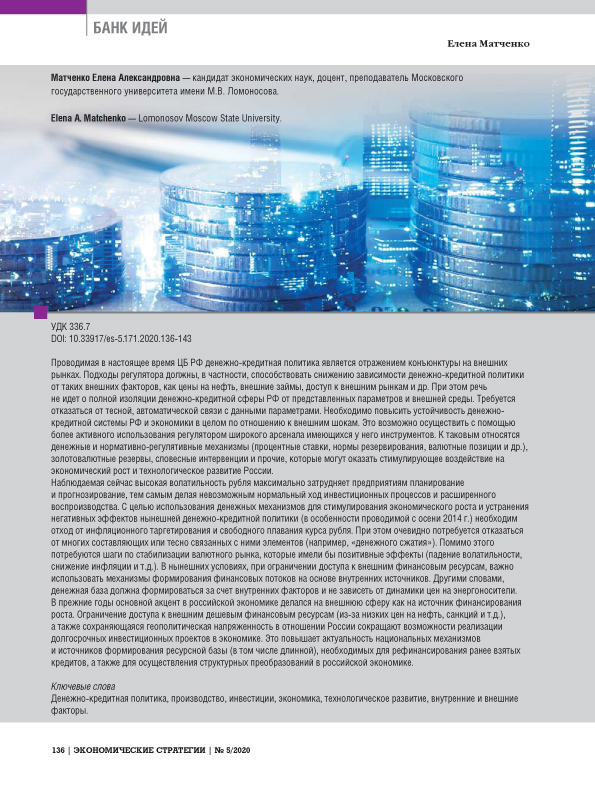
Influence of Monetary Policy on Technological Development of the Economy in a Long-Term Aspect

DOI: 10.33917/es-5.171.2020.136-143

Monetary policy currently pursued by the Central Bank of the Russian Federation is a reflection of external market conditions. Regulatory approaches should, in particular, help reduce the dependence of monetary policy on external factors — such as oil prices, foreign loans, access to foreign markets, etc. This is not about completely isolating the monetary sphere of the Russian Federation from parameters and the external environment. It is required to refuse close, automatic communication with the given parameters. It is necessary to increase the stability of the monetary system of the Russian Federation and the economy as a whole in relation to external shocks. This can be done through more active use of a wide range of tools available to the regulator. These include monetary and regulatory mechanisms (interest rates, reserve requirements, foreign exchange positions, etc.), gold reserves, verbal interventions, etc., which can have a stimulating effect on economic growth. The high volatility of the ruble now observed makes it extremely difficult for enterprises to plan and forecast, thereby making it impossible for the normal course of investment processes and expanded reproduction. In order to use monetary mechanisms to stimulate economic growth and eliminate the negative effects of current monetary policy (in particular, implemented since autumn 2014), a departure from inflation targeting and free floating of the ruble exchange rate is necessary. At the same time, it is obviously necessary to abandon many components or closely related elements (for example, “monetary contraction”). In addition, steps will be needed to stabilize the foreign exchange market, which would have positive effects (falling volatility, lower inflation, etc.). Under current conditions, with limited access to external financial resources, it is important to use mechanisms  for generating financial flows based on internal sources. In other words, the monetary base should be formed due to internal factors, and not depend on the dynamics of energy prices. In previous years, the main emphasis in the Russian economy was placed on the external sphere as a source of growth financing. Restricting access to external cheap financial resources (due to low oil prices, sanctions, etc.), as well as continuing geopolitical tensions with regard to Russia, reduce the possibilities for implementing longterm investment projects in the economy. This increases the relevance of national mechanisms and sources of formation of the resource base (including long) necessary to refinance previously taken loans, as well as to implement structural changes in the Russian economy.

Contemporary Approaches to Economic Stimulation Using Financial Instruments

DOI: 10.33917/es-8.166.2019.24-29

The Russian economy needs in adequate financial policy in the environment when other countries use actively financial stimulation measures, among which are protectionist measures, aimed at the growth of activity and defend of national economy. Contemporary financial protectionist measures often are not subject of international conventions that increase international trade and capital flow transparency. Countries use non-market mechanisms to support their national business in the competitive environment. Such mechanisms entail risks and opportunities for countries, as well as for business (large business in the first place). It’s necessary for Russian regulators to consider thoroughly approaches of other countries and broaden instruments they use

Actual Issues of Economic Policy in the European Union

DOI: 10.33917/es-8.166.2019.58-65

Today, the European Union (EU) is facing many challenges in the economic and financial sphere. Europeans are becoming less gullible with EU institutions and less tolerant of supranational interference in domestic politics. As a result, the process of European integration is gradually being modified. It was assumed that the process of economic integration, making Europeans more interdependent, should also lead to cultural assimilation and deeper political integration. Was the project too ambitious, given that Europeans are sufficiently heterogeneous in their economic interests, beliefs and sociocultural values to form a successful political union? Or are current difficulties a consequence of the inefficiency of supranational institutions? And how has the process of European economic integration affected cultural assimilation? All of these issues are becoming increasingly relevant as European integration develops

Where are You Going, Russia?

DOI: 10.33917/es-5.163.2019.58-69

To answer the question “Whither goest thou, Russia?”, the authors analyzed the period of the neoliberal reformation in the social and economic aspects. They summed up the political confrontation that had taken place in the “tumultuous” 1990s and identified the main trends towards the integral development of the Russian Federation for the near to medium terms. A situation that first occurred in the country, when the systems scientific and mental approaches are not in the binary opposition, but they are interacting research technologies, holds out hope for a success in studying the complicated actors of social life. In the authors’ opinion, for Russia’s successful development one can need a sovereignty of the State and society, to support creative directions in the intellectual sphere, to return the masses to active politics and to restore a direct and honest dialogue between the Government and civil society, otherwise there would be no way to save a considerable stratum of the population from a metacognitive bias with regard to their hope for a social and just transformation of society