Managing Group Conflicts in Industrial Enterprises. Part I

DOI: 10.33917/es-2.206.2026.138-143

In modern industrial enterprises, management can be carried out by administrative, institutionalized or non-institutional groups, as well as by a converging group built into the management structure for their coordinated functioning and development. These groups have their own goals and resources to achieve them [1]. Identification and analysis of potential conflicts between various groups, including between formal management and informal coalition teams representing socio-economic and other interests of the department employees, will enable managers to formulate practical recommendations for providing sustainable development of their industrial enterprises.

References:

1. Vartanyan A.A. Metodologiya komandno-koalitsionnogo upravleniya predpriyatiem [Methodology of Command-and-Coalition Enterprise Management]. Moscow, Izd-vo MAI-PRINT, 2008, 320 p.

2. Vartanyan A.A., Sidel’nikov Yu.V. Tseli gruppy [Goals of the group]. *Ekonomicheskie strategii,* 2005, no 7(41), pp. 114–119.

3. Tantsyura V.O., Gunin N.A., Yakovleva E.A. Psikhologiya upravleniya: kak ponimanie chelovecheskogo povedeniya pomogaet v upravlenii komandoy i prinyatii resheniy [Management Psychology: How Understanding Human Behavior Helps in Team Management and Decision Making]. *Kreativnaya ekonomika,* 2024, vol. 18, no 6, pp. 1431–1448.

4. Ryabinina E.V. Aktual’nye problemy konfliktologii: teoretiko-metodologicheskiy analiz [Current Issues in Conflictology: Theoretical and Methodological Analysis]. *Teorii i problemy politicheskikh issledovaniy,* 2016, no 1, pp. 126–141.

5. Ishchenko M.M., Bazhenova A.V. Upravlenie konfliktnymi situatsiyami v sovremennoy organizatsii [Conflict Management in a Modern Organization]. *Mirovye tsivilizatsii,* 2021, no 1, available at: https://wcj.world/PDF/13ECMZ121.pdf

6. Vartanyan A.A. Identifikatsiya gruppovykh konfliktov v ramkakh komandno-koalitsionnogo upravleniya na vysokotekhnologichnykh predpriyatiyakh [Identification of Group Conflicts within the Framework of Command-coalition Management in High-tech Enterprises]. *Ekonomika i upravlenie v mashinostroenii,* 2024, no 2, pp. 4–12.

7. Sukhov A.N. Sotsial’no-psikhologicheskaya konfliktologiya: sostoyanie i perspektivy razvitiya [Social and psychological conflictology: status and development prospects]. *Chelovecheskiy kapital.* 2022, no 12(168), vol. 1, pp. 247–256.

8. Sheynov V.P. Upravlenie konfliktami [Conflict Management]. Moscow, AST, 2024, 640 p.
Methodological Principles for Accelerating the Reproduction Processes of the Mineral Resource Base of Solid Minerals in a Mining Enterprise

DOI: 10.33917/es-2.206.2026.130-137

Mineral resource base is the foundation for the operations of mining enterprises and related industries. Certain mineral resources are of strategic importance for providing the country’s national and economic security and enhancing its technological sovereignty. Depletion of existing deposits and reduction in the number of studied geological sites with reliable information on ore potential are intensifying competition for new licensed areas for subsoil exploration between mining companies and investors. The key to successful reproduction of the mineral resource base in this context is to increase the pace of exploring potential deposits without losing the quality of the geological information obtained. Assessment of the reproduction processes acceleration is impossible without considering the influence of the time factor on economic systems. The article dwells on the main reasons why the time factor is one of the most significant ones in the mining enterprise’s economics. The article pays special attention to the methods for accelerating reproduction of the mineral resource base; among these methods the author identifies organizational, innovative, educational, financial and junior ones. Application of these methods is examined on the example of a successful mining company, Polymetal JSC, which is one of the leaders in the country’s gold mining industry.

References:

1. The Growing Role of Minerals and Metals for a Low Carbon Future. R. Puliti (ed.). Washington, DC, USA: World Bank Publications, 2017, 92 p., available at: http://hdl.handle.net/10986/28312

2. Titenko E.A. Faktor vremeni kak kriteriy razvitiya proizvodstva v ekonomicheskikh kontseptsiyakh [The Time Factor as a Criterion for the Development of Production in Economic Concepts]. *Biznes. Obrazovanie. Pravo,* 2013, no 1(22), pp. 157–160.

3. Kaganovich S.Ya. Vosproizvodstvo mineral’no-syr’evoy bazy [Reproduction of the Mineral Resource Base]. Moscow, Nedra, 1991.

4. Dushin A.V. Teoretiko-metodologicheskie osnovy gosudarstvennogo regulirovaniya vosproizvodstva mineral’no-syr’evoy bazy: diss. … d-ra ekon. nauk [Theoretical and Methodological Foundations of State Regulation of Reproduction of the Mineral Resource Base: diss…. Doctor of Economics]. FGBUN Institut ekonomii UrO RAN. Ekaterinburg, 2014.

5. Alekseev Ya.V, Popov I.V., Kulikov D.A. Rezul’taty geologicheskogo izucheniya nedr na ABTsM po “zayavitel’nomu printsipu” s osobennostyami ego realizatsii na primere korennogo zolota [Results of Geological Exploration for Diamonds, Base and Precious Metals (DBPM) Under the “Declaration Principle” of the Licensing, and Specifics of Implementation of the Principle to Primary Gold Deposits as an Example]. *Rudy i metally,* 2025, no 1, pp. 15–28, DOI: 10.47765/0869-5997-2025-10001

6. FGIS “ASLN” [FGIS “ASLN”], available at: https://asln.rosnedra.gov.ru

7. Varlamov A.I., Gogonenkov G.N., Mel’nikov P.N., Cheremisina E.N. Sostoyanie i perspektivy razvitiya tsifrovykh tekhnologiy v neftegazovoy geologii i nedropol’zovanii Rossii [The State and Prospects of Digital Technologies in Oil and Gas Geology and Subsoil Use in Russia]. *Geologiya nefti i gaza,* 2021, no 3, pp. 5–20.

Improving the Processes of Classification and Declassification

DOI: 10.33917/es-6.204.2025.134-143

The article proposes to examine a preliminary version of a program for improving methodological tools for increasing the level of objectivity when making decisions on classifying or declassifying information. The program consists of several stages, which include: conducting preliminary work, including collecting information and solving specially formulated problems, solution of which would facilitate the implementation of these stages; collecting additional information and solving the assigned problems; analyzing the information received and solving the problems that arise; ensuring ongoing monitoring of the implementation effectiveness of the proposed program. A total of 32 such problems are formulated. Furthermore, the authors discuss ways to improve methodological principles and methodological tools in this area. In conclusion, the authors present a plan for future research in the above area.

References:

1. Sagan C. The Demon-Haunted World: Science as a Candle in the Dark. Ballantine Book. New York, 1996, 457 p.

2. Zakon Rossiyskoy Federatsii ot 21.07.93 N 5485-1 “O gosudarstvennoy tayne” (v red. federal’nykh zakonov ot 06.10.97 N 131-FZ, ot 30.06.2003 N 86-FZ, ot 11.11.2003 N 153-FZ, ot 29.06.2004 N 58-FZ, ot 22.08.2004 N 122-FZ, ot 01.12.2007 N 294-FZ, ot 01.12.2007 N 318-FZ, ot 18.07.2009 N 180-FZ, ot 15.11.2010 N 299-FZ, ot 18.07.2011 N 242-FZ, ot 19.07.2011 N 248-FZ, ot 08.11.2011 N 309-FZ, ot 21.12.2013 N 377-FZ, ot 08.03.2015 N 23-FZ, ot 26.07.2017 N 193-FZ, ot 29.07.2018 N 256-FZ, ot 30.12.2020 N 481-FZ, ot 09.03.2021 N 39-FZ, ot 11.06.2021 N 170-FZ, ot 14.07.2022 N 292-FZ, ot 04.08.2022 N 359-FZ, ot 05.12.2022 N 498-FZ, ot 04.08.2023 N 432-FZ, ot 08.08.2024 N 249-FZ) [Law of the Russian Federation of 21.07.93 No. 5485-1 “On State Secrets” (as amended by federal laws of 06.10.97 No. 131-FZ, of 30.06.2003 No. 86-FZ, of 11.11.2003 No. 153-FZ, of 29.06.2004 No. 58-FZ, of 22.08.2004 No. 122-FZ, of 01.12.2007 No. 294-FZ, of 01.12.2007 No. 318-FZ, of 18.07.2009 No. 180-FZ, of 15.11.2010 No. 299-FZ, dated 18.07.2011 No. 242-FZ, dated 19.07.2011 No. 248-FZ, of 08.11.2011 No. 309-FZ, of 21.12.2013 No. 377-FZ, of 08.03.2015 No. 23-FZ, of 26.07.2017 No. 193-FZ, of 29.07.2018 No. 256-FZ, of 30.12.2020 No. 481-FZ, of 09.03.2021 No. 39-FZ, of 11.06.2021 No. 170-FZ, of 14.07.2022 No. 292-FZ, of 04.08.2022 No. 359-FZ, of 05.12.2022 No. 498-FZ, dated 04.08.2023 No. 432-FZ, dated 08.08.2024 No. 249-FZ)]. Konsul’tantPlyus, available at: https://www.consultant.ru/document/cons_doc_LAW_2481/

3. Veryutin V.N. Otdel’nye aspekty zashchity gosudarstvennoy tayny v Rossiyskoy Federatsii [Certain Aspects of the Protection of State Secrets in the Russian Federation]. Vestnik Voronezhskogo instituta MVD Rossii, 2009, no 2, pp. 17–22.

4. Kotov M.A., Kravchenko A.Yu., Chervonenko V.Yu. Ob opredelenii ekonomicheskogo ushcherba bezopasnosti gosudarstva vsledstvie nesanktsionirovannogo raskrytiya svedeniy, sostavlyayushchikh gosudarstvennuyu taynu v VS RF [On the Determination of Economic Damage to State Security Due to the Unauthorized Disclosure of Information Constituting a State Secret in the RF Armed Forces]. Voennaya mysl’, 2009, no 6, pp. 21–26.

Economic Strategies for University Campuses Functioning and Development

DOI: 10.33917/es-3.201.2025.136-144

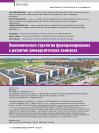
The article dwells on priorities and effects of creating and developing university campuses in the leading regions of the Russian Federation. The area of results application — recommended measures within the framework of implementing key economic strategies can be reflected in the state management practice of regional development, given the improvement of educational process quality on campuses. Scientific novelty lies in structuring the best regional practice of creating campuses for their successful development in the Russian university education system. Conclusions – maintaining economic balance of interests between state priorities in the field of university education and target guidelines for involving investors’ funds in projects of creating campuses in the regions of Russia serves as a tool for more effective stewardship of resources for managing regional potential in order to achieve technological sovereignty in the country.

References:

1. Maksimova K.A., Korenev V.I. Gradostroitel’nye aspekty razmeshcheniya universitetskikh kampusov v g. Tomske [Urban Planning Aspects of University Campuses in Tomsk]. Vestnik Tomskogo gosudarstvennogo arkhitekturno-stroitel’nogo universiteta, 2022, vol. 24, no 1, pp. 137–149.

2. Natsional’nyy proekt “Nauka i universitety” [National Project “Science and Universities”]. Minobrnauki Rossii, available at: https://minobrnauki.gov.ru/nac_project/

3. Postanovlenie Pravitel’stva RF ot 29 marta 2019 g. N 377 “Ob utverzhdenii gosudarstvennoy programmy Rossiyskoy Federatsii ‘Nauchno-tekhnologicheskoe razvitie Rossiyskoy Federatsii’” (s izm. i dop.) [Decree of the Government of the Russian Federation No. 377 dated March 29, 2019 “On Approval of the State Program of the Russian Federation ‘Scientific and Technological Development of the Russian Federation’” (with amendments and additions)]. Garant, available at. https://base.garant.ru/72216664/

4. Procampus [Website]. URL. https://prokampus.rf/campus/view?id=5

5. Belitskaya A.V., Kukharenko L.V. Kompleksnoe razvitie territorii kak pravovoy instrument gosudarstvenno-chastnogo partnerstva [Integrated Development of the Territory as a Legal Instrument of Public-private Partnership]. Yurist, 2023, no 2, pp. 27–32.

6. Lysov P.G. Organizatsionno-ekonomicheskiy mekhanizm funktsionirovaniya mezhvuzovskogo kampusa [Organizational and Economic Mechanism of Functioning of the Interuniversity Campus]. Kreativnaya ekonomika, 2022, vol. 16, no 12, pp. 5005–5024, DOI: 10.18334/ce.16.12.116651

7. Kicherova M.N., Kyrov D.N., Shelemekha K.S. Na puti k mezhvuzovskim kampusam: zelenoe deklarirovanie i real’nye ekologicheskie praktiki studencheskoy molodezhi [On the Way to Interuniversity Campuses: Green Declaration and Real Environmental Practices of Students]. Vysshee obrazovanie v Rossii, 2023, vol. 32, no 11, pp. 77–94, DOI: 10.31992/0869-3617-2023-32-11-77-94

8. Leyman E.N., Lozenko V.K. Mekhanizmy povysheniya investitsionnoy privlekatel’nosti imushchestvennogo kompleksa vuza i puti ikh formirovaniya [Mechanisms for Increasing the Investment Attractiveness of the University’s Property Complex and Ways of Their Formation]. Nauchnyy zhurnal NIU ITMO. (Seriya: Ekonomika i ekologicheskiy menedzhment). 2019. № 1. S. 102–111.

Anthropogenic Methodology of Triads of the Cognition and Leadership Dialectics

DOI: 10.33917/es-1.199.2025.138-143

Civilization development reveals a continuous dialectical process of cause-effect cognition of phenomena in all spheres of life.

Unlike observable Cause and Effect, the cognition process requires modern tools of observation and analysis. The synthesis of methods and models for studying cause-effect homeostasis endows the tools with the third component — intelligence, transforming the phenomenon into a dialectical triad.

References: 

1. Gegel’ G.V.F. Sistema nauk. Chast’ pervaya: Fenomenologiya dukha. 1807 g. [System of Sciences. Part One: Phenomenology of Spirit. 1807]. Moscow, Nauka, 2015.

2. Speranskiy A.A. Mnogomernye vektorno-fazovye attraktory gomeostaza sostoyaniy uprugikh system [Multidimensional Vector-phase Attractors of Homeostasis of States of Elastic Systems]. Dvigatel’, 2017, no 3, pp. 28–32.

Development of the Pharmaceutical Industry in India, Cooperation and Application of this Experience in the Russian Federation

DOI: 10.33917/es-1.199.2025.132-137

The purpose of this study is to identify future prospects for development of the pharmaceutical industry in the Russian Federation, based on Indian experience. Today, India is the «world’s pharmacy», producing a wide range of drugs: from original ones to generics and vaccines. The country’s success is in full production cycles.

Russian pharmaceutical industry is going through difficult times today: geopolitical uncertainty, sanctions pressure, currency growth — all this has a negative impact on the industry’s development. Another feature of the development of the pharmaceutical industry in Russia is the focus on importing both raw materials and finished products. The state is gradually moving away from this trend, trying to build progressively a model of its own production, and in the future, focus the industry on exports. If this trend continues, Russian pharmaceutical industry will be able to reach a new level in the coming years and provide the domestic market with drugs of its own production.

References: 

1. Kung-Chung & Uday S. Racherla. (2019). Innovation, Economic Development, and Intellectual Property in India and China. Springer opener. Retrieved from ARCIALA Series on Intellectual Assets and Law in Asia. Book series home (springer.com)

2. Logina M.V., Rodygina N.Yu., Musikhin V.I. Razvitie eksporta Rossii produktsii farmatsevticheskoy promyshlennosti v Indiyu [Development of Russian Exports of Pharmaceutical pProducts to India]. Obrazovanie i parvo, 2021, no 3, available at: https://cyberleninka.ru/article/n/razvitie-eksporta-rossii-produktsiifarmatsevticheskoy-promyshlennosti-v-indiyu

3. Kovalenko A.V., Khalimova A.A., Safronova Zh.S., Polyakova Yu.Yu. Ukhod inostrannogo kapitala iz farmatsevticheskoy otrasli Rossii [The Departure of

Foreign Capital from the Russian Pharmaceutical Industry]. Zdorov’e i obrazovanie v XXI veke, 2022, no 8, available at: https://cyberleninka.ru/article/n/uhodinostrannogo-kapitala-iz-farmatsevticheskoy-otrasli-rossi

4. Ovod A.I., Solyanina V.A., Nozdracheva E.N., Pasechko V.V. Eksportno-importnye operatsii v sfere lekarstvennogo obespecheniya Rossii [Exportimport Operations in the Field of pharmaceutical Supply in Russia]. ANI: ekonomika i upravlenie, 2023, no 1(42), available at: https://cyberleninka.ru/article/n/eksportno-importnye-operatsii-v-sfere-lekarstvennogo-obespecheniya-rossii

Mathematical Substantiation of Demand Management in the Medical Device Market

DOI: 10.33917/es-1.199.2025.126-131

The article dwells on the features of demand management in the medical products mark et from the standpoint of clinical marketing. The factors that determine demand at each level are described and t ypical tools of influence are proposed.

Using the scalar multiplication formula, the author proposes an algorithm for forecasting demand and contribution of each marketing tool, which helps to optimize the marketing budget. It is shown that demand management tools in the medical device market can be classified according to the type of impact and the nature of the influence on demand.

References: 

1. Igrunova O.M. Issledovanie podkhodov k opredeleniyu ponyatiya “Spros” [Research of Approaches to Defining the Concept of “Demand”]. Vestnik Moskovskogo gorodskogo pedagogicheskogo universiteta. Seriya: Ekonomika, 2015, no 1, available at: https://cyberleninka.ru/article/n/issledovanie-podhodovk-opredeleniyu-ponyatiya-spros

2. Avramenko S.A. Klassifikatsiya rynkov po tipu konechnogo potrebitelya [Classification of Markets by Type of end Consumer]. Voprosy regional’noy ekonomiki, 2012, no 3(12), pp. 3–7.

3. Zuenkova Yu.A., Mironov A.V. Elektronnyy registr patsientov kak regional’naya nudge-strategiya [Electronic Patient Registry as a Regional Nudge Strategy]. Vestnik MIRBIS, 2024, no 3(39), pp. 77–85, DOI 10.25634/MIRBIS.2024.3.10

4. Shilova G.F., Lyapunova N.V., Starostenkov N.V. Problemy mezhdistsiplinarnogo podkhoda v sovremennoy istorii [Problems of Interdisciplinary Approach in Modern History]. Vestnik sovremennoy nauki, 2015, no 7-1(7), pp. 77–81.

5. Stiggelbout A.M., Pieterse A.H., De Haes J.C. Shared decision making: Concepts, evidence, and practice. Patient Educ Couns., 2015/N 98(10), pp. 1172-9, DOI: 10.1016/j.pec.2015.06.022. Epub 2015 Jul 15. PMID: 26215573

6. Korotkov A.V., Vershinina A.A. O soderzhanii ekonomicheskoy kategorii i izmerenii rynochnogo sprosa [On the Content of the Economic Category and the Measurement of Market Demand]. Statistika i ekonomika, 2014, no 1, available at: https://cyberleninka.ru/article/n/o-soderzhanii-ekonomicheskoykategorii-i-izmerenii-rynochnogo-sprosa

Assessing Economic Security of a Commercial Organization Providing Medical Services

DOI: 10.33917/es-6.198.2024.138-143

Based on the analysis of existing methods for a comprehensive assessment of the economic security level of business entities, the author proposes a methodology for an integrated evaluation of the economic security of a commercial organization providing medical services, based on the calculation of a cumulative criterion via the distance method. This methodology makes it possible to consider peculiarities characterizing the aspects and risk factors of the economic security of a commercial organization providing medical services, to assess the level of economic security both in general for the organization and for its individual functional components as well.

References:

1. Glebova O.V., Mitrofanova M.N. Otsenka ekonomicheskoy bezopasnosti gostinichnogo predpriyatiya [Assesment of the Economic Security of a Hotel Enterprise]. Ekonomicheskaya bezopasnost’, 2023, vol. 6, no 3, pp. 1133–1152.

2. Krasnoshchek A.A., Dinets D.A. Sovremennye aspekty analiza i otsenki ekonomicheskoy bezopasnosti organizatsiy [Modern Aspects of Analysis and Assessment of Economic Security of Organizations]. Korporativnye finansy, 2010, no 4, pp. 73–83.

3. Kundakova L.R., Temirbaeva G.R., Daukenova G.A., Nurtazinova A.S. K voprosu kolichestvennoy otsenki ekonomicheskoy bezopasnosti firmy [On the Issue of Quantitative Assessment of the Economic Security of a Company]. Mezhdunarodnyy zhurnal prikladnykh i fundamental’nykh issledovaniy, 2017, no 9, pp. 148–152.

4. Mitrofanova M.N. Otsenka effektivnosti proektov po vnedreniyu nauchno-issledovatel’skogo i ispytatel’nogo oborudovaniya na promyshlennom predpriyatii [Assessment of the Effectiveness of Projects for the Implementation of Research and Testing Equipment at an Industrial Enterprise]. Upravlenie

proektami i programmami, 2015, no 3, pp. 196–204.

5. Sergeev A.A. Ekonomicheskaya bezopasnost’ predpriyatiya [Economic Security of an Enterprise: Textbook and Workshop for Universities]. Ucheb. i praktikum dlya vuzov. 3-e izd. Moscow, Yurayt, 2023.

6. Modenov A.K., Belyakova E.I., Vlasov M.P., Lelyavina T.A. Ekonomicheskaya bezopasnost’ predpriyatiya [Economic Security of an Enterprise]. Saint Petersburg, Izd-vo SPbGASU, 2019, 550 p.

7. Goloshchapova L.V., Yakushina S.O. Upravlenie finansovymi riskami v sfere zdravookhraneniya i sposoby ikh minimizatsii [Managing Financial Risks in the Healthcare Sector and Ways to Minimize Them]. Vestnik Akademii znaniy, 2019, no 31, pp. 278–281.

8. Zavrazhskiy A.V. Kompleksnoe strakhovanie riskov professional’noy meditsinskoy otvetstvennosti [Comprehensive Insurance of Professional Medical Liability Risks]. Problemy analiza riska, 2020, vol. 17, no 3, pp. 82–89.

9. Zadvornaya O.L., Alekseev V.A., Borisov K.N. Kadrovye riski v obespechenii bezopasnosti meditsinskoy deyatel’nosti [Personnel Risks in Ensuring the Safety of Medical Activities]. MIR (Modernizatsiya. Innovatsii. Razvitie), 2017, no 8, pp. 132–139.

10. Salkhaeva B.D., Nurbaeva G.K., Zhumakarimov M.A., Amanov S.B. Upravlenie riskami v zdravookhranenii: Obzor literatury [Risk Management in Healthcare: a Literature Review]. Journal of Health Development, 2020, vol. 17, no 35, pp. 24–29.

Choosing a Competitive Strategy for Launching a Medical Product on the Market: By the Example of Technical Rehabilitation Equipmen

DOI: 10.33917/es-4.196.2024.136-143

Competitive strategy of the company engaged in medical equipment in the B2G market is considered. The author analyzes the process of choosing a strategy for launching a new brand in conditions of high market competition — against the background of significant market monopolization and risks of the new competitors’ emergence. Driving forces of this market, regulation, target audiences and stakeholders are described.

References:

1. Kornienko D.A. Rynok rossiiskogo meditsinskogo oborudovaniya v period ekonomicheskikh sanktsii. Modernizatsiya rossiiskogo obshchestva i obrazovaniya: novye ekonomicheskie orientiry, strategii upravleniya, voprosy pravoprimeneniya i podgotovki kadrov [The Russian Medical Equipment Market During the Period of Economic Sanctions. Modernization of Russian Society and Education: New Economic Guidelines, Management Strategies, Law Enforcement Issues and Personnel Training]. Materialy XXIV Natsional’noi nauchnoi konferentsii (c mezhdunarodnym uchastiem). Taganrog, 2023. Tom I. Taganrog: Taganrogskij institut upravleniya i ekonomiki, 2023. pp. 412–429.

2.Kopylov M.A. Obespechenie ustoichivogo razvitiya rossiiskikh proizvoditelei medtekhniki v usloviyakh vneshne ekonomicheskikh sanktsii [Ensuring Sustainable Development of Russian Medical Equipment Manufacturers in the Context of Foreign Economic Sanctions]. Tsifrovizatsiya tekhnosfery: nauchnyi podkhod: Sbornik nauchnykh statei Natsional’noi nauchno-prakticheskoi konferentsii. Moskva: Rossiiskii tekhnologicheskii universitet, 2022. pp. 110–113.

3.Basil N. Stoma care: the market in products lets patients down. BMJ, 2013.

4.Simatov S.A. Problemy organizacii okazanija medicinskoj i reabilitacionnoj pomoshhi stomirovannym bol’nym na sovremennom jetape [Problems of the Organization of Medical and Rehabilitation Care for Stoma Patients at the Present Stage] // Vestnik medicinskogo instituta «REAVIZ». 2017. № 3. pp. 78–82.

5.Simatov S.A. Spornye i nereshennye voprosy okazanija pomoshhi stomirovannym pacientam v ambulatornyh uslovijah (obzor literatury) [Disputed and Unresolved Issues of Assistance to Stoma Patients in Outpatient Settings (a literature review)] / S.A. Simatov, M.Ju. Zasypkin, S.A. Stoljarov [et al.] // Vestnik medicinskogo instituta «REAVIZ». 2019. № 5. pp. 75–84.

6. Rasporyazhenie Pravitel’stva RF ot 22 noyabrya 2017 g. N 2599-r «O strategii razvitiya proizvodstva promyshlennoi produktsii reabilitatsionnoi napravlennosti do 2025 g.» [Order of the Government of the Russian Federation of November 22, 2017 No. 2599-r “On the Strategy for the Development of Industrial Production of Rehabilitation Products until 2025”]. Garant, available at: https://www.garant.ru/products/ipo/prime/doc/71719020/

7. Prikaz Ministerstva truda i sotsial’noi zashchity Rossiiskoi Federatsii ot 31.05.2023 № 482n «Ob utverzhdenii professional’nogo standarta «Pomoshchnik po ukhodu»» [Order of the Ministry of Labor and Social Protection of the Russian Federation dated May 31, 2023 No. 482n “On Approval of the Professional Standard Care Assistant”]. Garant, available at: https://www.garant.ru/products/ipo/prime/doc/407247740/

Subject-Oriented Business Process Management as a Tool for Innovative Development of an Enterprise

DOI: 10.33917/es-4.196.2024.128-136

The article explores mechanisms for increasing resilience and sustainability of commercial organizations in conditions of growing instability of the external environment. Approaches to understanding viability, sustainability and adaptability of an organization are analyzed. The concept of managerial cross-section is introduced. Among the highlighted sections, the authors examine in more details the tools for studying a communication aspect. Advantages of subject-oriented management for designing communications in an organization are described, some risks of implementing the proposed strategy are identified. Relevance of the study is determined by parameters and trends of change in the modern market environment, which really necessitate to strengthen the dynamics of renewal and adaptation processes, since acceleration of technological innovation is not accompanied by adequate and comparable development of management models. Results obtained can be applied for theoretical research into the functioning of sociotechnical systems of different scales. Also, the proposed approach can be put into practice as part of the development of measures aimed at transforming the company’s business model or improving the efficiency of operational management.

References:

1. Lavrikova Yu.G., Buchinskaya O.N., Myslyakova Yu.G. Teoriya khaosa: rasshirenie granits ekonomicheskikh issledovaniy [Chaos Theory: Expanding the Frontiers of Economic Research]. AlterEconomics, 2023, vol. 20, no 1, pp. 79–109, DOI: 10.31063/AlterEconomics/2023.20-1.5

2. Abramov V.I., Churkin D.A. Otsenka urovnya zrelosti sistemy upravleniya vzaimootnosheniyami s klientami [Assessing the Maturity Level of a Customer Relationship Management System]. Vestnik universiteta, 2022, no 12, pp, 5–13.

3. Pratt M., Kakula S. Motivatsiya v kommercheskoy kompanii s ispol’zovaniem kommunikatsiy, osnovannykh na tekhnologiyakh: V kn.: Dingli A., Khaddod F. Iskusstvennyy intellekt v Industrii 4.0. Issledovaniya v oblasti vychislitel’nogo intellekta [Motivation in a Commercial Company Using Technology-based Communications: In: Dingli A., Haddod F. Artificial Intelligence in Industry 4.0. Research in Computational Intelligence]. Springer, 2021, vol. 928, DOI: 10.1007/978-3-030-61045-6_2 https://link.springer.com/chapter/10.1007/978-3-030-61045-6_2

4. Abramov V.I., Abramov I.V., Polivanov K.V., Semenkov K.Yu. Kontseptual’naya mode’’ tsifrovoy sistemy analiticheskoy podderzhki distantsionnogo upravleniya personalom organizatsii [Conceptual Model of a Digital System of Analytical Support for Remote Management of an Organization’s Personnel]. Ekonomika, predprinimatel’stvo i pravo, 2023, vol. 13, vol. 7, pp. 2341–2352, DOI: 10.18334/epp.13.7.118326.

5. Romanova O.A., Sirotin D.V., Ponomareva A.O. Ot ekonomiki soprotivleniya — k rezil’entnoy ekonomike (na primere promyshlennogo regiona) [From the Economy of Resistance to the Resilient Economy (Using the Example of an Industrial Region)]. AlterEconomics, 2022, vol. 19, no 4, pp. 620–637, DOI: 10.31063/AlterEconomics/2022.19-4.4