The relationship between AGILE technology and the classical management cycle in the methodology of the system-activity approach
DOI: 10.33917/mic-6.125.2025.21-34

This article examines the relationship between agile technology and the classical management cycle in the methodology of the system-activity approach in modern socio-economic conditions. If you study the description of the Agile methodology in various sources and publications, you can see the general requirements for the organization of work during the project implementation process, but there is a lack of a rigid technological form of management according to this methodology. In the absence of such information, it is difficult to be sure that there are no «gaps», and the probability of defects is high if it is not possible to accurately identify the person responsible for the area where the defect occurred. In order to solve this problem, this article attempts to compare Agile methodology with the classical technological cycle of management activities. The paper shows that project management using the method of correlating Agile project management technology with the technological cycle of management activities will make project management organized, on the one hand, and ensure optimal tracking of «nuances» and «details», using the advantages of classical project management and Agile technology, while maximizing their weaknesses. the parties. Agile does not replace the technological management cycle, but complements it where flexibility is needed.

References:

1. Anisimov O.S. 100 shem. OOO Veliky Novgorod Pechatny Dvor, 2013, 156 p.

2. Anisimov O.S. Managerial decision-making. Meteorology and technology. M.: Rosako APK, 2002. 436 p.i.; 22.

3. Anes V., Abreu A., Diaz A., Kalado J. The Agile team assignment model for agile scaling. Informatics Procedia. 2023;219:1634–1641.

4. Beat K. Flexible by accident: how to apply flexible principles in academic research projects. SN Social Sciences. 2024;4(1):2.

5. Das S., Panda M., Rekha Sahu S., Patnaik D. Flexible change management: adaptation of flexible methodologies to enhance the sustainability of the organization. Journal of Research in the Field of Humanities and Social Sciences. 2023;6:41–52.

6. De Abreu J.N.F., Casagrande D.J. Lean manufacturing: combining a flexible approach with the philosophy of lean manufacturing and organizational efficiency. Revista Sistematica. 2024;14(6):1442–1453.

7. Excel in Chukvura. Flexible privacy in practice: integration of CCPA and GDPR within flexible frameworks in the US technology arena. International Journal of Scientific Research Updates. 2024;7(2):024–036.

8. Findsrud R. Flexible approach to innovation in the service sector: creating valuable innovations in the service sector with flexible integration of resources. The journal of value Creation. 2020;6(2):190–207.

9. Helmlinger P. Flexible transformation: a case study at an early stage of flexible implementation. Our economy. 2023;69(1):56–67.

10. Neuman M., Kuchel T., Ph.D. Diebold, Schenn E.M. Collision with flexible culture: identification of problems in the development of flexible thinking in organizations. Computer Science and information systems. 2024;21(3):1013–1031.
Method of forecast scenarios in assessing the competitiveness of tourism services

DOI: 10.33917/mic-1.114.2024.68-74

The scientific article graphically displays the economic essence of the method of forecast scenarios in assessing the development of competitiveness of tourism services. Target (tactical) development blocks and target development scenarios based on the theory of even subsets have been identified. A matrix of alternative strategies and corresponding tourism growth scenarios at the meso-economic level have been developed: optimistic; pessimistic (risk assessment) and optimal scenario.

References:

1. Galiullin I.R. Innovative competitive advantages of service sector enterprises: macro, meso-level research. I.R. Microeconomics. 2017;6:68-73. (In Russ.).

2. Zhukovskaya I.V. Systematization of scientific approaches to managing competitiveness in the service sector: economic essence, criteria. Microeconomics. 2020;2:29-37. (In Russ.).

3. Leonov E.F. Increasing the competitiveness of small and medium-sized service enterprises based on the formation of institutional space: dis. Ph.D. econ. Sciences: 08.00.05. Leonov Egor Fedorovich. St. Petersburg, 2017. 206 p. (In Russ.).

4. Fatkhutdinov R.A. Managing the competitiveness of an organization. M.: EKSMO, 2005. pp. 542-543. (In Russ.).

5. Khusaenov R.R. Development of Innovative Infrastructure Services in The Conditions of Discreteness of Its Components. International Journal of Advanced Research in Engineering and Technology. 2020;11(3):276-291.

Status and prospects for the development of the service sector on the example of the Republic of Tatarstan

DOI: 10.33917/mic-3.110.2023.72-79

The scientific article proposes an algorithm for determining the total tourism potential on the example of the most promising areas for the development of domestic tourism on the example of the Republic of Tatarstan: youth tourism; cultural and educational tourism; sports tourism; cruise tourism; ecological tourism; business tourism.

References:

1. Zhukovskaya I.V. Segmentation of the service market: problems, solutions // Microeconomics. 2021;2:32-37. (In Russ.).

2. Regions of Russia. Socio-economic indicators. 2021. Rosstat. URL: http://rosstat.gov.ru

3. Ragimkhanov A.V. Systematization of scientific approaches to the study of the competitiveness of services: from theory to practice / A.V. Ragimkhanov, I.V. Zhukovskaya // Microeconomics. 2022;1:75-78/ (In Russ.).

4. Statistical collection. Information-analytical materials. Methodology. Rosstat. URL: http://rosstat.gov.ru

Study of the innovative potential of service sector organizations on the example of the Republic of Tatarstan

DOI: 10.33917/mic-2.109.2023.93-100

In a scientific article, a study was made of the innovative potential of organizations on the example of the largest tour operators of the Republic of Tatarstan. Based on the components of the meso fractal, the EVA model was built, which allows assessing the degree of readiness for innovative changes and innovative development of tourism companies in the region.

References:

1. Portnov V.V. Controlling as a mechanism for effective management of the investment attractiveness of an industrial enterprise: dissertation … candidate of economic sciences: 08.00.05 / Portnov Viktor Valentinovich. – Nizhny Novgorod, 2011.

2. Zhukovskaya I.V. The specifics of the study of the service market on the example of the Republic of Tatarstan. Microeconomics. 2020;5:93-98. (In Russ.).

3. Ragimkhanov A.V. Synergy effect in the study of the competitiveness of enterprises on the example of the subjects of the tourist destination of the Republic of Tatarstan / A.V. Ragimkhanov, I.V. Zhukovskaya. Microeconomics. 2022;4:80-85. (In Russ.).

4. Svyatokho N.V. Conceptual bases for the study of the tourism potential of the region. Economics and Management. 2007;2:30-36. (In Russ.).

Directions for the development of the Russian tourism market on the example of the Republic of Tatarstan

DOI: 10.33917/mic-1.108.2023.85-92

The scientific article presents the directions for the development of a competitive market in the service sector on the example of tourist services of the Republic of Tatarstan. The specifics of the market are reflected, key tasks are identified, and a rating of the most popular business ideas (startups) in the region is presented.

References:

1. Zarutskaya V.S. Development of the tourist market in Russia: problems and potential. Theoretical and applied economics. 2021;1:21-38. (In Russ.).

2. Zhukovskaya I.V. The specifics of the study of the service market on the example of the Republic of Tatarstan. Microeconomics. 2020;5:93-98. (In Russ.).

3. Ragimkhanov A.V. The effect of synergy in the study of the competitiveness of enterprises on the example of the subjects of the tourist destination of the Republic of Tatarstan / A.V. Ragimkhanov, I.V. Zhukovskaya // Microeconomics. 2022; 4:80-85. (In Russ.).

Features of the study of the competitiveness of the service sector on the example of the Republic of Tatarstan

DOI: 10.33917/mic-5.106.2022.105-109

The scientific article proposes directions for supporting the competitiveness of the service sector on the example of the tourism industry of the Republic of Tatarstan. The formation of the regional tourist and volunteer center is substantiated, which allows expanding additional types of regional domestic tourism and accumulating a control center at the point of the most demanded and visited geographically, which accumulates information and digital support with the help of volunteers.

References:

1. Safina G.M., Gadzhiev Z.G., Dominova L.R. Risk tolerance of Russian service organizations in the context of the COVID-19 pandemic // in the collection: Comprehensive development of territorial systems and improving the efficiency of regional management in the context of digitalization of the economy. Materials of the III National (All-Russian) scientific-practical conference. Eagle, 2021. pp. 194-200. (In Russ.).

2. Rzaitdinov R.R. Ways to improve competitiveness in the service sector (on the example of a network of service centers for the repair of equipment) // Studies of young scientists: materials of the XX Intern. scientific conf. Kazan: Young scientist, 2021. pp. 33-36. (In Russ.). URL: https://moluch.ru/conf/stud/archive/394/16533/

3. Zhukovskaya I.V. Segmentation of the service market: problems, solutions // Microeconomics. 2021;2:32-37. (In Russ.).

4. Zhukovskaya I.V. Differentiation of competitiveness management methods on the example of the service market of services // Microeconomics. 2021;3:32-38. (In Russ.).

5. Ragimkhanov A.V. Systematization of scientific approaches to the study of the competitiveness of services: from theory to practice / A.V. Ragimkhanov, I.V. Zhukovskaya // Microeconomics. 2022;1:75-78. (In Russ.).

Systematization of scientific approaches to the study of competition and competitiveness of services: from theory to practice

DOI: 10.33917/mic-1.102.2022.75-82

In the scientific article, within the framework of the study of the terminological definitions of «competitiveness» and «competition», the concept of competitiveness of services is clarified. The classification of scientific schools in the field of management theory based on directive, descriptive and complex approaches is presented. The specific typology of the competitiveness of services in the context of the theoretical formula «personnel – processes – partners – products» is substantiated.

References:

1. Galiullin I.R. Innovative competitive advantages of service sector enterprises: macro, meso-level research. / I.R. Galiullin I.R., I.V. Zhukovskaya // Microeconomics. 2017;6:68-73. (In Russ.).

2. Zhukovskaya I.V. Market aspects of the implementation of the investment strategy of corporations // Economic Bulletin of the Republic of Tatarstan. 2009;4:42-45. (In Russ.).

3. Zhukovskaya I.V. Specifics of service market research on the example of the Republic of Tatarstan // Microeconomics. 2020;5:93-98. (In Russ.).

4. Leonov E.F. Improving the competitiveness of small and medium-sized enterprises in the service sector on the basis of the formation of an institutional space.: dis. Candidate of Economic Sciences: 08.00.05 / Leonov Egor Fedorovich. St. Petersburg, 2017. pp. 189-194. (In Russ.).

5. Mindeli D. Fundamentals of scientific management. High School, 1999. (In Russ.).

6. Robinson J. The economic origins of dictatorship and democracy. Higher Economics, 2006. 512 p. (In Russ.).

7. Fatkhutdinov R.A. Managing the competitiveness of an organization. Moscow: EKSMO, 2005. 546 p. (In Russ.).

8. Khusaenov Rustem R. Development of Innovative Infrastructure Services in The Conditions of Discreteness of Its Components / Rustem R. Khusaenov, Irina V. Zhukovskaya //International Journal of Advanced Research in Engineering and Technology (IJARET). ISSN Print: 0976-6480 and ISSN Online: 0976-6499. 2020;11(3):276-291.

9. Shamatov I.K. Evaluation of the market of innovative startups and stakeholders on the example of the Republic of Tatarstan / I.V. Zhukovskaya, I.K. Shamatov // Microeconomics. 2021;5:30-35. (In Russ.).

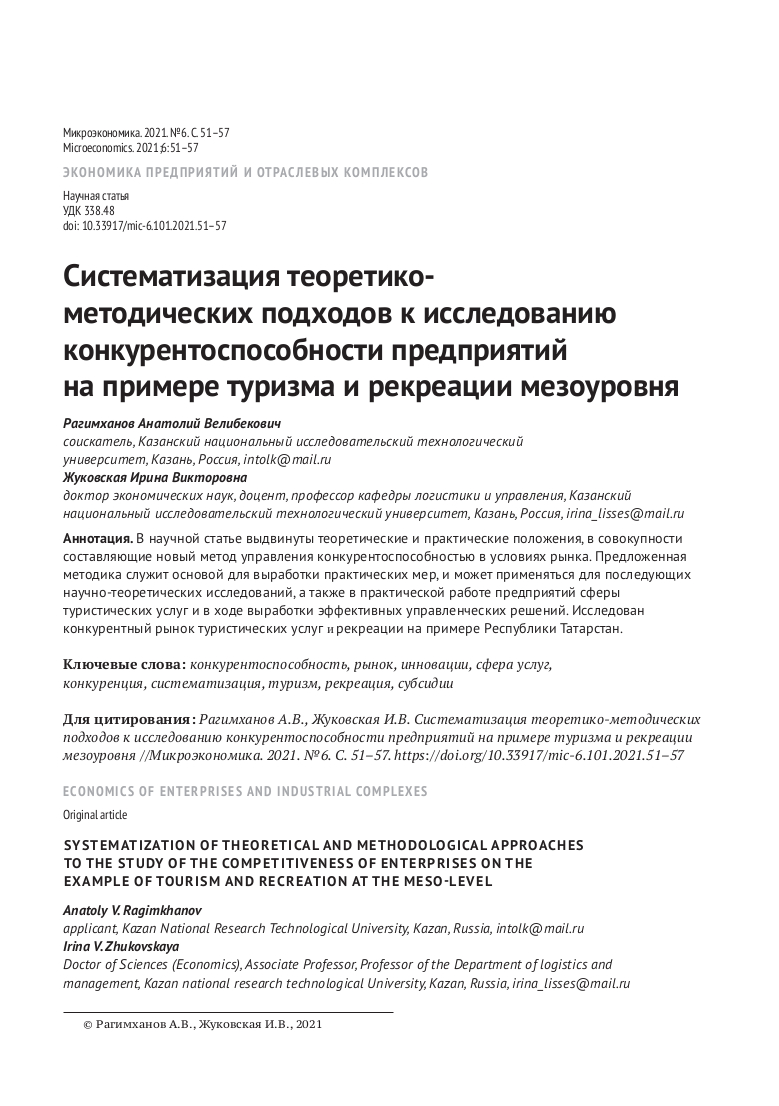
Systematization of theoretical and methodological approaches to the study of the competitiveness of enterprises on the example of tourism and recreation at the meso-level

DOI: 10.33917/mic-6.101.2021.51-57

The scientific article puts forward theoretical and practical provisions, in aggregate, constituting a new method of managing competitiveness in a market environment. The proposed methodology serves as the basis for the development of practical measures, and can be used for subsequent scientific and theoretical research, as well as in the practical work of enterprises in the field of tourism services and in the development of effective management decisions. The competitive market of tourist services and recreation is investigated on the example of the Republic of Tatarstan.

Differentiation of methods of competitiveness management on the example of the service market of services

DOI: 10.33917/mic-3.98.2021.32-38

The scientific article puts forward theoretical and practical provisions, in aggregate constituting a new method of managing competitiveness in the service sector. The methodology proposed by the author makes it possible to ensure the effectiveness of the process of managing competitiveness in market conditions and instability of economic development, and can also be used for subsequent scientific and theoretical research, and in the practical activities of service enterprises in the course of developing effective management decisions.

Service market segmentation: problems, solutions

DOI: 10.33917/mic-2.97.2021.32-37

The scientific article summarizes the concept of the service market of services. Based on the analysis of the respondents ‘ personal data, an attempt is made to segment the market by priority market niches that tend to be commercialized in the aspect: medical services, educational services, financial and information services on the example of the meso – level of the study-the Republic of Tatarstan.