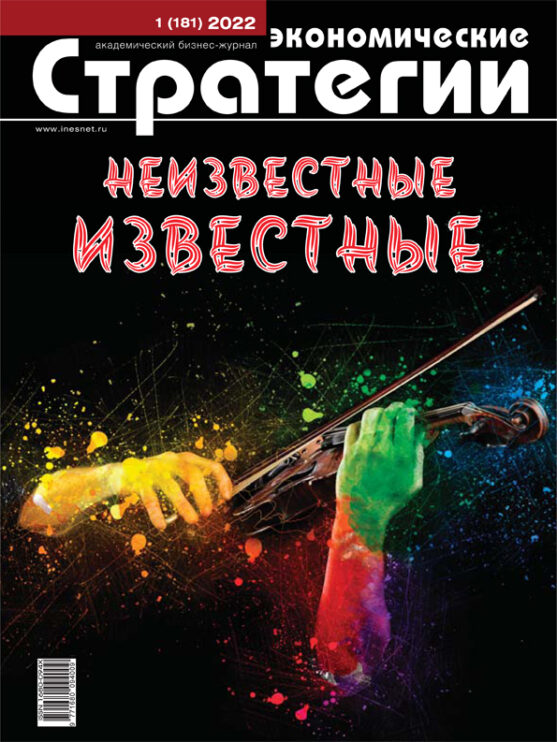
The "Economic Strategies" journal

2022


How to dominate the local furniture market without having your own production
DOI: 10.33917/mic-1.102.2022.55-65

The article is devoted to the analysis and forecasting of the institutional structure of the furniture market in Russia, taking into account the theory of economic dominance in a multilevel economy. It is shown that despite the conservative changes in the market, a stable hierarchy of companies has quickly developed on it, which determines the architecture and logic of its development in the medium term. The article examines in detail the situation in the Russian furniture market in 2020, which arose under the influence of the current epidemiological and economic situation. In the context of the groups described in this theory, the factors that furniture companies had to face depending on their size, market position and organizational structure are shown, the prospects for their development are assessed and general recommendations are given for each group. Identification of the key market players and comparison of the institutional strength of its participants belonging to different levels of the hierarchy makes it possible to form scenarios for its development and build appropriate forecasts for the development of this sector of the economy. Particular attention is paid to the relationship between the structure and key players in the furniture market and the housing construction market. It is shown that there is a potential for mutual strengthening of the institutional strength of the key players in both markets, but so far it has been implemented to a weak degree. These relationships are expected to strengthen in the coming years.

References:

1. Blokhin A.A. Institutional rent in a multilevel economy // Problems of forecasting. 2019;4:16-26. (In Russ.).

2. Blokhin A.A., Lomakin-Rumyantsev I.V., Naumov S.A. Alfa-business in the Russian food market // Economic strategies. 2019;6:68-77. (In Russ.).

3. Vertogradov V.A. Market strategies of alpha, beta, gamma in the context of the theory of economic dominance // Economic strategies. 2020;2:50-53. (In Russ.).

4. Studnikov C.C. Higher education in Russia: the heyday of economic dominance // The world of the new economy. 2021;1:112-120. (In Russ.).

5. Mertsalova A., Shchurenkov N., Kostyrev A. The shavings were removed from the furniture // newspaper «Kommersant», No. 221 of 2.12.2020. URL: https://www.kommersant.ru/doc/4594631

6. RBC Market Research. Furniture retail chains, 2019. URL: https://marketing.rbc.ru/research/issue/64188

7. Mauborn Rene, Kim Chan V. The strategy of the Blue Ocean. How to find or create a market free of other players. Publisher: Mann, Ivanov and Ferber, 2020. 336 p. (In Russ.).

8. Fligstin N. Architecture of markets: economic sociology of capitalist societies of the XXI century / translated from English by A. A. Kurakin; edited by V.V. Radaev; National. research. un-t «Higher School of Economics». Moscow: Publishing House of the Higher School of Economics, 2013. 392 p. URL: https://publications.hse.ru/books/94309661

9. Blokhin A.A., Sternik S.G., Teleshev G.V. Institutional transformations of housing construction in 2020 // Problems of forecasting. 2021;2(185):43-55. (In Russ.).
Analysis of rational preferences in the image-forming space

DOI: 10.33917/mic-1.102.2022.40-54

The principles and algorithms of the analysis of rational preferences of the target group in the image-forming space are considered, with an special attention on the correctness of the application of methods and interpretation of results, based on the identification of factors that determine market processes, and the construction of images of ideal goods/ brands/ firms in the perception of the target group. The issues of promoting a product/ brand/ company based on the analysis of rational preferences are discussed. Examples of solving practical problems of identifying factors of rational preference of goods/ brands/ firms, building their ideal images in the space of rational preferences, analyzing the configuration of ideal images, developing a strategy and essential details of promotion are given using the presented approach.

This article is a continuation of the author’s research presented in No 2(97), No 3(98), No 4(99) and No 5(100) of the journal for 2021.

References:

1. Zakuskin S.V. Analysis of rational choice in the image-forming space // Microeconomics. 2021;5:14-29. (In Russ.).

2. Zakuskin S.V. Analysis of consumer ideals in the space of image-forming factors: problem statement and identification of factors // Microeconomics. 2021;2:19-31. (In Russ.).

3. Zakuskin S.V. Features of the analysis of the formation and differentiation of market images in the space of rational attitude // Creative Economy. 2020; 14(12):3635-3656. (In Russ.).

4. Zakuskin S.V. Integration of marketing communications based on the analysis of consumer preferences // Russian Entrepreneurship. 2018;19(6):1913-1937.

5. Zakuskin S.V. Planning of marketing experiments // Marketing and marketing research. 2018;2:100-106. (In Russ.).

6. Lukina A.V., Krutko M.A., Matveev I.V., Tsekhov A.S., Kiselev V.V. Investigation of the perception of environmental friendliness of goods by consumers and assessment of its impact on the choice of goods when buying // Drukerovsky Vestnik. 2018;2(22):92-103. (In Russ.).

7. Tregubenko P.V. Application of the method of joint analysis for assessing consumer preferences in industrial markets // Practical marketing. 2013;10 (200):36-40. (In Russ.).

8. Chan Kim V., Moborn R. Strategy of the Blue Ocean. How to find or create a market free of other players. Moscow: Mann, Ivanov and Ferber. 2017. 336 p. (In Russ.).

Methodological approaches to the goals of Russian economic development in digitalisation

DOI: 10.33917/mic-1.102.2022.30-39

The article studies a set of national programmes and federal projects directly and indirectly influencing human resourcing of the national programme for creation of a digital economy in the Russian Federation. It studies implementation criteria of the programmes and projects and changes in their quantitative indicators. It specifically focuses on implementation of main methodological approaches: programme goal, complex-based, process-based, systemic, and situational approaches as a basis for a hierarchy of the set of programmes and projects.

References:

1. On national goals and strategic objectives in development of the Russian Federation until 2024: Decree of the President of the Russian Federation of 07.05.2018 No 204 (ver. of 19.07.2018). Collected RF legislation. 14.05.2018. No 20. p. 2817.

2. On the Strategy for scientific and technological development of the Russian Federation: Decree of the President of the RF of 01.12.2016 No 642. Collected RF legislation, 05.12.2016. No. 49. p. 6887.

3. On the federal budget for 2020 and the planned period of 2021 and 2022: Federal law of 02.12.2019 No 380-FZ. Official website for legal information http://www.pravo.gov.ru. 03.12.2019. effective from 01.01.2020. International economic activities.

4. On approval of the government program of the Russian Federation «Development of education»: Decree of the RF Government of 26.12.2017 No 1642 (ver. of 30.11.2019). Collected RF legislation. 01.01.2018. No 1 (Part II). p. 375.

5. On approval of the government program of the Russian Federation «Economic development and innovative economy»: Decree of the RF Government of 15.04.2014 No 316 (ver. of 30.11.2019). Collected RF legislation. 05.05.2014. No 18 (Part II). p. 2162.

6. Description of the federal project «Regulatory control of digital environment» of the national program «Digital economy of the Russian Federation» (approved by the Executive Committee of the Government Commission for Digital Development and Use of Information Technologies for Improving the Living Standards and Conditions of Doing Business, Protocol of 28.05.2019 No 9), published online. URL: https://digital.gov.ru as of 09.07.2019

7. Description of the national project (program) «International cooperation and export» (approved by the Executive Committee of the Council on Strategic Development and National Projects attached to the President of the Russian Federation, Protocol of 24.12.2018 No 16). Not published.

8. Description of the national project (program) «Labour productivity and employment support» (approved by the Executive Committee of the Council on Strategic Development and National Projects attached to the President of the Russian Federation, Protocol of 24.12.2018 No 16). Not published.

9. Belous A.P., Lyalkov S.Yu. Vector of business development in the flow of the digital revolution. Banking. 2017; 10:16-19. (In Russ.).

10. Bodrunov S., Plotnikov V., Vertakova Y. Technological Development as a Factor of Ensuring the National Security, Proceedings of the 30th International Business Information Management Association Conference — Vision 2020: Sustainable Economic development, Innovation Management, and Global Growth. 2017. 8-9 November. Madrid. P. 66-74.

Logical and analytical events of economic transactions involving state property or its obligations

DOI: 10.33917/mic-1.102.2022.22-29

A series of facts of the economic life of any organization has its own history. The direct adoption of a management decision is preceded by a plan and planning based on the analysis of special economic operations in the area of interest to us. The article presents the types of logical stages, which, in turn, contain certain analytical events. The formulation of specific tasks that should be solved in economic operations involving the state (state property and obligations) in the interests of the state should be entrusted to the person making the management decision.

References:


1. Opalsky A.P., Aleshin A.S., Ushanov P.V. About the formulation of tasks which solution is necessary for achievement of the state interests in the transactions and operations carried out with participation of the state property and obligations //Management Sciences in Russia. 2019;9(3):28-39. (In Russ.).

2. Opalsky A.P., Aleshin A.S., Ushanov P.V. On the possibility of classification of the economic role of the state due to economic transactions involving the state or its property. Microeconomics. 2021;6:17-23. (In Russ.). https://doi.org/10.33917/mic-6.101.2021.17-23.

3. Signs of schemes and nominal participation of the parties. URL: www.np-kres.ru 

Model for the development of a long-term forecast for the development of fundamental and exploratory scientific research in the context of the implementation of strategic planning documents in Russia

DOI: 10.33917/mic-1.102.2022.5-21

The article deals with the regulatory and legal grounds and the subject of development of the forecast for the development of fundamental and exploratory scientific research. Provisions, factors and conditions regulating the formation of this forecast have been developed. Proposals for the development of information and expert support of the forecast are formulated.

References:

1. Scenario conditions for a long-term forecast of the socio-economic development of the Russian Federation until 2030 / Ministry of Economic Development of Russia. M., 2013. URL: https://institutiones.com/general/2373-klyuchevye-problemy-razrabotki-scenarnyx-uslovij.html

2. Mindeli L., Ostapyuk S., Chernykh S. Long-term forecasting of the development of fundamental science in Russia: methodological aspects // Society and Economics. 2017;10:5–22. (In Russ.).

3. Sidelnikov Yu.V., Minaev E.S. Technology of expert scenario forecasting. M.: MAI Publishing House, 2017.

4. Zubova L.G., Mindeli L.E., Motova M.A. et al. Methodological aspects of developing a long-term forecast of scientific and technological development / TsISN // Information Bulletin. 2004;6:31–74. (In Russ.).

5. Mindeli L.E., Ostapyuk S.F., Fetisov V.P. On the organization of long-term forecasting of fundamental and search scientific research // Economics and Mathematical Methods. 2019;55(1):56-67. (In Russ.).

6. Ostapyuk S.F. Conditions, stages, features and information support of the procedure for forecasting the development of fundamental and exploratory scientific research. Collection of articles on the results of the international scientific-practical conference «The state and trends in the development of science, technology and innovation». M.: IPRAN RAS, 2021. (In Russ.).

7. Makosko A.A., Abrosimov V.K. On forecasting the development of science as a task of weak artificial intelligence (conceptual approach) // Innovations. 2018; 9 (239):13–19. (In Russ.).

8. Pletnev K.I., Lazarenko N.E. Expertise in the scientific and technical sphere: methodology and organization. M.: Publishing House of the RAGS, 2003. (In Russ.).

9. Dushkin R.V. Why hybrid AI systems are the future // Economic strategies. 2018;156:84–93. (In Russ.).

10. Russell S., Norvig P. Artificial intelligence. Modern approach. 2nd ed. M.: Williams, 2006.

11. Marcus G. Deep Learning: A Critical Appraisal. New York University, 2017. Cornell University Library. URL: http://arxiv.org/1801.00631

12. Sokolov A.V. Foresight: a look into the future // Foresight. 2007;1(1):8–15. (In Russ.).

13. Novikov D.A., Chkhartishvili A.G. Active forecast. M.: IPU RAN, 2002. (In Russ.).

14. Belousov D.R., Frolov I.E. Long-term scientific and technological forecast: construction methodologies, contours of the technological future, development scenario // Foresight. 2008; 2(3):54-67. (In Russ.).

15. Website of the Council for Science under the Ministry of Education and Science of the Russian Federation. URL: http://sovet-po-nauke.ru/info/31012017-declaration_goszadanie

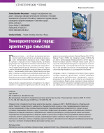
University City: the Architecture of Meanings

DOI: https://doi.org/10.33917/es-1.181.2022.154-158

Collection of articles “University City: the Architecture of Meanings”, published in 2021 by VTsIOM together with the Publishing House of the Tomsk State University, brought together authors from different countries, adhering to various scientific fields, which are connected by a common interest in understanding the university city phenomenon. Today, in the context of advanced demands for science, technology and effective education, a convergent vision of social and educational elements of production and the knowledge dissemination as the basic characteristic of a post-industrial society is becoming of high demand. One of historically tested responses to demands of the time is creation and development of university cities, where a single social, educational and communicative space is formed. Problems, hypotheses and examples of successful world and Russian experience form a kind of architecture of meanings, which the authors of the book discuss in a popular form.

Crystal of Growth: Towards the Russian Economic Miracle

DOI: https://doi.org/10.33917/es-1.181.2022.146-149

Review of the book by A.S. Galushka, A.K. Niyazmetov, M.O. Okulov “Crystal of Growth: Towards the Russian Economic Miracle”, published in 2021 by Nashe Zavtra CJSC with support of Rostec State Corporation, Siber JSC and RT-Security JSC.

On Similarities Between Phenomena of the Quantum and Genetic World

DOI: https://doi.org/10.33917/es-1.181.2022.138-145

The article is dedicated to two world-famous scientists, the founder of Soviet genetics and experimental biology, Nikolay Konstantinovich Koltsov (1872–1940) and his brilliant student, the founder of chemical mutagenesis, Hero of Socialist Labour, Lenin Prize laureate, Nobel Prize nominee (1962), member-correspondent of the Academy of Sciences of the USSR Iosif Abramovich Rapoport (1912–1990). Both made a huge contribution to convergence and blending of different sciences, bridging living and non-living nature. Just over 120 years ago, two great theories emerged — the quantum and the gene one. Both theories played a revolutionary role in natural science, having established two fundamental features of the material world — discreteness and discontinuity. Speaking at the same time in the language of discontinuity, quantum physics and genetics throughout the entire 20th century were following parallel courses, enriching themselves with new facts and ideas. The laws they discovered have broken many ideas on the “good old world”, where phenomenological interconnections dominate, have reduced the essence of all things and phenomena to combinatorics and the atoms and genes activities, have given the keys to controlling many natural processes. Dynamic nature of the microworld objects’ research would continue in the 21st century, since many unsolved problems related to human needs remain in the field of high energy physics, genetics, molecular biology and nanotechnologies.

Management Schools in Russia in the 20th Century: on the History of the Issue

DOI: https://doi.org/10.33917/es-1.181.2022.126-137

The studies on the history of managerial thought do not fully cover the development of management schools in Russia in the 20th century and don’t mention many scientists, who were at the origins of scientific schools, and organizations within which they emerged. Hypotheses are put forward about how researchers in the last 30 years have made an attempt to study the schools of managerial thought in the 20th century in various organizations, especially universities. Narrative, comparative and historical research methods are used. The author describes the main schools of management in Russia in the 20th century, their origins, evolution, inspirers and leaders, as well as their main scientific works. The question of scientific schools of the two greatest mega-projects, successfully implemented in the USSR – nuclear and space project, remains unexplored. It is concluded that in Russia during the twentieth century. Management thought was developing, but it is currently extremely difficult to describe a holistic picture of the evolution of scientific management schools.

Источники:

1. Bezborodova M.A. Zarubezhnye nauchnye shkoly v psikhologii [Foreign Scientific Schools in Psychology]. Ucheb. posobie. Moscow, Moskovskii pedagogicheskii gosudarstvennyi universitet, 2020.

2. Nauchnye shkoly Voenno-vozdushnoi inzhenernoi akademii imeni professora N.E. Zhukovskogo (Voennogo aviatsionnogo tekhnicheskogo universiteta): istoriya razvitiya i sovremennoe sostoyanie: izdano k 80-letiyu VVIA im. prof. N.E. Zhukovskogo (VATU) [Scientific Schools of the Air Force Engineering Academy Named after Professor N.E. Zhukovsky (Military Aviation Technical University): History of Development and Current State: Published on the 80th Anniversary of the Air Force Engineering Academy Named after N.E. Zhukovsky (VATU)]. Moscow, Akademiya aviatsii, 2000.

3. Nauchnye shkoly Moskovskogo gosudarstvennogo tekhnicheskogo universiteta imeni N.E. Baumana. Istoriya razvitiya [Scientific Schools of the Bauman Moscow State

Technical University. History of Development]. 2-e izd. Moscow, Izd-vo MGTU im. N.E. Baumana, 2005.

4. Zaparii V.V. Nauchnye shkoly Ural’skogo federal’nogo universiteta: Entsiklopediya [Scientific Schools of the Ural Federal University: Encyclopedia]. Ekaterinburg, Izd-vo Ural’skogo universiteta, 2020.

5. Sadovnichii V.A., et al. O nauchnykh issledovaniyakh i nauchnykh shkolakh. Evraziiskoe prostranstvo [On Scientific Research and Scientific Schools. Eurasian Space]. Pod red. V.A. Sadovnichego (gl. red.), I.V. Semina, A.V. Sidorovicha. Moscow, Izd-vo Moskovskogo un-ta, 2010, 255 p. (Seriya: Evraziiskie universitety XXI veka / Evraziiskaya assots. un-tov).

6. Ustyuzhanina E.V., Evsyukov S.G., Petrov A.G., Kazankin R.V., Dmitrieva M.B. Nauchnaya shkola kak strukturnaya edinitsa nauchnoi deyatel’nosti [Scientific School as a Structural unit of Scientific Activity]. Moscow, TsEMI RAN, 2011, pp. 4, 8, 9. (Preprint #WP/2011/288).

Major Factors of the Settlement of Migrants from Central Asian Countries in Siberia and the Far East

DOI: https://doi.org/10.33917/es-1.181.2022.118-125

With the Soviet Union’s collapse Russia became a recipient country for labour migrants from Central Asian countries. First of all, this is related to the fact that migration subsystem has been formed, based on socio-economic relations between the countries of the former Soviet Union, as well as to geographic proximity; secondly, there are more opportunities for migrants in Russia — there is the lack of jobs in their countries, low wages and therefore migrants move to Russia mainly in search of a better life. In this article, the authors examine the settlement dynamics of migrants from Central Asian countries in the Siberian Federal District and in the Far Eastern Federal District. The main factors that influence the resettlement of migrants in these territories were identified. As a result of the study, it was revealed that these two federal districts are quite attractive for migrants from the mentioned countries, despite rather severe climate, since in case of the Central Asian countries the socio-economic factor prevails over the natural-climatic one.

Источники:

1. Otchet o nauchno-issledovatel’skoi rabote “Printsipy formirovaniya Ekaterinburgskoi aglomeratsii”: Etap 2 “Podgotovka proektnykh predlozhenii po formirovaniyu Ekaterinburgskoi aglomeratsii” [Report on the “Principles of Forming the Yekaterinburg Agglomeration” Research Work: Stage 2 “Preparation of Project Proposals for the Formation of the Yekaterinburg Agglomeration”]. Ministerstvo stroitel’stva i razvitiya infrastruktury Sverdlovskoi oblasti, available at: https://minstroy.midural.ru/article/show/id/1185.

2. Ryazantsev S.V. Rol’ trudovoi migratsii v razvitii ekonomiki Rossiiskoi Federatsii [Role of Labour Migration in the Development of the Russian Federation’s Economy]. RefWorld, available at: https://www.refworld.org.ru/docid/58875fb04.html.

3. Shafranov-Kutsev G.F. Sotsial’no-demograficheskie problemy osvoeniya Sibiri [Socio-demographic Problems of Siberian Exploration]. Siberian Socium, 2017, no. 1, pp. 13–24, available at: DOI: https://doi.org/10.21684/2587-8484-2017-1-1-9-17

4. Rasporyazhenie Pravitel’stva RF ot 27 maya 2013 g. N 848-r “Perechen’ territorii prioritetnogo zaseleniya” (vstupilo v silu s 1 yanvarya 2014 g.) [Decree of the Government of the Russian Federation of May 27, 2013 No. 848-r “List of Priority Settlement Areas” (Came into Force on January 1, 2014)]. Ofitsial’nyi sait Pravitel’stva RF, available at: http://government.ru/docs/2130/

5. Migratsionnye protsessy v Sibiri: narody, kul’tury, gosudarstvennaya politika [Migration Processes in Siberia: Peoples, Cultures, State Policy]. Sb. nauch. trudov. Omsk: ITs KAN, 2018, 328 p.

6. V Primor’e zhdut na rabotu trudovykh migrantov [Primorye is Waiting for Labour Migrants to Work]. Sputnik Tadzhikistan, 2018, July, 19, available at: https://sptnkne.ws/scfu.

7. Federal’naya sluzhba gosudarstvennoi statistiki, available at: https://rosstat.gov.ru/