Is Poverty Eradicable? Concept of Natural Poverty

DOI: 10.33917/es-5.203.2025.58-63

The problem of poverty remains one of the most significant in the national and global economies. Today the effectiveness of fighting it is in question, as well as the feasibility of achieving poverty eradication goals. The present study aims to discover whether poverty can be eradicated and, in case of impossibility — to assess the level to which poverty can be reduced. The article proves the impossibility of overcoming poverty not “on paper”, whether it’s absolute, relative or deprivation poverty. In any case, there is always a portion of poor population that, either by their own choice or as a result of destructive or irrational behaviour, doesn’t leave the state of poverty. It is proposed to classify this part of the population as natural poverty. Based on analysis of a number of destructive habits, inherent in individuals unable to escape poverty, it is proved that they possess at least three of the six deviations from socially accepted behaviour studied. The author examines the level of natural poverty in Russia, to this end a method for estimating the level of natural poverty, based on probabilistic approach, is developed. It is revealed that natural poverty in the Russian Federation is declining, especially during periods of crisis, which demonstrates gradual recovery of Russian society.

References:

1. Atkinson A.B. Measuring Poverty around the World. London, Princeton University Press, 2019, 464 p.

2. Belopashentseva P.V. Chto govorit o rossiyskoy bednosti deprivatsionnyy podkhod? [What does the Deprivation Approach Say about Russian Poverty?]. Monitoring obshchestvennogo mneniya: ekonomicheskie i sotsial’nye peremeny, 2022, no 4, pp. 110–129.

3. Perskaya V.V. Perekhod k mnogopolyarnosti: polya srazheniy ili pozitsionnoe protivostoyanie? [Transition to Multipolarity: Battlefields or Positional Opposition?]. Ekonomicheskie strategii, 2019, no 1, pp. 62–69.

4. Tsel’ 1: Povsemestnaya likvidatsiya nishchety vo vsekh ee formakh [Goal 1: End Poverty in All its Forms Everywhere]. OON, available at: https://www.un.org/sustainabledevelopment/ru/poverty/

5. Poverty and Inequity Platform. PIP. The World Bank, available at: https://pip.worldbank.org/home

6. Kashnikova T.V. Fenomen bednosti i ego strukturno-funktsional’nye kharakteristiki [The Phenomenon of Poverty and its Structural and Functional Characteristics]. Gosudarstvennoe i munitsipal’noe upravlenie. Uchenye zapiski, 2021, no 3, pp. 70–74.

7. Rethinking Poverty. Report on the World Social Situation 2010, available at: https://www.un.org/esa/socdev/rwss/docs/2010/fullreport.pdf

8. Ravallion M., Chen S. Global poverty measurement when relative income matters. Journal of Public Economics, 2019, no 177, pp. 104046.

9. Hickel J., Dorninger C., Wieland H., Suwandi I. Imperialist appropriation in the world economy: Drain from the global South through unequal exchange, 1990–2015. Global Environmental Change, 2022, no 73, pp. 102467.

Poverty and the “Free Rider Problem” in Russian Society. Interrelationship and Solutions

DOI: 10.33917/es-1.187.2023.36-38

Two shortcomings of our economy — poverty and the “free rider problem” — have the same origin — an exorbitant tax burden on wages. Mathematical modeling of the transition process from modern to transactional taxation, carried out by a group of Russian scientists, has shown that due to this transition, the country’s economy will begin to grow at a rate of 6–7% per year. And most importantly, the very concept of misery will disappear in the country and poverty will be reduced significantly.

References:

1. Eksperty predlozhili reshenie “problemy bezbiletnika” [Experts have Proposed a Solution to the “Free Rider Problem”]. RBK, 2022, 9 dekabrya, available at:

https://www.rbc.ru/economics/09/12/2022/63919fe19a79478d83afaf82.

2. Neravenstvo i bednost’ [Inequality and Poverty]. Federal’naya sluzhba gosudarstvennoi statistiki, available at: https://rosstat.gov.ru/folder/13723.

3. Sotsial’no-ekonomicheskii byulleten’. 2021 [Socio-economic Bulletin. 2021]. Pod red. A.V. Shcherbakova; Tsentr sotsial’no-ekonomicheskogo prognozirovaniya

im. D.I. Mendeleeva, Sretenskii klub im. S.P. Kurdyumova. Moscow, Grifon, 2022.

4. Shcherbakov A.V., Rumyantsev V.Yu., Oleskin A.V. Setevaya ekonomika [Network Economy]. Pod red. A.V. Shcherbakova; Tsentr sotsial’no-ekonomicheskogo

prognozirovaniya im. D.I. Mendeleeva, Sretenskii klub im. S.P. Kurdyumova. Moscow, Grifon, 2020.

5. Shcherbakov A.V., Malkov S.Yu. Mobilizatsionnaya ekonomika Rossii [Mobilization Economy of Russia]. Moscow, Grifon, 2022.

6. Smit A. Issledovanie o prirode i prichinakh bogatstva narodov [Survey on the Nature and Causes of the Wealth of Nations]. Kn. 1–3. Moscow, Azbuka, 2019.

The EAEU Demography and Human Capital: Trends and Losses in the Context of a Pandemic

DOI: https://doi.org/10.33917/es-6.180.2021.20-29

Demographic dynamics becomes crucially important for successful scenario of the future for both Eurasian integration and each EAEU member state. The “pandemic crisis” caused an increase in excess mortality, reduced social well-being and created serious legal and managerial conflicts. Within the EAEU new barriers to mobility and migration have emerged and social tension has increased. In the existing realities the current supranational solutions are insufficient, they are poorly focused on achieving the demographic security of the EAEU member states. Coordinated actions are needed to significantly improve the demographic situation in the EAEU.

Social protests as prerequisites for economic degradation

DOI: 10.33917/mic-6.101.2021.83-102

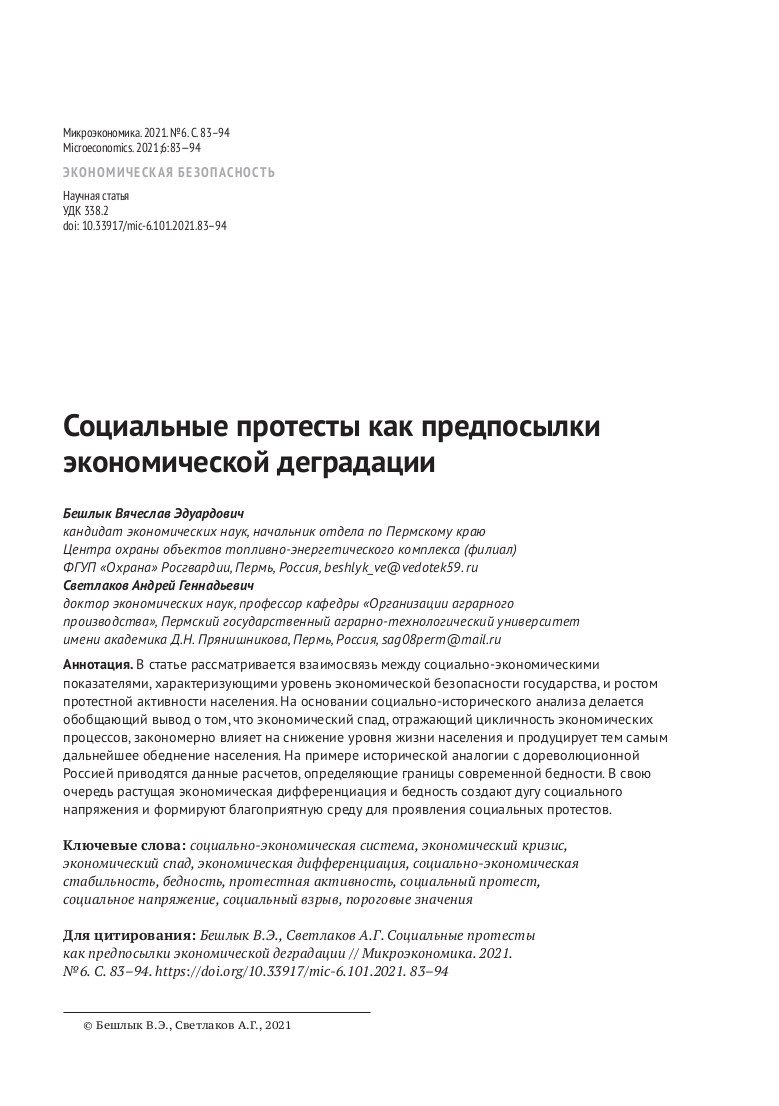
The article examines the relationship between socio-economic indicators characterizing the level of economic security of the state and the growth of protest activity of the population. Based on the socio-historical analysis, a generalizing conclusion is made that the economic downturn, reflecting the cyclical nature of economic processes, naturally affects the decline in the standard of living of the population and thereby produces further impoverishment of the population. Using the example of a historical analogy with pre-revolutionary Russia, the calculation data defining the boundaries of modern poverty are given. In turn, growing economic differentiation and poverty create an arc of social tension and form a favorable environment for the manifestation of social protests.

Spatial Development: China’s Experience

DOI: https://doi.org/10.33917/es-2.176.2021.6-15

Increased interest in China is due not only to its successes in combating the pandemic — the PRC is the only major country in the world that has managed to maintain a positive economic growth dynamics. Moreover, more than 40 years of successful reforms certainly make the Chinese experience deserving special attention and study. The present article analyzes the spatial development of China over the past decades, which in addition to a component purely economically measured by percentage of GDP growth of the country and individual regions, has got important social, demographic, cultural, historical and ethnic components

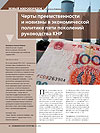
Continuity and Novelty Features in the Economic Policy of Five Generations of the PRC Leadership

#6. Forecasts and Results
Continuity and Novelty Features in the Economic Policy of Five Generations of the PRC Leadership

After founding of the PRC in 1949 the economic policy of the country was formed by five generations of the Chinese leader. The program of “new democracy” and gradual socialist transformations, put forward initially, was interrupted by “accelerated construction of socialism”, by “the great leap forward and people’s communes”, and then — by decade of the “cultural revolution”. The new economic start initiated after putting forward the task of building “socialism with Chinese specifics”, requiring to follow the principle of “practice — criterion of truth”. “The center of gravity” in the party and state work shifted to economic construction, and in the subsequent more than 35 years of reforms social and economic course of the Chinese leadership was remaining consistent, being supplemented only by “creative discoveries” of the new generation of leaders.