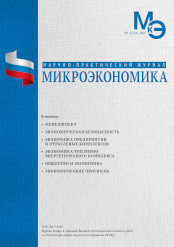
The "Economic Strategies" journal

#2. 2025


Role of marketing communications in the development of commercial companies

DOI: 10.33917/mic-2.121.2025.82-89

The purpose of the study is a comprehensive assessment of the role of marketing communications in the development of commercial companies. In this regard, both classic promotion tools and innovative individualized tools are considered. The essence and significance of integrated communications are defined. The specifics of the activities of brand ambassadors as an effective form of promotion are revealed.

References:

1. Abramov R.A., Temnikova Yu.Yu. Evaluation of the effectiveness of communications of the Department of Transport and Development of Road Transport Infrastructure of Moscow with the population within the framework of the implementation of strategic projects. Management Sciences. 2024;14(4): 53-66.

2. Aleksunin V.A. Marketing communications / Aleksunin V.A., Dubanevich E.V., Sklyar E.N. Moscow: Dashkov i K, 2023.196 p.

3. Varlygina Z.V. Types of marketing information obtained from social networks and ways of working with it. Marketing and marketing research. 2024;4:43-48.

4. Kuzmina O.G. Integrated marketing communications. Theory and practice of advertising: textbook / O.G. Kuzmina, O.Yu. Posukhova. M.: RIOR: INFRA-M, 2023. 187 p.

5. Polit-Zanizdra T.A. Brand ambassadors – a new link between business and consumer. Young scientist. 2024;18:432-434.

6. Sinyaeva I.M. Marketing for masters: Textbook / Under the general editorship of I.M. Sinyaeva. M.: University textbook, NIC INFRA-M, 2022. 368 p.

7. Smirnov I.V. Theory of marketing communications: a tutorial. Vladimir: VSU, 2022. 163 p.

8. Tutov L.A., Izmailov A.A. Digital technologies at the service of entrepreneurship: new challenges for regulation. Bulletin of Moscow University. 2024;3:81-89.

9. Chumikov A.N. Advertising and public relations: Image, reputation, brand. 2nd ind., corr. and add. Textbook. Series «Textbook of the new generation». Moscow, 2023. 159 p.

10. Yagodkina M.V. Advertising in the communication process: teaching aid. St. Petersburg: Piter, 2024. 28 p.

Application of a functional management assessment model in conjunction with MVP and GAP analysis to improve quality management of the federal project «Building a network of modern campuses»

DOI: 10.33917/mic-2.121.2025.90-100

This article examines the organizational and economic aspects of applying the functional management assessment model in conjunction with MVP and GAP analysis to improve quality management of the federal project «Building a network of modern Campuses» in modern conditions. The communication profile of the federal project management methodology was built using a functional management assessment model.

The paper shows that GAP analysis makes it possible to identify discrepancies between the current level of quality of the educational infrastructure and the required level of quality defined by the goals of the federal project. The analysis allows you to identify key areas that require improvements, such as technical equipment, safety, accessibility for people with disabilities, shows that GAP analysis makes it possible to identify discrepancies between the current level of quality of the educational infrastructure and the required level of quality defined by the goals of the federal project. The analysis allows you to identify key areas that require improvements, such as technical equipment, safety, accessibility for people with disabilities, etc. Based on the results of the annals on the results of the analysis of the MVP model of the Mediaplan Information System, the authors came to the conclusion that the necessary quality control principles are embedded in the system and cannot be circumvented, which allows us to reduce the distance between the expectations of the target audience and stakeholders of the project and reality, and in emergency cases promptly implement changes «on the ground».

References:

1. Verstina N.G., Donskaya O.O. Comprehensive analysis of the role of a private partner in the creation of new campuses. Current tasks strategic approach and development – 2023: proceedings of the IV International Scientific Conference. Moscow, 2024. pp. 968-973.

2. Glezin D.D., Sollapov V.I. Application of SWOT and GAP analysis in the study of organizational quality management systems. Scientific Review. 2024;31(5):4177-4182.

3. Zherebtsova A.V., Lisova A.M. Models of life cycles of systems. Full lifecycle management systems for high-tech products in mechanical engineering: new sources of growth: proceedings of the All-Russian Scientific and Practical Conference. 2018. pp. 78-81.

4. Zapparov B.A., Pashina A.D., Feifer R.L., Abramov D.A. Specifics of economic planning for flexible technological product development at the regional level. Kazan Economic Bulletin. 2019;6 (44):15-19.

5. Krolkova N.A., Bolgova A.M. The possibilities of developing a consortium of minimally viable products (MVP) for large businesses in Russia. the text of the development of the method of strategic management. Issues of psychology and law. 2023;184:163-172.

6. Kuzmin A.M., Vysokovskaya E.A. GAP analysis is one of the most important methods of strategic analysis. Methods of quality management. 2021;12:53.

7. Latkov N.Yu., Ashvanyan S.K., Vidyakin A.V. Decision interview as a way to test a minimally viable product. Competitiveness in the global world: economics, science, technology. 2022;5:45-46.

Formation of technological solutions for renewable and low-carbon energy projects in oil and gas companies

DOI: 10.33917/mic-2.121.2025.101-105

Technologies largely determine the economic efficiency of project decisions and play a key role in gaining a competitive advantage. Currently, oil and gas companies are faced with the issue of forming a long-term development strategy for emerging energy transition, including setting priorities for allocating funds to the development of technologies in the field of renewable energy sources and low-carbon projects. The article presents the results of systematization and prioritization of such technologies and their use in the development of strategies for «smart investment» in «green» technologies.

References:

1. The Future of Geothermal Energy, International Energy Agency. URL:   https://www.iea.org/reports/the-future-of-geothermal-energy

2. How a Technology Similar to Fracking Can Store Renewable Energy Underground Without Lithium Batteries, Incide Climate News. URL:   https://insideclimatenews.org/news/27082024/renewable-energy-underground-storage-technology

3. Telegina E.A., Chapaykin D.A. Directions of energy transition in the policy of global oil and gas companies, Problems of forecasting, 2022;5:129-137.

Study on the spatial effect of high-quality development of China’s energy industry on economic growth. Part 1

DOI: 10.33917/mic-2.121.2025.106-110

The energy system is a complex multi-dimensional and multi-criteria optimization system, and the energy development levels in different regions and at different stages of development are different. The Development and Reform Commission of China and the Energy Administration in the «Strategy for Energy Production and Revolution (2016–2030)» proposed that China’s inter-regional energy transformation should be based on security and focus on high-quality development, so as to promote the spatial effect of energy development on economic growth. This paper selects data from 30 provinces in China from 2000 to 2022, and uses Moran’s index and spatial Durbin’s error model to study the impact and spatial effect of China’s energy industry development on economic growth.

References:

1. Tobler W.R. A computer movie simulating urban growth in the Detroit region. Economic geography. 1970;46:234-240.

2. Cressie N. Statistics for spatial data. John Wiley & Sons. 2015. pp. 633-649.

3. LeSage J., Pace R.K. Introduction to spatial econometrics. Chapman and Hall, 2009.

4. Elhorst J.P. Spatial econometrics: from cross-sectional data to spatial panels. Heidelberg: Springer, 2014. 119 p.

5. Demidova O.A. Spatial aspects of wage curve estimation in Russia / O.A. Demidova, E.A. Timofeeva. Journal of the New Economic Association. 2021; 3(51):69-101.

6. Fingleton B. Estimates of time to economic convergence: an analysis of regions of the European Union. International regional science review. 1999;22(1):5-34.

7. Rey S.J., Montouri B.D. US regional income convergence: a spatial econometric perspective. Regional studies. 1999;33(2):143-156.

8. Guo Shouting, Jin Zhibo. Research on the spatial spillover effect of digital inclusive finance on regional industrial structure upgrading. Economic Perspectives. 2022;6:77-87.

9. Li Jiang, Wu Yuming. A review of cutting-edge theories, methods and applications of spatial econometrics. Contemporary Economic Management. 2024;06:30-41.

10. Anselin L. Lagrange multiplier test diagnostics for spatial dependence and spatial heterogeneity. Geographical analysis. 1988;20(1):1-17.

11. Su Yi, Lin Zhouzhou. Research on the spatial effect and influencing factors of regional innovation activities. Journal of Quantitative and Technical Economics. 2017;11:63-80.

12. Tang Baojun, Wu Yun, Wang Chongzhou, Zou Ying. Research on Provincial Energy High-quality Development Index (2012-2022). Journal of Beijing Institute of Technology (Social Sciences Edition). 2023;02:17-23.

Environmental and economic aspects of the production of «green» methanol in oil and gas fields

DOI: 10.33917/mic-2.121.2025.111-117

The article discusses the process of methanol production from hydrogen (H2) and carbon dioxide (СО₂) as a promising direction in the field of gas chemistry. Methanol, which is the most common inhibitor of the formation of gas hydrates, can be synthesized from CO₂. The paper describes in detail the main stages of the process, discusses modern technological solutions such as the use of «green» hydrogen, and shows the economic and environmental aspects of production.

References:

Karasevich V.A. Fundamentals of hydrogen energy: Textbook. Moscow: Publishing Center of Gubkin Russian State University of Oil and Gas (NIU), 2023. 100 p.

2. LUKOIL–West Siberia LLC.  URL: https://zs.lukoil.ru/ru/About/Structure/Yamalneftegaz

3. Prospects for the use of a carbon dioxide capture unit at the branches of PJSC Mosenergo / S.A. Petelin, A.N. Vivchar, P.V. Bubley, V.A. Serdyukov, O.Yu. Sigitov, 2022. 32 p.

 4. Noerma J. Azhari, Denanti Erika, St. Mardiana, Thalabul Ilmi, Melia L. Gunawan, I. G. B. N. Makertihartha, Grandprix T. M. Kadja. Methanol synthesis from CO2: A mechanical overview. Results in Engineering, 2022.

5. The wind power. URL: https://www.thewindpower.net/turbine_en_460_unison_u57.php

Digital technologies in social services to the population: possibilities and limitations

DOI: 10.33917/mic-2.121.2025.118-126

The article presents the main opportunities that digital technologies create in the social sphere. The author illustrates what opportunities digital transformation creates in this area: many processes can be automated, citizens can receive social services online without visiting government agencies Transparency and control over the provision of social services is increased, organizations providing social services can reduce costs by introducing new technologies. At the same time, there are a number of barriers to the implementation of digital technologies in this area. This article analyzes the main ones: digital inequality, lack of necessary infrastructure, financial constraints, digital skills of employees, the necessary regulatory framework has not been created. The use of digital technologies in social support of the population creates many opportunities, but for successful digital transformation of this sphere it is necessary to take into account all the limitations characteristic of the social sphere.

References:

1. Shah N. et al. The role of digital technology and digital innovation towards firm performance in a digital economy. Kybernetes. 2024;53(2):620-644.

2. Popov E.V., Semyachkov K.A. Instrumentation for the development of digital technologies in the public sector. Regional Economy: Theory and Practice. 2018;16(7 (454)):1320-1337.

3. Smotritskaya I.I. Public administration in the context of digital economy development: strategic challenges and risks. STAGE: economic theory, analysis, practice. 2018;4:60-72.

4. Milakovich M.E. Digital governance: New technologies for improving public service and participation. Routledge, 2012.

5. West D.M. Digital government: Technology and public sector performance. Princeton University Press, 2005.

6. Savaget P., Chiarini T., & Evans S. Empowering political participation through artificial intelligence. Science and Public Policy, 2018.

7. Afanasyeva A.S. E-government capabilities in Singapore. Theory and practice of social development. 2015;20:174-176.

8. Shakhabov I.V., Melnikov Yu.Yu., Smyshlyaev A.V. Features of the development of digital technologies in healthcare in the context of the COVID-19 pandemic. Scientific review. Medical sciences. 2020;6:66-71.

9. Senbekov M. et al. The recent progress and applications of digital technologies in healthcare: a review. International journal of telemedicine and applications. 2020;1.

10. Mitchell M., Kan L. Digital technology and the future of health systems. Health Systems & Reform. 2019;5(2):113-120.

11. Haleem A. et al. Understanding the role of digital technologies in education: a review. Sustainable operations and computers. 2022;3:275-285.

12. Timotheou S. et al. Impacts of digital technologies on education and factors influencing schools’ digital capacity and transformation: A literature review. Education and information technologies. 2023;28(6):6695-6726.

13. Di Pietro, G., Biagi F., Costa P., Karpiński Z., & Mazza J. The likely impact of COVID-19 on education: Reflections based on the existing literature and recent international datasets. 2020. Vol.30275.

Problems of global economic development in 2024–2026

According to the IMF, the US GDP growth rate in 2025 will decrease to 1,6% with the forecast for US GDP growth in 2024 being 2,1%. Our article [1] provides an analysis of «Black Monday» on August 5, 2024, which marked the beginning of the global financial crisis. In this article, we will outline the further course of this crisis. In Russia, GDP growth for the first half of 2024 was 4,6%, for 2024 – 4,1%. The forecast for real GDP for the world was 3,2% in 2024 and, according to the IMF, the Ministry of Economic Development of the Russian Federation gave a conservative scenario, according to which the growth of Russian GDP in 2025 will be 1,7%, inflation 3,7% (Kommersant, 09.14.2024, p. 19).

References:

1. Kuzovkin A.I., Stakun A.V. Forecast of the dynamics of global economic development for 2024–2025. Microeconomics. 2024;4:27–38.

Sustainability of the economic supersystem of Russia and Belarus under nuclear attack

DOI: 10.33917/mic-2.121.2025.5-13

Approaches to ensuring the sustainability of the economic supersystem of Russia and Belarus in the event of a nuclear attack are formulated. The technology under consideration is proposed as an integral part of the infrastructural segment of the economic supersystem for work in the context of implementing complex special projects (operations) with the adoption of justified management decisions that fit into the boundaries of trust between the command center and the operational zone, focused on the priorities of the strategy for conducting the SVO.

References:

1. Ageev A.I., Loginov E.L. The world community in conditions of supercritical bifurcation. Management of complex organizational and technical systems in conditions of supercritical situations: Proceedings of the international scientific and practical conference, Moscow, April 21-22, 2022. Moscow: Institute of Economic Strategies, 2022. pp. 9-12.

2. Ageev A.I. The role of sanctions, conflicts and special operations: reflections on the future. Part 1. Scientific Bulletin of the defense-industrial complex of Russia. 2023;4:66-74.

3. Ageev A.I., Grabchak E.P., Loginov E.L. Russia in a supercritical situation: managing the restoration of life support functions to overcome the consequences of a natural macrodisaster. Economic strategies. 2021;23(5 (179)):28-35.

4. Makarov V.L., Ageev A.I., Bakhtizin A.R., Grabchak E.P., Loginov E.L. Modeling the Consequences of a Nuclear Strike. Economic Strategies. 2022;24(4 (184)):6-16.

5. Grabchak E.P., Loginov E.L. New Possibilities of Electromagnetic Pulse Attacks on Critical Infrastructure Facilities. Transformation of Modern Warfare: Proceedings of the III All-Russian Scientific Conference, Omsk, February 16, 2024. Omsk: Military Academy of Logistics named after General of the Army A.V. Khrulev, 2024. pp. 108-112.

6. Ageev A.I., Loginov E.L. New Great War: Chronicles of a Well-Forgotten Future. Economic Strategies. 2014;16(6-7(122-123)):16-33.

7. Ageev A.I., Loginov E.L. Strategic Predetermination of Special Military Operations in the World Supersystem. Economic Strategies. 2023;25(4(190)):6-19.

8. Ageev A.I., Grabchak E.P., Loginov E.L. Use of Artificial Intelligence in the Implementation of Troop Command and Management of Civilian Facilities as a Single Hybrid Battlefield. Neurocomputers and Their Application: Abstracts of the XX All-Russian Scientific Conference, Moscow, March 22, 2022. Moscow: MGPPU, 2022. pp. 31-33.

9. Loginov E.L., Grabchak E.P., Epishkin I.I., Derkach A.K. Using quantum computing with the formation of a single computational space of ultra-large dimensions in the sphere of supplies of fuel and energy resources in the context of special period situations. Artificial societies. 2024;19(2).

10. Ageev A.I., Grabchak E.P., Loginov E.L. Using supercomputer technologies to manage the work of ultra-large organizational systems in the implementation of complex special projects (operations). Microeconomics. 2024;1:5-10.

11. Makarov V.L., Bakhtizin A.R., Loginov E.L. Application of Economic and Mathematical Methods and Models of Optimal Planning in the Digital Economy of the Future (Central Economics and Mathematics Institute of the USSR Academy of Sciences and Central Economics and Mathematics Institute of the Russian Academy of Sciences: Prognostic Interpretation and Development of the Scientific Heritage of Nobel Laureates L.V. Kantorovich and V.V. Leontiev). Moscow: Central Economics and Mathematics Institute of the Russian Academy of Sciences, 2022. 248 p.

State and prospects of scientific and technical co-operation and development of the EAEU

DOI: 10.33917/mic-2.121.2025.14-23

Globalisation, accompanied by the industrial leadership of «developed countries», is being replaced by regionalisation, which is built on conditions of equality and cooperation in common interests. The EU and the Eurasian Economic Union are illustrative examples of the international organisation of regional economic integration. In the context of changes in the architecture of the global technological system, the EAEU faces the task of deepening scientific and technical co-operation. On the agenda is the issue of reducing the level of import dependence in a number of types of finished products, the solution to these issues is associated with the involvement of research base: Eurasian technology platforms, the work of which is aimed at consolidating the scientific potential of the EAEU countries on the way to achieving technological sovereignty. The article analyses the organisation of scientific and technical cooperation in the EU in order to use this experience to solve problems and justify the prospects of scientific and technical cooperation and industrial cooperation within the EAEU.

References:

1. Decision of the Supreme Eurasian Economic Council of 11.12.2020 No. 12: Strategic Directions for the Development of Eurasian Economic Integration until 2025. Effective date: 12.01.2021.

2. Platonova I.N. et al. International Economic Relations in the Global Economy: textbook for universities. Moscow: Yurait, 2023. 528 p.

3. Smitienko B.M. et al. World Economy in 2 Parts. Part 1: textbook for universities / edited by B.M. Smitienko, N.V. Lukyanovich. – 4th ed., revised. and additional. Moscow: Yurait, 2023. 216 p.

4. Ignatova O.V., Orlova N.L., Gorbunova O.A., Ason T.A. Global Economy and International Economic Relations. Workshop: Textbook for Universities / edited by O.V. Ignatova. Moscow: Yurait, 2023. 212 p.

5. Glazyev S.Yu. Problems of Development of Eurasian Economic Integration: How to Resolve Them? Eurasian Integration: Economics, Law, Politics. 2022; 3 (41). URL: https://cyberleninka.ru/article/n/problemy-razvitiya-evraziyskoy-ekonomicheskoy-integratsii-kak-ih-razreshit

6. Glazyev S.Yu. On Strategic Directions of Development of the EAEU. Eurasian Integration: Economics, Law, Politics. 2020;1 (31). URL: https://cyberleninka.ru/article/n/o-strategicheskih-napravleniyah-razvitiya-eaes

7. Glazyev S.Yu. EAEU – EU: Prospects for a Comprehensive Economic Agreement. Eurasian Integration: Economics, Law, Politics. 2019;4 (30). URL: https://cyberleninka.ru/article/n/eaes-es-perspektivy-vseobemlyuschego-ekonomicheskogo-soglasheniya

8. Glazyev S.Yu., Tkachuk S.P. On the Parameters of Economic Development in the EAEU until 2035. International Trade and Trade Policy. 2023;9(1):90–112.

9. Federal State Statistics Service. URL: https://www.gks.ru/

System of sources of intellectual property rights as a key tool for protecting intellectual property and stimulating innovation and the development of the global economy

DOI: 10.33917/mic-2.121.2025.24-39

This article examines the methodological aspects of the formation of a system of sources of intellectual property (IP) law as a key tool for protecting intellectual property and stimulating innovation in modern conditions.

It is determined that the practice of the economic judicial Board of the Supreme Court of the Russian Federation in trademark protection cases should be improved, including with regard to formal requirements for the preparation and consideration of court cases. It is shown that in modern legal practice, trademarks are considered only as legal instruments with which copyright holders have the right to prevent the production and sale of identical or confusingly similar products by opponents. The use of existing means to protect the interests of copyright holders within the framework of the “fuzzy” concept of trademarks allows all business entities and authorities to take a fresh look at trademarks: not only as a legal instrument, but also as an organizational and economic instrument. Intellectual property, as an intangible asset with commercial value, like any object of copyright ownership, can be seriously affected by the actions of third parties. Such damage must be compensated by the copyright holder in court. Thus, violators may be held civilly or criminally liable for the illegal use of such trademarks or service marks. The trademark owner has the right to demand compensation for damages and has the right to publish the court’s decision in the mass media. It should also be noted that trademarks and service marks are a means of personalizing goods and their manufacturers. Trademarks and service marks have different concepts, functions, and types. The legislation of the Russian Federation provides for civil or criminal liability for illegal use. It is shown that the system of sources of intellectual property rights is complex and multilevel.

References:

1. Andrievskaya A.N., Kostornov D.A. Sound trademarks in the system of non-traditional trademarks. Law and management. 2024;12:213-215.

2. Biyukov E. On the issue of the term «trademark use» in relation to the ways of using a trademark on the Internet.  In: Legal Protection of Intellectual property: problems of theory and practice. 2020. pp. 311-317.

3. Bondar I.V. Regulation of the process of using trademarks and termination of legal protection of a trademark. In the collection: Legal problems of the organization of intellectual activity in the Armed Forces of the Russian Federation. Military University of the Ministry of Defense of the Russian Federation. Moscow, 2021. pp. 9-13.

4. Bochkova D.K. The possibility of trademark registration in the name of several persons, with the exception of registration of a collective trademark. Colloquium Is A Journal. 2020;4-7 (56):75-77.

5. Burchik S.S. Intellectual property as an intangible asset in the discussion on the abolition of antimonopoly intellectual property immunities in the Russian Federation. Theory and practice of modern science. 2020;7 (61):53-80.