Author page: Elena Tishchenko

Classification of Artificial Intelligence Tools for the Purpose of Electronic Auctions

DOI: 10.33917/es-4.202.2025.70-77

The article dwells on the essence of artificial intelligence as a mathematical model used to automate human cognitive activity. The author identifies practical tasks that can be solved with the help of the above technology, such as automation of routine business processes, marketing offers personalization, fraud detection, management decision-making support and others. Industries where artificial intelligence is actively used are studied, including healthcare, finance, retail, manufacturing, energy and telecommunications. Special attention is paid to specific examples of applying ar tificial intelligence in auctions, in particular in real estate, energy, online advertising and distribution of computing resources. The author reveals auction models, their essence and areas of application, such as online auctions, programmatic adver tising, spot electricity markets, financial markets and government procurement.

The article analyzes the prospects for introducing artificial intelligence-based tools into auctions in the context of fur ther digitalization of the Russian economy and potential benefits of their application, such as increased profits, optimized use of resources, reduced labour costs and other operating costs.

References:

1. Smith C. Introduction. The History of Artificial Intelligence, available at: https://courses.cs.washington.edu/ courses/csep590/06au/projects/history-ai.pdf

2. Timofeeva A.Yu., Koroleva E.N. Iskusstvennyy intellekt v upravlenii ekonomikoy [Artificial Intelligence in Economic Management]. Nauka XXI veka: aktual’nye napravleniya razvitiya, 2021, no 1-2, pp. 184–188.

3. Reutov R.V. Vliyanie innovatsiy tsifrovoy ekonomiki na mekhanizm neytralizatsii defektov bankovskogo rynka: Ekonomiko-pravovye problem obespecheniya ekonomicheskoy bezopasnosti [The Impact of Digital Economy Innovations on the Mechanism for Neutralizing Defects in the Banking Market:

Economic and Legal Problems of Ensuring Economic Security]. 2021, pp. 99–102.

4. Talapina E.V. Ispol’zovanie iskusstvennogo intellekta v gosudarstvennom upravlenii [Use of Artificial Intelligence in Public Administration]. Informatsionnoe obshchestvo, 2021, no 3, pp. 16–22.

5. Nikitaeva A.Y., Salem A.B.M. Institutional framework for the development of artificial intelligence in the industry. Journal of Institutional Studies, 2022, vol. 14, no 1, pp. 108–126.

6. Zhang C., Lu Y. Study on artificial intelligence: The state of the art and future prospects. Journal of Industrial Information Integration, 2021, available at:

https://www.sciencedirect.com/science/article/abs/pii/S2452414X21000248

7. Fiala P., Flusserova L. Modelirovanie i reshenie dvustoronnikh auktsionov [Modeling and Solving Two-sided Auctions]. Khronoekonomika, 2022, no 4(38), pp. 4–8.

8. Kapusto A.V., Banshchikov D.O. Auktsiony i ikh modelirovanie: Tendentsii ekonomicheskogo razvitiya v XXI veke [Auctions and Their Modeling: Trends of Economic Development in the 21st Century]. 2021, pp. 428–431.

The White Sea Transport System as an Element of a Complex Multi-Agent Logistics System of the BRICS Countries: Increasing Adaptability and Minimizing Risks

DOI: 10.33917/es-3.201.2025.22-33

The growing problems in managing export commodity flows associated with sanctions pressure and global market changes require active use of modern adaptive approaches to coordinating all participants in the commodity movement processes. The authors try to analyze the magnitude of tasks at the level of trade and transport interaction of the BRICS countries and distinguish the White Sea transport system as a nucleus for organizing alternative transport routes and their development based on the construction of modern multi-agent systems. The White Sea transport system will open up new opportunities for increasing competitiveness of the Russian economy and its mobility, taking into account all existing restrictions of geographical, economic and technological nature.

References:

1.Lyakhnitskiy V.E. Izyskaniya ust’yakh r. Severnoy Dviny, proizvedennye v 1915–1916 godakh dlya sostavleniya proekta avanporta gor. Arkhangel’ska: Trudy otdela torgovykh portov [Surveys at the Mouths of the Northern Dvina River, Conducted in 1915–1916 to Draw up a Project for an outer Harbor Near the City of Arkhangelsk: Works of the Department of Commercial Ports.]. Vyp. XLIX. Ministerstvo torgovli i promyshlennosti. Petrograd, Tipografiya M-va put. soobshch. (t-va I.N. Kushnerev i K°), 1916, p. 22.

2. Perechen’ porucheniy po itogam rabochey poezdki v Arkhangel’skuyu oblast’ 11 dekabrya 2023 g. [List of Instructions Following the Working Trip to the Arkhangelsk Region on December 11, 2023]. Ofitsial’nyy sayt Prezidenta RF, available at: http://www.kremlin.ru/acts/assignments/orders/73379

3. Sovmestnaya deklaratsiya 14-y vstrechi ministrov sel’skogo khozyaystva stran BRIKS. 28 iyunya 2024 g. [Joint Declaration of the 14th BRICS Agriculture Ministers’ Meeting. 28 June 2024], available at: https://cdn.brics-russia2024.ru/upload/docs/

4. Strategiya ekonomicheskogo partnerstva BRIKS do 2025 g. [BRICS Economic Partnership Strategy until 2025], available at: https://www.economy.gov. ru/material/file/636aa3edbc0dcc2356ebb6f8d594ccb0/114813.pdf

5. Narushena morskaya torgovlya: Voyna na Ukraine i ee vliyanie na logistiku morskoy torgovli [Maritime Trade Disrupted: The War in Ukraine and Its Effects on Maritime Trade Logistics]. UNCTAD, available at: https://unctad.org/ukraine-in-focus/maritime-trade-disrupted

6. Kratkoe rukovodstvo po znaniyam “Odin poyas — odin put’”: Osnovnye punkty znaniy [Belt and Road Initiative Quick Guide: Key Knowledge Points]. Kitayskaya set’ “Odin poyas i odin put’”, available at: https://www.yidaiyilu.gov.cn/p/86670.html

7. Ishekenova B. U Kazakhstana i Kitaya poyavitsya novaya zheleznaya doroga [Elektronnyy resurs]. LSM.kz, 2023, 6 iyunya, available at: https://lsm.kz/ kazahstan-i-kitaj-svyazhet-novaya-zheleznaya-doroga-podrobnosti

8. Boldachev A.V. Sobytiynaya ontologiya vs ob”ektnaya [Event-based Ontology vs. Object-based Ontology]. Khabr, 2022, 21 dekabrya, available at: https:// habr.com/ru/articles/706916/

Strategy for Step-by-step Expansion of Digital Engineering System Tools with Artificial Intelligence

DOI: 10.33917/es-3.195.2024.68-79

This work continues to examine the model-oriented system engineering [1–3] and at the same time presents an approach based on streamlining and sequentially complex complementing of MBSE formats according to the principle “from simpler to more complex” with the subsequent study of the possibility to include the considered modeling formats in tool platforms of digital engineering. The main focus is made on the systematic orderliness and logic of the approach presentation, with the understanding that in the subject area there is a wide range of divergent definitions (the well-known effect of the language of the Tower of Babel builders).

References:

1. Kondrat’ev V.V. Model’no-orientirovannyy sistemnyy inzhiniring 2.0 [Model-Based Systems Engineering 2.0]. Moscow, MF TI, 2021.

2. Garichev S.N., Gorbachev R.A., Davydenko E.V., Dzhaparov B.A., Kondrat’ev V.V. Model’no-orientirovannyy inzhiniring fiziko-tekhnicheskikh, informatsionnykh i intellektual’nykh system [Model-Based Engineering of Physical, Technical, Information and Intelligent Systems]. Trudy MFTI, 2022, vol.

14, no 2.

3. Kondrat’ev V.V., Tishchenko E.B. Arkhitekturnyy inzhiniring gibridnykh modeley, vklyuchayushchikh tsifrovye dvoyniki i mashinnoe obuchenie [Architectural Engineering of Hybrid Models Incorporating Digital Twins and Machine Learning]. Ekonomicheskie strategii, 2023, no 5(191), pp. 94–99, DOI:

10.33917/es-5.191.2023.94-99

4. Semin A.N., Tishchenko E.B., Kislitskiy M.M., Kurdyumov A.V. Razvitie metodologicheskikh polozheniy proektnogo upravleniya v sfere obespecheniya tekhnologicheskogo suvereniteta APK [Development of Methodological Provisions of Project Management in the Field of Ensuring Technological Sovereignty of the Agro-Industrial Complex]. Fundamental’nye i prikladnye issledovaniya kooperativnogo sektora ekonomiki, 2022, no 4, pp. 3–10.

5. Kondrat’ev V.V., Lorents V.Ya. Daesh’ inzhiniring! [Give me Engineering!]. Moscow, Eksmo, 2007 (Navigator dlya professionala).

6. Romanov A.A. Prikladnoy sistemnyy inzhiniring [Applied Systems Engineering]. Moscow, FIZMATLIT, 2015.

7. Borovkov A.I., Burdakov S.F., Klyavin O.I., Mel’nikova M.P., Mikhaylov A.A., Nemov A.S., Pal’mov V.A., Silina E.N. Komp’yuternyy inzhiniring [Computer Engineering]. Ucheb. posobie. Saint Petersburg, Izd-vo Politekhn. un-ta, 2012.

8. Potyupkin A.Yu., Chechkin A.V. Iskusstvennyy intellekt. Na baze informatsionno-sistemnoy izbytochnosti [Artificial Intelligence. Based on Information System Redundancy]. Moscow, Kurs, 2022.

9. Organizatsionnyy dizayn. Resheniya dlya korporatsiy, kompaniy, predpriyatiy: Mul’timediynoe uchebnoe posobie + Praktikum na CD-R [Organizational Design. Solutions for Corporations, Companies, Enterprises: Multimedia Textbook + Workshop on CD-R]. Pod red. V.V. Kondrat’eva. Moscow, INFRA-M, 2018 (Upravlenie proizvodstvom).

10. ArchiMate. Vikipediya, available at: https://ru.wikipedia.org/

11. Generativnyy iskusstvennyy intellekt [Generative Artificial Intelligence]. Vikipediya. URL: https://ru.wikipedia.org/

Architectural Engineering of Hybrid Models Incorporating Digital Twins and Machine Learning

DOI: 10.33917/es-5.191.2023.94-99

In modern engineering of complex technical systems [1] digital twins and artificial intelligence systems started to be applied, while these subsystems have their own methods and tools for systemic, mathematical and computer modeling. Lack of a normalized approach to combining data from disparate sub-systems into a single system results in a “one-off” assembly methodology or in creation of unique digital models and intelligent systems, which impedes their further transformation into more complex both technical and intelligent systems. In this regard, the search for a standard form of representing such subsystems into a single system becomes relevant, along with the task of developing a methodology for the unified design and production of intelligent systems based on the use of model-oriented system engineering [2, 3, 4]. The work names and systematizes methods and techniques for such developments, demonstrates a standard approach to a normalized platform representation of models of various subsystems, which initially have their own methods and presentation tools; results of a normalized policy for constructing a platform of models from various subsystems for an anthropomorphic robot and spacecraft are described. Within the framework of the presented example, complementary methods of digital multiphysics modeling, digital twins and machine learning are positioned.

References:

1. Romanov A.A. Prikladnoi sistemnyi inzhiniring [Applied Systems Engineering]. Moscow, FIZMATLIT, 2015.

2. Kondrat’ev V.V. Model’no-orientirovannyi sistemnyi inzhiniring 2.0 [Model-Based Systems Engineering 2.0]. Moscow, MFTI, 2021.

3. Garichev S.N., Gorbachev R.A., Davydenko E.V., Dzhaparov B.A., Kondrat’ev V.V. Model’no-orientirovannyi inzhiniring fiziko-tekhnicheskikh, informatsionnykh i intellektual’nykh system [Model-based Engineering of Physical, Technical, Information and Intelligent Systems]. Trudy MFTI, 2022, vol.

14, no 2.

4. Aleshchenko A.S., Klishev O.P., Kondrat’ev V.V., Rasskazov A.A. Sovmeshchenie arkhitekturnykh i matematicheskikh modelei v sistemnom inzhiniringe tekhnicheskikh system [Combination of Architectural and Mathematical Models in System Engineering of Technical Systems]. Kosmonavtika i raketostroenie, 2021, no 5.

5. Potyupkin A.Yu., Chechkin A.V. Iskusstvennyi intellekt. Na baze informatsionno-sistemnoi izbytochnosti [Artificial Intelligence. Based on InformationSystem Redundancy]. Mosc ow, Kurs, 2022.

6. GOST R 57700-37–2021. Komp’yuternye modeli i modelirovanie. Tsifrovye dvoiniki izdeliya. Obshchie polozheniya [GOST R 57700-37–2021. Computer

models and simulation. Digital twins of products. General provisions]. Kodeks. URL: https://docs.cntd.ru/document/1200180928

7. Borovkov A.I., Burdakov S.F., Klyavin O.I., et al. Komp’yuternyi inzhiniring [Computer Engineering]. Ucheb. posobie. Saint Petersburg, Izd-vo Politekhn.

un-ta, 2012.

8. Peredovye proizvodstvennye tekhnologii: vozmozhnosti dlya Rossii. Ekspertno-analiticheskii doklad: Monografiya [Advanced Manufacturing Technologies: Opportunities for Russia. Expert Analytical Report: Monograph]. Pod red. A.I. Borovkova. Saint Petersburg, Politekh-Press, 2020.

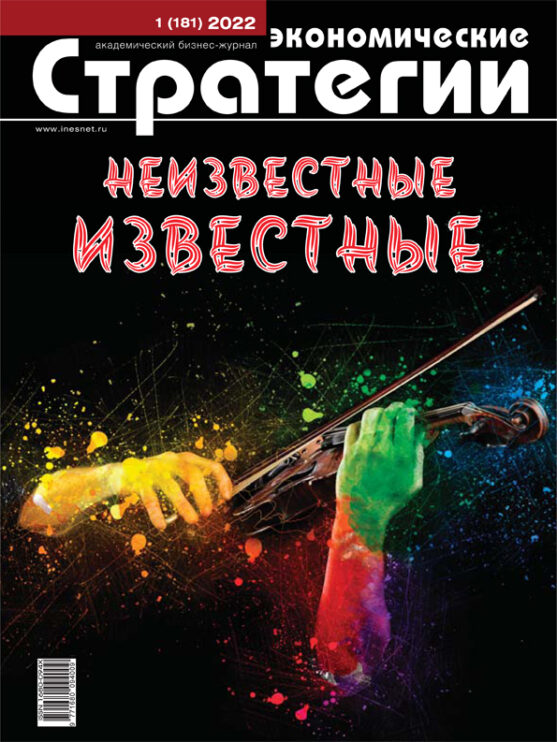
The Cradle of Life will Become the “Pasture„ of “Unicorns„

DOI: https://doi.org/10.33917/es-1.181.2022.112-117

The era of digital reorganisation will engender transformation of the world economy, largely determining the vector of civilizational development. Despite the losses of the 20th century, Russia, having the potential of fundamental science and resource self-sufficiency, is still among the few countries capable of leadership in changing conditions. Post-COVID economy has only accelerated the transformation process, generating thrust for the rapid growth of “unicorns”, mainly in the markets of platform and ecosystem solutions. Russia may become the “homeland” of such “unicorns”, and their scaling will provide the growing consumer market of Africa, which is a favourable territory for development and localization of scaling of science-intensive exports that can ensure the well-being of national economies.

Источники:

1. Mirovaya geografiya kompanii-edinorogov [Global Geography of Unicorn Companies]. Nauka, tekhnologii, innovatsii, 2021, September, 24, available at: https://issek.hse.ru/mirror/pubs/share/508603329.pdf.

2. United Nations e-Government Survey 2018. United Nations, 2018, available at: https://publicadministration.un.org/egovkb/Portals/egovkb/Documents/un/2018-Survey/E-Government%20Survey%202018_FINAL%20for%20web.pdf.

3. Rossiya stala odnim iz mirovykh liderov po urovnyu proniknoveniya fintekh-uslug [Russia has Become One of the World Leaders in Terms of Fintech Services Penetration]. EY, available at: https://www.ey.com/ru_ru/news/2019/11/news-ey-fintech-survey-2019.

4. Pri Mishustine nalogovoe vedomstvo Rossii stalo odnim iz luchshikh v mire [Under Mishustin, the Tax Department of Russia has Become One of the Best in the World]. Federal’noe agentstvo novostei, available at: https://riafan.ru/1242831-pri-mishustine-nalogovoe-vedomstvo-rossii-stalo-odnim-iz-luchshikh-v-mire.

5. African Economic Outlook 2021. African Development Bank Group, available at: https://www.afdb.org/en/knowledge/publications/african-economic-outlook.

6. Sammit “Rossiya — Afrika” [Russia-Africa Summit]. Ofitsial’nyi sait Prezidenta RF, available at: http://www.kremlin.ru/events/president/news/61893.

7. From magazine: African air cargo market bucks global trend. Logistics update Africa, available at: https://www.logupdateafrica.com/african-air-cargo-marketbucks-global-trend.

The Relationship of Industry and Science in France by the Example of the École Polytechnique

#3. TARGET'S Issue
The Relationship of Industry and Science in France by the Example of the École Polytechnique

The paper investigated the current state of innovation system in France. By the example of the Higher School of Engineering École Polytechnique it considers formation of technology transfer center as a link between university innovation activity and entrepreneurial activity of major national corporations in France. The article examines principles of interaction between the major players of the university innovation system and their role in supporting small innovative companies formed as a result of the university innovative activity.