Methodological Model for Studying the Spanish Political Mentality. Part 2

DOI: 10.33917/es-4.202.2025.38-49

Spanish political mentality is a historically determined, multidimensional and systemic result of a long multi-ethnic and transcivilizational process. To study it, a methodological concept of imprinting was used, which was firstly substantiated within the framework of the present study. The article formulates the concept of the imprinting-suggestion phenomenon, the basic structural elements of which are represented primarily by epochal political events, as well as great cultural figures and outstanding governors. Taking into account these invariant predictors, critical periods in the history of Spain that influenced the course of its political mentalization are discussed. Based on methodological potential of the imprinting concept, its root sources — romanization and christianization — are revealed. The article examines the evolution specifics of polymentality in Moorish Spain, emergence of Spanish Catholicism and significance of the Reconquista in forming the foundations of the Spanish mentality. These and other key moments in the history of the Kingdom of Spain from this perspective are still awaiting their researchers. The final section provides an analytical review of the philosophical and theological principles of the Spanish political mentality.

References:

[1-32] See in No. 3/2025. p. 21.

33. Simon G. Voyny Rima v Ispanii. 154–133 gg. do n.e. [Rome’s Wars in Spain. 154–133 BC]. Saint Petersburg, 2008.

34. Losev A.F., Chistyakova N.A., Boroday T.Yu., et al. Antichnost’ kak tip kul’tury [Antiquity as a Type of Culture]. Moscow, Nauka, 1988.

35. Rüpke J. (Edit.). A Companion to Roman Religion. Wiley-Blackwell, 2007.

36. Kyumon F. Vostochnye religii v rimskom yazychestve [Eastern Religions in Roman Paganism]. Saint Petersburg, Evraziya, 2002.

37. Shayd Dzh. Religiya rimlyan [Religion of the Romans]. Moscow, 2006, p. 32.

38. Dzhons A.Χ. Gibel’ antichnogo mira [The Death of the Ancient World]. Rostov n/D, Feniks, 1997.

39. Ortega-i-Gasset Kh. Izbrannye trudy [Selected Works]. 2-e izd. Moscow, Ves’ mir, 2000, pp. 330, 331.

40. Badian Е. Roman Imperialism of the Late Republic. Oxford, 1968, p. 5.

41. Yakovleva L.E. Problema natsional’noy identichnosti v ispanskoy filosofii XX veka [The Problem of National Identity in Spanish Philosophy of the Twentieth Century], available at: https://conf.esp-centr.sfedu.ru/materials/995/yakovleva.pdf

42. Klaude D. Istoriya vestgotov [Geschichte der Westgoten]. Saint Petersburg, Evraziya, 2003.

43. Dzhon F. Mak-Artur. Tolkovanie knig Novogo Zaveta. 1-e Poslanie k Timofeyu [Interpretation of the Books of the New Testament. 1st Epistle to Timothy]. Moscow, Slavyanskoe Evangel’skoe Obshchestvo, 2002, p. 9.

44. Deko A. Apostol Pavel [Apostle Paul]. Moscow, Molodaya gvardiya, 2005, p. 56.

45. Cardaillac L. Santiago apóstol: el santo de los dos mundos. El Colegio de Jalisco, 2002.

46. Berdyaev N.A. Dukh i real’nost’ [Spirit and Reality]. Moscow, AST, Astrel’, 2011, p. 10.

Methodological Model for Studying the Spanish Political Mentality

DOI: 10.33917/es-3.201.2025.14-21

Spanish political mentality is a historically determined, multidimensional and systemic result of a long multi-ethnic and transcivilizational process. To study it, a methodological concept of imprinting was used, which was firstly substantiated within the framework of the present study. The article formulates the concept of the imprinting-suggestion phenomenon, the basic structural elements of which are represented primarily by epochal political events, as well as great cultural figures and outstanding governors. Taking into account these invariant predictors, critical periods in the history of Spain that influenced the course of its political mentalization are discussed. Based on methodological potential of the imprinting concept, its root sources — romanization and christianization — are revealed. The article examines the evolution specifics of polymentality in Moorish Spain, emergence of Spanish Catholicism and significance of the Reconquista in forming the foundations of the Spanish mentality. These and other key moments in the history of the Kingdom of Spain from this perspective are still awaiting their researchers. The final section provides an analytical review of the philosophical and theological principles of the Spanish political mentality.

References: 

1. Abellan J.L. Los españoles vistos por si mismos. Madrid, 1977.

2. Rodríguez-San Pedro L.E. La Edad Moderna: Universidades de la Monarquía Católica. Plétora y diversidad. Universia. España: Universidades, 2013, available at: // https://es.scribd.com/document/358750879/Edad-Moderna-Universidades-Monarquia-Catolica-Pletora-Diversidad

3. Ajo G. y Sáinz de Zúñiga C.M. Historia de las Universidades Hispánicas: orígenes y desarrollo desde su aparición hasta nuestros días. Madrid: Centro de Estudios e Investigaciones “Alonso de Madrigal”, 1957–1979.

4. Francisco Díez de Velasco. Religiones en España. Historia y presente. Madrid — España, 2012.

5. Spain — UNESCO World Heritage Convention, available at: // https://whc.unesco.org/en/statesparties/es

6. Kaptereva T.P. Iskusstvo Ispanii. Srednie veka. Epokha Vozrozhdeniya [Art of Spain. Middle Ages. Renaissance]. Moscow, 1988, p. 248.

7. Tuñón de Lara М. El hecho religioso en España. 1968.

8. Elliot J.H. La España imperial, 1469–1716. Barcelona: Edotorial Vicens-Vives, 1987.

9. Fernandez Calzada M. Heterogeneous cultural-historical West: Spanish-Catholic civilization; Spanish America; China and the Spanish, the world’s first, globalization. Biocosmology — neo-aristotelism, vol. 14, no. 1&2, Winter/Spring, 2024, pp. 88–126.

10. Shaw D.L. La generación del 98. Madrid: Ediciones Cátedra, 1977.

11. Ortega y Gasset J. Ensayos sobre la “Generación del 98” y otros escritores españoles contemporáneos. Madrid, Alianza, 1981.

12. 11. Rakityanskiy N.M. Mental’nye issledovaniya global’nykh politicheskikh mirov [Mental Explorations of Global Political Worlds]. Moscow, Izd-vo Moskovskogo universiteta, 2020, pp. 22–30.

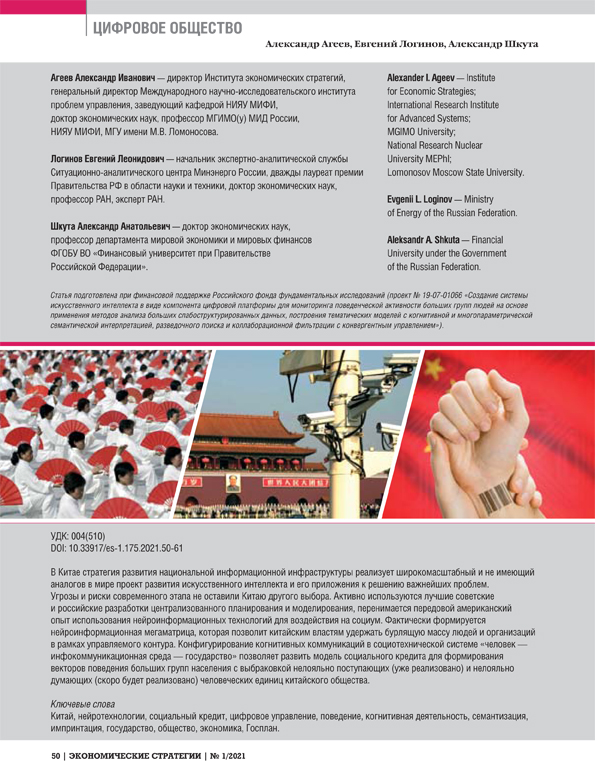
China as a Neural-Information Megamatrix: Digital Technologies for Structuring Cognitive Ensembles of Order

DOI: 10.33917/es-1.175.2021.50-61

In China, the strategy for the national information infrastructure development is implementing a large-scale and unparalleled project for developing artificial intelligence and its application to solving critical problems. Threats and risks of the current stage left no choice to China. The best Soviet and Russian developments of centralized planning and modeling are actively used, advanced American experience in applying neuroinformation technologies to influence society is being adopted. In fact, a neuroinformational mega-matrix is being formed, which will allow the Chinese authorities to keep the seething mass of people and organizations within a controlled circuit. Configuring cognitive communications in the socio-technical system “person — infocommunication environment — the state” allows to develop a social credit model for forming behavior vectors in large groups of the population with culling disloyal in behaviour (implemented now) and disloyal in thinking (soon to be implemented) human units of the China-community

Battle for the Future: Who Will Be the First in the World to Master the Noomonitoring and Cognitive Programming of Subjective Reality?

#2. Alliance Great
Battle for the Future: Who Will Be the First in the World to Master the Noomonitoring and Cognitive Programming of Subjective Reality?

The key factor determining the victory in the battle for the future is not the territory, not the army and not the volume of financial, material and intellectual resources being involved. The key factor of the victory is cognitive programming of subjective reality: mass-individual adjustment of the semantic interpretation of the existence goal and life success to form the material future through self-adjustment of the surrounding subjective reality to the “image of Victory” in cognitive perception of oneself and the surrounding material, virtual and imaginary individual world. Special urgency is acquired by this factor in conditions of building a “digital economy”. The basis of such mechanisms constitutes noomonitoring as a tool for making a “cognitive snapshot” of subjective reality, forecasting, planning and metaprogramming on its basis the “image of Victory” by forming in groups of individuals new knowledge about themselves and the surrounding world, as well as the structure of ideological and professional patterns for interpreting surrounding reality and its subsequent correction within the personal management while developing and implementing management decisions of individuals and groups as a basic reference point for managing groups of interrelated people, machines, technical, including information, systems and natural objects.