Achilles, the Tortoise and Schrodinger’s Cat. Some Features of Modern Evolution of Developing Countries

DOI: 10.33917/es-4.202.2025.50-59

The author draws attention to the fact that many international organizations consider it necessary to abandon the term “developing countries.” Reason for this is because countries outside the developed world do not represent a homogeneous group. The number of former developing countries that managed to enter in the group of developed countries is extremely small. The article examines the development factors that contribute to such transition, as well as two approaches to sustainable development: resilience and sustainability. The author states that there is no rational recipe for national success, and successful development is more a matter of art than rational knowledge. He also examines six country cases — the most successful developing countries according to the World Bank. In the end, the author comes to conclusion that modern technological progress makes building a model of the developing world’s future very difficult.

References:

1. Time to stop referring to the “developing world”. World Bank Blogs, January 23, 2024, available at: https://blogs.worldbank.org/en/opendata/time-stopreferring-developing-world

2. Is the term ‘developing world’ outdated? World Economic Forum, Nov 19, 2015, available at: https://www.weforum.org/stories/2015/11/is-the-termdeveloping-world-outdated/

3. Developing country: an outdated term in The Lancet. The Lancet, Sept 14, 2019, available at: https://www.thelancet.com/journals/lancet/article/PIIS0140-6736(19)31098-0/fulltext

4. Oscar Abraham Raya López. How are countries classified according to their level of development? Mexican Center for International Relations, June 24, 2022, available at: https://cemeri.org/ru/enciclopedia/e-clasificacion-nivel-desarrollo-paises-fv

5. Spisok naimenee razvitykh stran [List of Least Developed Countries]. OON, available at: ht tps://www.un.org/ru/development/ldc/list.shtml

6. Top Five Fastest-Growing Economies in 2024. Euromonitor International, October 6, 2024, available at: https://www.euromonitor.com/article/top-fivefastest-growing-economies-in-2024#:~:text=Out%20of%20the%20world’s%2062,%2C%20Vietnam%2C%20Indonesia%20and%20China

7. Three hundred years of applied sustainability in forestry, available at: https://www.research-collection.ethz.ch/bitstream/handle/20.500.11850/154087/1/eth-7348-01.pdf

8. The overall performance of all 193 UN Member States. SDR, available at: https://dashboards.sdgindex.org/rankings

9. The turbulent world of resilience: interpretations and themes for transdisciplinary dialogue. Springer Nature Link, available at: https://doi.org/10.1007/s10584-018-2358-0

10. ZOE, the Institute for Future-Fit Economies [Website]. ZOE, available at: https://zoe-institut.de/en/home-2/

11. The Economic Resilience Index, available at: https://zoe-institut.de/wpcontent/uploads/2023/09/Economic_Resilience_Index_Final-1.pdf

12. Knuth K. The term “resilience” is everywhere — but what does it really mean. Ensia, available at: https://ensia.com/articles/what-is-resilience/

Ambivalent Economic Stability. Sustainability vs. Resilience

DOI: 10.33917/es-4.196.2024.90-97

The author addressed the topic of comparing the meanings of the terms “sustainability” and “resilience” due to the fact that both these terms are used in economic literature, and at the same time they are both translated into Russian as “sustainability”, which sometimes causes incorrect understanding of the meaning of certain texts. The article dwells on genesis and areas of application of these terms, it is noted that the frequency of applying the word “resilience” has increased significantly in recent years. At the same time, a generally accepted definition of this term has not yet been developed, at least in its economic application. The same is referred to the term “sustainability”. Disadvantages of each of the terms are listed and debate on the priority of one term over another is considered. The author briefly discussed the use of terms in the current context of the Russian economy. It is concluded that while in terms of “resilience” the domestic economy has demonstrated visible success, then in terms of “sustainability” prospects there are serious problems.

References:

1. Concise Oxford Dictionary. Tenth Edition. Oxford University Press, Oxford, 1999.

2. McAslan A., Director of the Torrens Resilience Institute. The Concept of Resilience: Understanding its Origins, Meaning and Utility. Australia, Adelaide, 2010, 14 March, available at: https://www.flinders.edu.au/content/dam/documents/research/torrens-resilience-institute/resilience-origins-and-utility.pdf

3. Moser, et al. (2019). Climatic Change, available at: https://doi.org/10.1007/s10584-018-2358-0

4. ZOE, the Institute for Future-Fit Economies, available at: https://zoe-institut.de/en/home-2/

5. The Economic Resilience Index. Assessing the ability of EU economies to thrive in times of change, available at: https://zoe-institut.de/wp-content/ uploads/2023/09/Economic_Resilience_Index_Final-1.pdf

6. Rose A. Economic Resilience: Concepts and Measurement, available at: https://www.wto.org/english/res_e/reser_e/adam_rose_040321.pdf

7. Knuth K. The term “resilience” is everywhere — but what does it really mean, available at: https://ensia.com/articles/what-is-resilience/

8. Schmithüsen F.J. Three hundred years of applied sustainability in forestry, available at: https://www.research-collection.ethz.ch/bitstream/ handle/20.500.11850/154087/1/eth-7348-01.pdf

9. A Brief History of Sustainability, available at: https://thesustainableagency.com/blog/the-history-of-sustainability/#:~:text=In%201972%2C%20 sustainability%20was%20first,industrialized%20communities%2C%20among%20other%20suggestions

10. Purvis B., Mao Y., Robinson D. Three pillars of sustainability: in search of conceptual origins, available at: https://link.springer.com/article/10.1007/ s11625-018-0627-5

11. Knuth K. The term “resilience” is everywhere — but what does it really mean, available at: https://ensia.com/articles/what-is-resilience/
12. Six Key Factors for Achieving Sustainable Manufacturing, available at: https://www.foundrymag.com/opinion/article/21924600/six-key-factors-forachieving-sustainable-manufacturing

Resilience as a Strategic Imperative in the Age of Uncertainty

DOI: https://doi.org/10.33917/es-6.180.2021.58-62

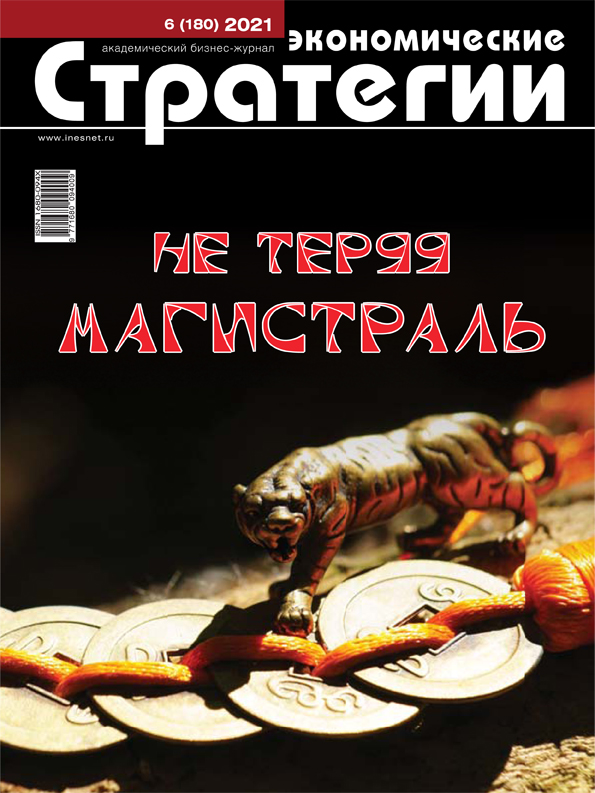
The article examines resilience as a new approach to supporting economic growth under the global uncertainty and sudden shocks. We describe resilience as a method for dynamic stabilization of complex systems, as a new imperative for growth policy, and as a new standard of risk management.

Источники:

1. Smorodinskaya N.V., Katukov D.D. Raspredelennoe proizvodstvo v usloviyakh shoka pandemii: uyazvimost’, rezil’entnost’ i novyi etap globalizatsii [Distributed Production Under the Pandemic Shock: Vulnerability, Resilience and the New Stage of Globalization]. Voprosy ekonomiki, 2021. №12 (V pechati.)

2. Walker J., Cooper M. Genealogies of resilience. Security Dialogue, 2011, Vol. 42, no 2, pp. 143–160.

3. OECD, SIDA. Resilience systems analysis: Learning and recommendations report. Paris: OECD Publishing, 2017.

4. Smorodinskaya N.V. Uslozhnenie organizatsii  ekonomicheskikh sistem v usloviyakh nelineinogo razvitiya [Growing Organizational Complexity of Economic Systems Under Non-Linear Development]. Vestnik Instituta ekonomiki RAN, 2017, no 5, pp. 104–115.

5. OECD. A systemic resilience approach to dealing with COVID-19 and future shocks. OECD Policy Responses to Coronavirus (COVID-19). 2020.

6. Sreedevi R., Saranga H. Uncertainty and supply chain risk: The moderating role of supply chain flexibility in risk mitigation. International Journal of Production Economics, 2017, Vol. 193, pp. 332–342.

7. Linkov I., Trump B. D. The science and practice of resilience. Cham, Springer, 2019.

8. Ivanov D., Dolgui A., Sokolov B. Ripple effect in the supply chain: Definitions, frameworks and future research perspectives. Handbook of ripple effects in the supply chain. Cham, Springer, 2019, pp. 1–33.

9. PIIE. Rebuilding the global economy. PIIE briefing 21-1. Peterson Institute for International Economics, 2021, Washington, DC.

10. Smorodinskaya N. V., Katukov D.D. Rezil’entnost’ ekonomicheskikh sistem v epokhu globalizatsii i vnezapnykh shokov [Resilience of Economic Systems in the Age of Globalization and Sudden Shocks]. Vestnik Instituta ekonomiki RAN, 2021, no 5, pp. 93–115

11. Smorodinskaya N. V., Malygin V. E., Katukov D.D. Rol’ endogennykh mekhanizmov i faktora slozhnosti v dostizhenii sbalansirovannogo ekonomicheskogo rosta [The Role of Endogenous Mechanisms and the Factor of Complexity in Achieving Sustainable Economic Growth]. Vestnik Instituta ekonomiki RAN, 2020, no 1, pp. 113–129.

12. Root H.L. Network origins of the global economy: East vs. West in a complex systems perspective. Cambridge, Cambridge University Press, 2020.