Role of Nuclear Industry in the Global Energy Transition under the Influence of Exogenous Shocks
DOI: 10.33917/es-6.204.2025.100-107

Over the past five years, significant fluctuations in global nuclear energy production have been observed. From 2015 to 2022 its production growth slowed down and in 2022 a decline in production volumes was even observed. As a result, the share of nuclear energy in the global energy balance has significantly decreased over the past 20 years. However, the record energy price increases in 2022, coupled with climate change pressures, have prompted a number of countries to recognize the need to revive and develop the nuclear industry. The article analyses the consequences of the 2022 price crisis for the energy sectors of leading European countries, as well as the reasons that caused the change in the European Parliament’s position in respect of the nuclear energy. The main factors influencing development of the global nuclear energy at the present moment and determining its possible future development are identified. In addition, the article discusses the main players in the global nuclear energy market, examines position of Russia and Rosatom State Corporation therein and identifies new market segments with potentially high levels of competition in the nearest future.

References:

1. European electricity prices and costs. Ember, available at: https://ember-energy.org/data/european-electricity-prices-and-costs/

2. Cracking Under Pressure: Inside the Race to Fix France’s Nuclear Plants. Bloomberg, available at: https://www.bloomberg.com/news/features/2023-01-28/ inside-edf-s-race-to-fix-france-s-nuclear-reactors

3. EDF Moves Back Into State Hands With a Multitude of Burdens. Bloomberg, available at: https://www.bloomberg.com/news/articles/2023-06-08/edf-moves-back-into-state-ownership-with-a-multitude-of-burdens

4. Nuclear Energy. Our World in Data, available at: https://ourworldindata.org/nuclear-energy

5. Electricity generation in Germany in 2023. Energy-charts, available at: https://www.energy-charts.info/downloads/electricity_generation_germany_ 2023.pdf

6. EU parliament backs labelling gas and nuclear investments as green. Reuters, available at: https://www.reuters.com/business/sustainable-business/eu-parliament-vote-green-gas-nuclear-rules-2022-07-06/

7. Technical assessment of nuclear energy with respect to the ‘do no significant harm’ criteria of Regulation (EU) 2020/852 (‘Taxonomy Regulation’). European Commission, available at: https://finance.ec.europa.eu/document/download/e8dce5a0-f1e3-4d5a-8566-0692d40a8d99_en?filename=210329-jrc-report-nuclear-energy-assessment_en.pdf

8. Nuclear Power and Secure Energy Transitions From today’s challenges to tomorrow’s clean energy systems. IEA, available at: https://iea.blob.core.windows.net/assets/016228e1-42bd-4ca7-bad9-a227c4a40b04/NuclearPowerandSecureEnergyTransitions.pdf

9. Inflation Reduction Act of 2022. Congress.gov, available at: https://www.congress.gov/bill/117th-congress/house-bill/5376/text

10. Atomu nuzhny den’gi [Atom Needs Money]. Rosatomnewsletter, available at: https://rosatomnewsletter.com/ru/2024/01/27/nuclear-needs-finance/

Analytical technology of the “economic cross” — a toolkit for modeling the efficiency of closing the nuclear fuel cycle

DOI: 10.33917/es-4.190.2023.92-101

Changes in the economic development priorities during transition to a post-industrial society inevitably forces us to reconsider approaches to the role of innovation in the modern economy, including in nuclear energy. The life cycles of nuclear energy resources and nuclear power units are intersected, and at this intersection energy is generated, revenue occurs, etc. The rest of these life cycles are mainly costs. Method of analyzing this life cycles intersection was named the “economic cross”. The purpose of the study presented in the article is to specify conditions, under which the final revenue, with regard to discounting, will exceed the total costs, and nuclear power technology will be profitable.

References:

1. Kleiner G.B., Rybachuk M.A., Karpinskaya V.A. Strategicheskoe planirovanie i sistemnaya optimizatsiya natsional’noi ekonomiki [Strategic Planning and System Optimization of the National Economy]. Problemy prognozirovaniya, 2022, no 3(192), pp. 6–15.

2. Kleiner G.B. Inklyuzivnyi rost v ekonomike zamknutogo tsikla [Inclusive Growth in a Circular Economy] Ekonomicheskoe vozrozhdenie Rossii, 2022, no 3(73), pp. 37–44.

3. Kleiner G.B., Rybachuk M.A., Karpinskaya V.A. Systemic factors and prerequisites for the inclusive growth of the russian economy. Smart Innovation, Systems and Technologies, 2022, vol. 287, pp. 3–14.

4. Steblyanskaya A.N., Ai M., Efimova O.V., Kleiner G.B., Rybachuk M.A. Multi-capital approach for sustainable growth: experience from the oil & gas companies. Finance: Theory and Practice, 2022, vol. 26, no 4, pp. 29–43.

5. Veretekhina S.V., Kleiner G.B. Kontseptual’nye polozheniya upravleniya sotsial’no-ekonomicheskimi sistemami primenitel’no k podderzhke eksporta otechestvennoi naukoemkoi produktsii v usloviyakh novoi ekonomicheskoi real’nosti [Conceptual Provisions for Managing Socio-Economic Systems in Relation to Supporting the Export of Domestic High-Tech Products in the New Economic Reality]. Russian Economic Bulletin, 2022, vol. 5, no 4, pp. 244–251.

6. Adamov E.O. “Proryv” v yadernoi energetike [“Breakthrough” in Nuclear Power]. Energeticheskaya politika, 2019, no 4, pp. 78–85.

7. Kleiner G.B. Novaya teoriya ekonomicheskikh sistem i ee prilozheniya [New Theory of Economic Systems and Its Applications]. Vestnik RAN, 2011, no 9, pp. 794–808.

8. Timokhin D., Putilov A. Principles of Design of a Learning Management System for Development of Economic Skills for Nuclear Engineering Education. Advances in Intelligent Systems and Computing, 2021, vol. 1310, pp. 40–48.

9. Timokhin D.V., Putilov A.V. Innovatsionnye vozmozhnosti ispol’zovaniya metodologii “ekonomicheskogo kresta” v prognozirovanii perspektiv razvitiya dvukhkomponentnoi atomnoi energetiki [Innovative Possibilities of Applying the “Economic Cross” Methodology in Forecasting the Development Prospects of two-component nuclear energy]. Innovatsii, 2020, no 1, pp. 12–21.

10. Putilov A., Timokhin D., Pimenova V. Adaptation of the educational process to the requirements of the global nuclear market according the concept of “economic cross” through its digitalization. Procedia Computer Science, 2020, no 169, pp. 452–457.

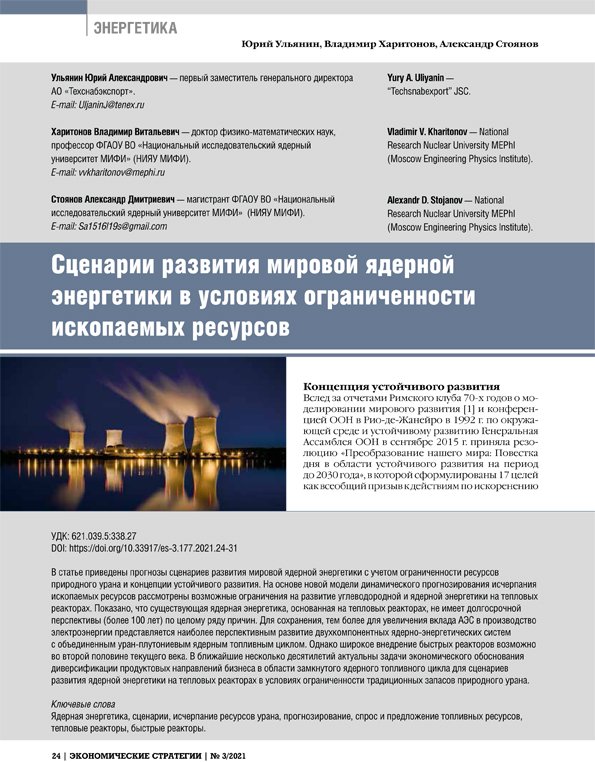
Scenarios for the Development of World Nuclear Power in the Context of Limited Fossil Resources

DOI: https://doi.org/10.33917/es-3.177.2021.24-31

Forecasts of the scenarios for the development of the world nuclear power industry are given, taking into account the limited resources of natural uranium and the concept of sustainable development. On the basis of a new model of dynamic forecasting of the depletion of fossil resources, possible restrictions on the development of hydrocarbon and nuclear energy at thermal reactors are considered. It is shown that the existing nuclear power based on thermal reactors does not have a long-term perspective (more than 100 years) for a number of reasons. The most promising development in order to maintain and, moreover, increase the contribution of nuclear power plants to electricity generation, is the two-component nuclear power system with a combined uranium-plutonium nuclear fuel cycle. However, the widespread introduction of fast-neutron reactors is possible in the second half of this century. For the next few decades, the tasks of economic substantiation of the diversification of business product lines in the field of a closed nuclear fuel cycle for scenarios of the development of nuclear power on thermal reactors in conditions of limited traditional reserves of natural uranium are urgent

Evaluation of the Competitiveness of Nuclear Power Projects In the World Market

#7-8. Burning Ground

In the nearest 15 years up to 130 nuclear units could come into operation, from 40 to 80 of which — in Asia, with 15 reactors already under construction. The share of nuclear power in the world energy balance may rise up to 30%.