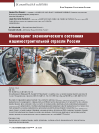
Monitoring Economic Situation of the Engineering Industry in Russia
DOI: 10.33917/es-3.201.2025.122-127

Research object of the present scientific article is the most significant, technologically advanced branch of industry, remaining within the framework of the Ministry of Industry and Trade of Russia, namely mechanical engineering. The purpose of this article is to analyze systematically the problem of providing impor t substitution, technological renewal and sustainable functioning of the most important industry, as well as to determine the main directions of its fur ther development in order to achieve technological sovereignty of the country in the context of a hybrid sanctions war declared by the United States and unfriendly countries. As a result of a comprehensive analysis, the authors deal with strategic problems and prospects for the development of mechanical engineering as a trend in the development of the industry and economy of the Russian Federation as a whole.

References:

1. Programma “Tsifrovaya ekonomika Rossiyskoy Federatsii” (utv. rasporyazheniem Pravitel’stva RF ot 28 iyunya 2017 g. N 1632-r [Digital Economy of the Russian Federation: Program. — Approved by the Order of the Government of the Russian Federation of June 28, 2017 No. 1632-r.], available at: http://static. government.ru/media/files/9gFM4FHj4PsB79I5v7yLVuPgu4bvR7 M0.pdf

2. Poslanie Prezidenta RF Federal’nomu sobraniyu RF ot 29 fevralya 2024 g. [Address of the President of the Russian Federation to the Federal Assembly of the Russian Federation dated February 29, 2024]. Ofitsial’nyy sayt Prezidenta RF, available at: ht tp://www.kremlin.ru/acts/bank/50431

3. Peterburgskiy mezhdunarodnyy ekonomicheskiy forum. Sankt-Peterburg, 4–8 iyunya 2024 g. [St. Petersburg International Economic Forum. St. Petersburg, June 4–8, 2024.]. RIA Novosti, available at: ht tps://rio.ru/20240608/putin-2893212072.html

4. Prognoz sotsial’no-ekonomicheskogo razvitiya Rossiyskoy Federatsii na 2022 god i na planovyy period 2023 i 2024 godov [Forecast of Socio-economic Development of the Russian Federation for 2022 and for the Planning Period of 2023 and 2024], available at: https://www.economy.gov.ru/material/file/ d7f5f5dea44bda4c30d42aac04cc1fca/prognoz_socialno_ekonom_razvitiya_rf_2022-2024.pdf

5. Postanovlenie Pravitel’stva Rossiyskoy Federatsii ot 15 iyunya 2023 g. N 988 “O vnesenii izmeneniy v postanovlenie Pravitel’stva Rossiyskoy Federatsii ot 18 maya 2011 g. N 378” [Resolution of the Government of the Russian Federation of June 15, 2023 No. 988 “On Amendments to the Resolution of the Government of the Russian Federation of May 18, 2011 No. 378”]. Ofitsial’noe opublikovanie pravovykh aktov, available at: http://publication.pravo.gov.ru/ document/0001202306150033

6. Prognoz dolgosrochnogo sotsial’no-ekonomicheskogo razvitiya Rossiyskoy Federatsii na period do 2030 goda (utv. rasporyazheniem Pravitel’stva RF ot 6 oktyabrya 2021 g. N 2816-r) [Forecast of the Long-term Socio-economic Development of the Russian Federation for the Period up to 2030]. Ofitsial’nyy sayt Pravitel’stva RF, available at: http://government.ru/docs/12582

Analyzing Specific Features of Economic Activity of Enterprises of the Russian Military-Industrial Complex

DOI: 10.33917/es-2.200.2025.62-69

The article examines key features of the economic activity of the Russian military-industrial complex (MIC). At the same time, it is substantiated that terms and concepts used in modern economic theory to characterize the activities of the defence industrial enterprises do not fully reflect the essence of the economic processes taking place in the MIC.

References: 

1. Shcheglov D.K., Pilikov N.A., Timofeev V.I. Kontseptual’nye osnovy tsifrovoy transformatsii organizatsiy oboronno-promyshlennogo kompleksa [Conceptual Foundations of Digital Transformation of Defense Industry Organizations]. Avtomatizatsiya v promyshlennosti, 2021, no 2, pp. 13–23.

2. Plotnikov V.A., Kharlamov A.V. Rossiyskiy oboronno-promyshlennyy kompleks kak faktor obespecheniya natsional’noy bezopasnosti i ustoychivogo sotsial’noekonomicheskogo razvitiya [The Russian Military-industrial Complex as a Factor in Ensuring National Security and Sustainable Socio-economic Development]. Ekonomika i upravlenie, 2017, no 11, pp. 53–60.

3. Shapoval E.V., Shelest M.V. Oboronno-promyshlennyy kompleks v sovremennoy ekonomike Rossii [The Military-industrial Complex in the Modern Economy of Russia]. Vestnik Gosudarstvennogo universiteta upravleniya, 2015, no 1, pp. 116–122.

4. Ovchinnikova A.V., Matveev V.V. Razvitie oboronno-promyshlennogo kompleksa Rossii i obespechenie konkurentosposobnosti natsional’noy ekonomiki [Development of the Russian Military-industrial Complex and Ensuring the Competitiveness of the National Economy]. Vestnik Yuzhno-Ural’skogo gosudarstvennogo universiteta, Seriya: Ekonomika i menedzhment, 2021, no 15(2), pp. 99–105.

5. Kazantsev S.V. Znachenie oboronno-promyshlennogo kompleksa dlya pod”ema rossiyskoy ekonomiki [The Importance of the Military-Industrial Complex for the Boom of the Russian Economy]. Finansovyy zhurnal, 2014, no 1, pp. 45–52.

6. Shcherbakov G.V. Tochki Laffera, zona fiskal’nykh protivorechiy i stepen’ soglasiya nalogoplatel’shchikov [Laffer Points, the Zone of Fiscal Contradictions and the Degree of Taxpayer Agreement]. Vestnik Rossiyskogo universiteta druzhby narodov, Seriya: Ekonomika, 2019, no 27(1), pp. 49–62.

7. Polozhikhina M.A. Evolyutsiya obshchestva potrebleniya: ot Zhaklin Kennedi do Grety Tunberg [The Evolution of Consumer Society: From Jacqueline Kennedy to Greta Thunberg]. Sotsial’nye novatsii i sotsial’nye nauki, 2020, no 2(2), pp. 7–36.

8. Byatets I.V. Vliyanie riska na pribyl’ predpriyatiya [The Impact of Risk on Enterprise Profits]. Vestnik Udmurtskogo universiteta, Seriya: Ekonomika i pravo, 2011, no 1, pp. 28–30.

9. Eroshin S.E. Parametricheskiy monitoring predpriyatiy oboronno-promyshlennykh ob”edineniy: Avtoref. dis…. d-ra ekon. nauk: 5.2.3 [Parametric Monitoring of Enterprises of Defense-industrial Associations: Abstract of dis…. Doctor of Economics: 5.2.3]. Moskovskiy gosudarstvennyy universitet. Moscow, 2023, 49 p.

10. Shcheglov D.K., Saybel’ A.G. Formalizovannyy podkhod k prognozirovaniyu srokov i stoimosti razrabotki voenno-tekhnicheskikh system [A Formalized Approach to Forecasting the Timing and Cost of Developing Military-technical Systems]. Oboronnyy kompleks — nauchno-tekhnicheskomu progressu Rossii, 2022, no 3(155), pp. 33–44.

“Space” Strategic Matrix: Concentration of the Russian Competitiveness Key Factors in the Struggle for Dominance in Strategic Business Areas of the Global Economy

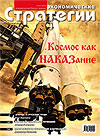
#5. Space Like a Punishment
“Space” Strategic Matrix: Concentration of the Russian Competitiveness Key Factors in the Struggle for Dominance in Strategic Business Areas of the Global Economy

Efficient use of space technologies and systems enables us to construct a model of techno-mediated social-economic progress, which will determine the format of states’ and corporations’ dominance in strategic business areas. Space is becoming a bifurcation point of conservation — of real-national sovereignty of those countries that are interested in it and can afford it. It is necessary to form a comprehensive space activity strategy for concentration of the Russian competitiveness key factors in the struggle for dominance in the world economy.

WTO and Modernization of Russian Education: What Expects Us?

#3. Conceptual viruses

When students begin to understand that with the Russian “documents of state standard” they are not required in the labor market, Russian universities will empty.

Innovative Supply and Demand: the Market Mechanism Singularity

#9. Triupmh of chronophages

It seems that talk about creating some special innovation legislation is screening to do nothing, just wait: it’s well known that the procedure of legislation development and adoption is a long process, and innovations do not wait, we are so far behind anyway.

Local Authorities in France in Terms of Financial and Economic Crisis

#12. Evil People

Over time, the point of view existed in France that financial independence is the tax independence. But recent years changes and decisions of the Constitutional Council showed that if local authorities even have the financial independence, they cannot enjoy any tax independence.