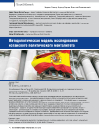
Methodological Model for Studying the Spanish Political Mentality
DOI: 10.33917/es-3.201.2025.14-21

Spanish political mentality is a historically determined, multidimensional and systemic result of a long multi-ethnic and transcivilizational process. To study it, a methodological concept of imprinting was used, which was firstly substantiated within the framework of the present study. The article formulates the concept of the imprinting-suggestion phenomenon, the basic structural elements of which are represented primarily by epochal political events, as well as great cultural figures and outstanding governors. Taking into account these invariant predictors, critical periods in the history of Spain that influenced the course of its political mentalization are discussed. Based on methodological potential of the imprinting concept, its root sources — romanization and christianization — are revealed. The article examines the evolution specifics of polymentality in Moorish Spain, emergence of Spanish Catholicism and significance of the Reconquista in forming the foundations of the Spanish mentality. These and other key moments in the history of the Kingdom of Spain from this perspective are still awaiting their researchers. The final section provides an analytical review of the philosophical and theological principles of the Spanish political mentality.

References: 

1. Abellan J.L. Los españoles vistos por si mismos. Madrid, 1977.

2. Rodríguez-San Pedro L.E. La Edad Moderna: Universidades de la Monarquía Católica. Plétora y diversidad. Universia. España: Universidades, 2013, available at: // https://es.scribd.com/document/358750879/Edad-Moderna-Universidades-Monarquia-Catolica-Pletora-Diversidad

3. Ajo G. y Sáinz de Zúñiga C.M. Historia de las Universidades Hispánicas: orígenes y desarrollo desde su aparición hasta nuestros días. Madrid: Centro de Estudios e Investigaciones “Alonso de Madrigal”, 1957–1979.

4. Francisco Díez de Velasco. Religiones en España. Historia y presente. Madrid — España, 2012.

5. Spain — UNESCO World Heritage Convention, available at: // https://whc.unesco.org/en/statesparties/es

6. Kaptereva T.P. Iskusstvo Ispanii. Srednie veka. Epokha Vozrozhdeniya [Art of Spain. Middle Ages. Renaissance]. Moscow, 1988, p. 248.

7. Tuñón de Lara М. El hecho religioso en España. 1968.

8. Elliot J.H. La España imperial, 1469–1716. Barcelona: Edotorial Vicens-Vives, 1987.

9. Fernandez Calzada M. Heterogeneous cultural-historical West: Spanish-Catholic civilization; Spanish America; China and the Spanish, the world’s first, globalization. Biocosmology — neo-aristotelism, vol. 14, no. 1&2, Winter/Spring, 2024, pp. 88–126.

10. Shaw D.L. La generación del 98. Madrid: Ediciones Cátedra, 1977.

11. Ortega y Gasset J. Ensayos sobre la “Generación del 98” y otros escritores españoles contemporáneos. Madrid, Alianza, 1981.

12. 11. Rakityanskiy N.M. Mental’nye issledovaniya global’nykh politicheskikh mirov [Mental Explorations of Global Political Worlds]. Moscow, Izd-vo Moskovskogo universiteta, 2020, pp. 22–30.
Technological Sovereignty — a Tool for Providing Sustainable Development of the Country

DOI: 10.33917/es-3.201.2025.6-13

The article dwells on the role of technological sovereignty in ensuring the country’s sustainable development. The authors examine the concept of technological sovereignty, its main components and its relationship with economic, social and environmental sustainability. Particular attention is paid to analysis of the key areas for strengthening technological sovereignty, including the development of a research base, stimulation of innovation, personnel training and government support. Examples of Russia and other countries show successful practices and challenges related to achieving technological independence. It is shown that technological sovereignty is a necessary condition for sustainable development, allowing to reduce dependence on external factors and ensure the country’s long-term innovative development. In conclusion, the authors put forward recommendations for forming a comprehensive strategy for technological development based on strengthening scientific potential and creating a favourable environment for innovation.

References: 

1. Razvitie ekonomicheskikh sistem: teoriya, metodologiya, praktika: Monografiya (nauchnoe izdanie) [Development of Economic Systems: Theory, Methodology, Practice: Monograph (Scientific Edition)]. FGAOU VO “Samarskiy natsional’nyy issledovatel’skiy universitet imeni akademika S.P. Koroleva, et al; pod. red. B.N. Gerasimova. Penza, PGAU, 2024, 275 p.

2. Trusina I., Ermolaeva E., Abramov V., Gopeenko V. Otsenka mirovogo razvitiya v invariantnoy sisteme koordinat energeticheskikh edinits: perspektivy novykh industrial’nykh ekonomik [Assessment of Global Development in an Invariant Coordinate System of Energy Units: Prospects for New Industrial Economies]. Zhurnal infrastruktury, politiki i razvitiya, 2024, no 8(1):3110, DOI: https://doi.org/10.24294/jipd.v8i1.3110

3. Afanas’ev A.A. Tekhnologicheskiy suverenitet kak nauchnaya kategoriya v sisteme sovremennogo znaniya [Technological Sovereignty as a Scientific Category in the System of Modern Knowledge]. Ekonomika, predprinimatel’stvo i pravo, 2022, vol. 12, no 9, pp. 2377–2394.

4. Kvint V.L., Novikova I.V., Alimuradov M.K., Sasaev N.I. Strategirovanie tekhnologicheskogo suvereniteta natsional’noy ekonomiki [Strategizing the Technological Sovereignty of the National Economy]. Upravlencheskoe konsul’tirovanie, 2022, no 9, pp. 57–67, DOI: 10.22394/1726-1139-2022-9-57-67

5. Baydarov D.Yu., Faykov D.Yu. Na puti k tekhnologicheskomu suverenitetu: teoreticheskie podkhody, praktika, predlozheniya [On the Way to Technological Sovereignty: Theoretical Approaches, Practice, Proposals]. Ekonomicheskoe vozrozhdenie Rossii, 2023, no 1, pp. 23–34.

6. Abramov V.I., Gavrilyuk A.V., Putilov A.V. Sravnenie podkhodov k obespecheniyu tekhnologicheskogo suvereniteta v raznykh stranakh: Trendy razvitiya sovremennogo obshchestva: upravlencheskie, pravovye, ekonomicheskie i sotsial’nye aspekty: Sb. nauchnykh statey 14-y Vserossiyskoy nauchnoprakticheskoy konferentsii [Comparison of Approaches to Ensuring Technological Sovereignty in Different Countries: Trends in the Development of Modern Society: Managerial, Legal, Economic and Social Aspects: Collection of scientific articles of the 14th All-Russian Scientific and Practical Conference]. Kursk, Universitetskaya kniga, 2024, pp. 15–21.