Civilizational Values as an Object of Interdisciplinary Analysis. Part II
DOI: 10.33917/es-1.205.2026.108-115

The article presents results of the Interdisciplinary Scientific Seminar «Mathematical Methods for Analyzing Complex Systems», which is held at the Faculty of Global Processes of M.V. Lomonosov Moscow State University and in the Sevastopol Branch of Moscow State University. The authors have managed to identify Russian civilization by constructing its value matrix through the method of paired comparisons (Saati method). The elements being compared were traditional Russian spiritual and moral values, listed in Decree № 809 of the President of the Russian Federation dated November 9, 2022.

References:

[1–16] See in no. 6/2025, p. 112–113.

17. Sovet OON po pravam cheloveka prinyal rezolyutsiyu, posvyashchennuyu voprosu traditsionnykh tsennostey [The UN Human Rights Council Adopted a Resolution on the Issue of Traditional Values]. Otdel vneshnikh tserkovnykh svyazey Moskovskogo patriarkhata. Razdel “Novosti”, available at: https://mospat.ru/ru/news/55822/

18. Ukaz Prezidenta Rossiyskoy Federatsii ot 12 maya 2009 g. N 537 “O Strategii natsional’noy bezopasnosti Rossiyskoy Federatsii do 2020 goda” [Decree of the President of the Russian Federation of May 12, 2009 No. 537 “On the National Security Strategy of the Russian Federation until 2020”]. Ofitsial’nyy sayt Prezidenta RF, available at: http://www.kremlin.ru/acts/bank/29277

19. Ukaz Prezidenta Rossiyskoy Federatsii ot 31 dekabrya 2015 g. N 683 “O Strategii natsional’noy bezopasnosti Rossiyskoy Federatsii” [Decree of the President of the Russian Federation of December 31, 2015 No. 683 “On the National Security Strategy of the Russian Federation”]. Ofitsial’nyy sayt Prezidenta RF, available at: http://www.kremlin.ru/acts/bank/40391

20. Ukaz Prezidenta Rossiyskoy Federatsii ot 2 iyulya 2021 g. N 400 “O Strategii natsional’noy bezopasnosti Rossiyskoy Federatsii” [Decree of the President of the Russian Federation of July 2, 2021 No. 400 “On the National Security Strategy of the Russian Federation”]. Ofitsial’nyy sayt Prezidenta RF, available at: http://www.kremlin.ru/acts/bank/47046

21. Ukaz Prezidenta Rossiyskoy Federatsii ot 9 noyabrya 2022 g. N 809 “Ob utverzhdenii Osnov gosudarstvennoy politiki po sokhraneniyu i ukrepleniyu traditsionnykh rossiyskikh dukhovno-nravstvennykh tsennostey”, paragraph 4 [Decree of the President of the Russian Federation of November 9, 2022 No. 809 “On Approval of the Fundamentals of State Policy for the Preservation and Strengthening of Traditional Russian Spiritual and Moral Values”, paragraph 4]. Ofitsial’noe opublikovanie pravovykh aktov, available at: http://publication.pravo.gov.ru/Document/View/0001202211090019/

22. Kontseptsiya vneshney politiki Rossiyskoy Federatsii (utv. Prezidentom Rossiyskoy Federatsii 31 marta 2023 g.) [Concept of Foreign Policy of the Russian Federation (approved by the President of the Russian Federation on March 31, 2023)]. MID Rossii, available at: https://www.mid.ru/ru/detail-materialpage/1860586/
Civilizational Values as an Object of Interdisciplinary Analysis

DOI: 10.33917/es-6.204.2025.108-113

The article presents results of the Interdisciplinary Scientific Seminar «Mathematical Methods for Analyzing Complex Systems», which is held at the Faculty of Global Processes of M.V. Lomonosov Moscow State University and in the Sevastopol Branch of Moscow State University. The authors have managed to identify Russian civilization by constructing its value matrix through the method of paired comparisons (Saati method). The elements being compared were traditional Russian spiritual and moral values, listed in Decree № 809 of the President of the Russian Federation dated November 9, 2022.

References:

1. Sravnitel’noe izuchenie tsivilizatsiy: Khrestomatiya [Comparative Studies of Civilizations: A Reader]. Ucheb. posobie dlya studentov vuzov. Sost., red. i vstup. st. B.S. Erasov. M.: Aspekt Press, 1998. 556 p.

2. Bol’shakov V.I. Russkoy tsivilizatsii 4000 let. Ot Svyatoy zemli k Svyatoy Rusi [Russian Civilization is 4,000 Years Old. From the Holy Land to Holy Rus’]. Moscow OOO “Tertsiya”, 2024, 248 p.

3. Kochetkov V.V. Identichnost’ i kul’tura v sovremennykh mezhdunarodnykh otnosheniyakh [Identity and Culture in Contemporary International Relations]. Ucheb. Posobie. Moscow, MGU imeni M.V. Lomonosova, 2015, 320 p.; Lan’: elektronno-bibliotechnaya sistema, available at: https://e.lanbook.com/book/114605

4. Malkov S.Yu. Sotsial’naya samoorganizatsiya i istoricheskiy protsess: Vozmozhnosti matematicheskogo modelirovaniya [Social Self-Organization and Historical Process: Possibilities of Mathematical Modeling]. Moscow, LIBROKOM, 2009, 240 p.

5. Novikova L.I. Tsivilizatsiya kak ideya i kak ob”yasnitel’nyy printsip istoricheskogo protsessa [Civilization as an Idea and as an Explanatory Principle of the Historical Process]. Tsivilizatsiya, Vyp. 1. Moscow, Nauka, 1992, 231 p.

6. Kireevskiy I.V. Dukhovnye osnovy russkoy zhizni [Spiritual Foundations of Russian Life]. Moscow, Institut russkoy tsivilizatsii, 2007, 445 p.

7. Kirsanov K.A., Popova S.A. Istoriya i razvitie mirovykh tsivilizatsiy: V 4 ch. Ch. 1. Obshchie voprosy tsivilizatsionnogo razvitiya [History and Development of World Civilizations: In 4 Parts. Part 1. General Issues of Civilizational Development]. Moscow, Institut mirovykh tsivilizatsiy, 2024, 180 p.

8. Tolmacheva R.P. Tsivilizatsiya Rossii: zarozhdenie i razvitie [Russian Civilization: Origin and Development]. Moscow, Dashkov i K., 2018, 402 p.

9. Kornilov S.V. Russkie filosofy [Russian Philosophers]. Saint Petersburg, Lan’, 2001, 446 p.

10. Kravchenko P.P. Svyataya Rus’: istoricheskaya missiya, natsional’naya ideya, forma pravleniya [Holy Rus’: Historical Mission, National Idea, Form of Government]. Moscow, Filin”, 2019, 450 p.

11. Karamzin H.M. Zapiska o drevney i novoy Rossii v ee politicheskom i grazhdanskom otnosheniyakh [A Note on Ancient and New Russia in its Political and Civil Relations]. Moscow, Nauka. Glavnaya redaktsiya vostochnoy literatury, 1991, 127 p.

12. Il’in I.A. Rossiya est’ zhivoy organism: Russkaya ideya [Russia is a Living Organism: The Russian Idea]. Moscow, Respublika, 1992. 496 s.

Consolidating Meanings of the North Caucasus as a Factor in Protecting Russian Civilizational Code in Conditions of Cognitive War

DOI: 10.33917/es-6.192.2023.96-103

The authors present the results of the expert seminars of the “Meanings of the Caucasus” Laboratory” project on the development of consolidating semantic structures that are relevant for the youth of the North Caucasus Federal District. The key challenges in the cognitive sphere, that the civilizational identity of the multinational people of Russia faces in the North Caucasus, are examined.

The authors provide materials from expert discussions of possible options for countering existing threats through the search for consolidating meanings and practices in the following areas: historical memory, value system, image of the future. They identify key historical events and personalities whose activities have had a constructive, unifying character for the Russian Caucasus, and in modern conditions are positively perceived by the youth audience. The article also highlights value orientations specific to the North Caucasus, that correlate with the all-Russian system of traditional spiritual and moral values. An analysis of the honor codes that were in demand over three historical eras (Russian Empire, USSR, modern Russia) by residents of the North Caucasus with description of the common core of values is provided.

Conclusion is made about the need to promote the above described consolidating meanings through the existing publicinstitutions of the North Caucasus Federal District.

References:

1. Il’nitskii A.M. Mental’naya voina Rossii [Mental War of Russia]. Voennaya mysl’, 2021, no 8, pp. 19–33.

2. Magomedova M.A. Mezhetnicheskie konflikty i protivorechiya na Severnom Kavkaze v kontekste regional’noi bezopasnosti [Interethnic Conflicts and Contradictions in the North Caucasus in the Context of Regional Security]. Vlast’, 2023, no 2, pp. 72–78.

3. Starodubrovskaya I.V., Kazenin K.I. Severnyi Kavkaz: Quo Vadis? Ekspertnyi doklad [North Caucasus: Quo Vadis? Expert Report]. Moscow, 2013, 67 p.

4. Nadein-Raevskii V.A. Pantyurkizm: ideologiya, istoriya, politika. Ekspansionistskaya doktrina: ot Osmanskoi imperii do nashikh dnei i sud’by Turtsii, Rossii i Armenii [Pan-Turkism: Ideology, History, Politics. Expansionist Doctrine: from the Ottoman Empire to the Present Day and the Fate of Turkey, Russia and Armenia]. Moscow, Russkaya panorama, 2017, 316 p.

5. Ukaz Prezidenta RF ot 31 marta 2023 g. N 229 “Ob utverzhdenii Kontseptsii vneshnei politiki Rossiiskoi Federatsii” [Decree of the President of the Russian Federation of March 31, 2023 No. 229 “On approval of the Foreign Policy Concept of the Russian Federation”]. Ofitsial’nyi sait Prezidenta RF, available at: http://kremlin.ru/events/preysident/news/70811

6. Ukaz Prezidenta RF ot 9 noyabrya 2022 g. N 809 “Ob utverzhdenii Osnov gosudarstvennoi politiki po sokhraneniyu i ukrepleniyu traditsionnykh rossiiskikh dukhovno-nravstvennykh tsennostei” [. Decree of the President of the Russian Federation of November 9, 2022 No. 809 “On approval of the Fundamentals of State Policy for the Preservation and Strengthening of Traditional Russian Spiritual and Moral Values”]. Ofitsial’nyi sait Prezidenta RF, available at: http://www.kremlin.ru/acts/bank/48502

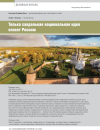
Only a Sacred National Idea will Save Russia

DOI: https://doi.org/10.33917/es-4.184.2022.120-127

In analyzing the essence of the Russian national idea and the way of reviving spiritual and moral values, it is necessary not only to understand the causes and events that destroyed the Soviet state, but also to build a program of overcoming the systemic crisis based on our own historical experience in the historical and philosophical context. The power perceived in Ancient Russia, along with the adoption of Christianity, gained sacredness from Byzantium, which absorbed all the experience of Antiquity, Ancient Judea and the Roman Empire. The article formulates a historiosophical concept, defines the systemic crisis of statehood, and outlines a way out of the time of troubles through the genuine institution of democracy in Russia, the Zemsky Sobor (Russian People’s Assembly), which is inherent in Russian civilization.) from the indigenous classes: the clergy and the peasantry, the officers and the Cossacks, the merchants and the resurgent Russian entrepreneurship, the workers and peasants, the scientific and engineering and creative elite.