Some Theoretical Approaches and Forecasts in the Sphere of Foreign Direct Investment

DOI: 10.33917/es-5.203.2025.28-33

In 2024, the Nobel Prize was awarded to American economists Daron Acemoglu, Simon Johnson, and James Robinson (new institutional economics). The article contains a critical analysis of theoretical approaches and anti-Russian statements of the new Nobel laureates. Contrary to their optimistic expectations, the socio-economic development of a number of A frican countries after the “Arab Spring” is characterized by acute problems and economic indicators of the leading countries of “democratic” Europe remain relatively weak for a long period of time. The ar ticle also examines current trends and forecasts in foreign direct investments (FDI). High levels of uncer tainty in the global economy and new tariffs imposed by the United States in 2025 are creating a lot of new risks for global value chains and foreign direct investments. In these circumstances, the author suggests recalling some of the ideas of past Nobel laureates Paul Krugman, Simon Kuznets, V.V. Leontief and Jan Tinbergen on the role of economic, industrial and migration policies, as well as policy in the sphere of foreign direct investments and economic integration. The article also offers some recommendations for economic policy in Russia.

References:

1. Adzhemoglu S., Robinson D. Pochemu odni strany bogatye, a drugie bednye. Proiskhozhdenie vlasti, protsvetaniya i nishchety [Why Nations Fail. The Origins of Power, Prosperity, and Poverty]. Moscow, AST, 2024, 668 p.

2. The Sveriges Riksbank Prize in Economic Sciences in Memory of Alfred Nobel 2024: Press Release. The Nobel Prize, available at: https://www.nobelprize.org/prizes/economic-sciences/2024/press-release/

3. Biggest Support Package to Ukraine So Far Increases Swedish Support to SEK 29.5 Billion for 2025. Government Offices of Sweden, available at: https://www.government.se/press-releases/2025/03/biggest-support-package-to-ukraine-so-far-increases-swedish-support-to-sek-29.5-billion-for-2025

4. Tatuzov V.Yu. Ogranichitel’naya monetarnaya politika — prepyatstvie dlya pryamykh inostrannykh investitsiy [Restrictive Monetary Policy — an Obstacle to Foreign Direct Investment]. Vestnik Moskovskogo universiteta. Seriya 6. Ekonomika, 2024, no 4(59), pp. 49–65, DOI: https://doi.org/10.55959/MSU0130-0105-6-59-4-3

5. Global Investment Trends Monitor, 2025, no 48, UNCTAD, available at: https://unctad.org/publications-search?f%5B0%5D=product%3A6096.

6. Handbook of Statistics — 2024. UNCTAD, available at: https://unctad.org/system/files/official-document/tdstat49_en.pdf

7. UNCTAD Trade and Development Foresights 2025: Under Pressure — Uncertainty Reshapes Global Economic Prospects. Geneva, UNCTAD, 2025, 55 p.

8. Leontief W. Domestic Production and Foreign Trade; The American Capital Position Re-Examined. Proceedings of the American Philosophical Society, 1953, no 4(97), pp. 332–349.

9. Kuznets S., Rubin E. Immigration and the Foreign Born. New York, NBER, 1954, 107 p.

10. Kuznets S. Population, Capital and Growth. London, Neineman, 1974, 342 p.

Institutionalization of the Business Value Formation Process: Historical Stages and Modern Challenges

DOI: 10.33917/es-2.200.2025.54-61

The study was carried out within the framework of D. North’s concept of the institutional framework of interactions. The article presents the author’s periodization of the stages of institutionalization in the process of business valuation formation. The author provides an analysis of the development stages and transformation of the institutional framework of the process of business value formation, based on dominant beliefs. Analysis covers the stages from the “pre-cost” of business in early historical periods to specifics of the cost of business in the context of digital technologies.

References: 

1. Gorodetskiy A. Ob osnovakh institutsional’noy transformatsii (teoreticheskiy aspekt) [On the Foundations of Institutional Transformation (Theoretical Aspect)]. Voprosy ekonomiki, 2000, no 10, pp. 118–133.

2. Loginova L.V. Institutsionalizatsiya ekonomicheskikh interesov: metodologicheskiy aspect: Formirovanie rossiyskoy modeli rynochnoy ekonomiki: protivorechiya i perspektivy [Institutionalization of Economic Interests: Methodological Aspect: Formation of the Russian Model of Market Economy: Contradictions and Prospects]. Pod red. K.A. Khubieva. Part 2. Moscow, Ekonomicheskiy fakul’tet, TEIS, 2003, pp. 259–265.

3. Oleynik A.N. Institutsional’nye aspekty sotsial’no-ekonomicheskikh transformatsiy [Institutional Aspects of Socio-economic Transformations]. Moscow, TEIS, 2000, 158 p.

4. Nort D.K. Pyat’ tezisov ob institutsional’nykh izmeneniyakh: Kvartal’nyy byulleten’ kluba ekonomistov [Five Theses on Institutional Change: Quarterly Bulletin of the Economists’ Club]. Minsk, Institut privatizatsii i menedzhmenta, 1998, pp. 3–15.

5. Nort D.K. Avtobiografiya. Lektsiya pamyati Al’freda Nobelya: Laureaty Nobelevskoy premii po ekonomike: avtobiografii, lektsii, kommentarii [Autobiography. Lecture in Memory of Alfred Nobel: Nobel Prize Laureates in Economics: Autobiographies, Lectures, Commentaries]. Pod red. V.V. Okrepilova. Vol. 2, Saint Petersburg, Nauka, 2009, pp. 297–315.

6. Adno Yu.L., Aleksandrova I.I., Baykov N.M., et al. Mirovaya ekonomika: global’nye tendentsii za 100 let [World Economy: Global Trends Over 100 Years]. Pod red. I.S. Koroleva. Moscow, Yurist”, 2003, 604 p.

7. Maddison А. The World Economy: a Millennial Perspective. Paris, Development Center of the OECD, 2001, 388 p.

8. North D.C., Thomas R.P. The rise of the Western world: a new economic history. Cambridge, Cambridge University Press, 1999, 171 p.

9. Gloveli G.D. Geopoliticheskaya ekonomiya v Rossii: ot diskussiy o samobytnosti k global’nym modelyam (XIX v. — pervaya tret’ XX v.) [Geopolitical Economy in Russia: From Discussions of Identity to Global Models (19th Century — First Third of the 20th Century)]. Saint Petersburg, Aleteyya, 2009, 204 p.

10. Nort D.K. Ponimanie protsessa ekonomicheskikh izmeneniy [Understanding the Process of Economics Change]. Moscow, ID GU — VShE, 2010, 256 p.

11. Novaya postindustrial’naya volna na Zapade: Antologiya [The New Post-Industrial Wave in the West: An Anthology]. Pod red. V.L. Inozemtseva. Moscow, Academia, 1999, 640 p.

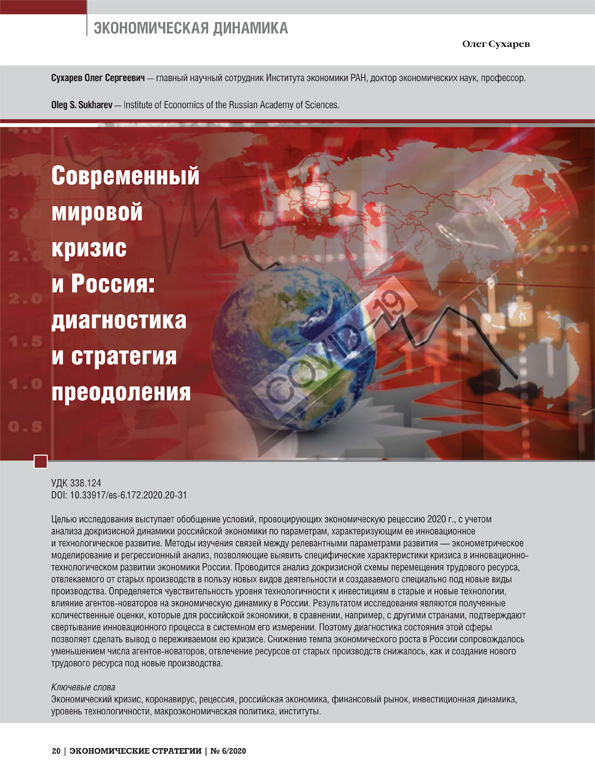
Modern World Crisis and Russia: Diagnostics and Status of Overcoming

DOI: 10.33917/es-6.172.2020.20-31

The purpose of the study is to generalize the conditions that provoke the economic recession of 2020, taking into account the analysis of the pre-crisis dynamics of the Russian economy according to the parameters characterizing its innovative and technological development. The method of studying the relationships between the relevant development parameters is econometric modeling and regression analysis, which allow to identify the specific characteristics of the crisis in the innovative and technological development of the Russian economy. The analysis of the pre-crisis pattern of the movement of labor resources distracted from old industries in favor of new activities, and created specifically for new types of production. The sensitivity of the level of manufacturability to investments in old and new technologies, the influence of innovative agents on the economic dynamics in Russia are determined. The result of the study is the quantitative estimates obtained, which for the Russian economy, in comparison, for example, with other countries confirm the folding of the innovation process in its systemic dimension. Therefore, the diagnosis of the state of this sphere gives a conclusion about its crisis state. The decrease in the rate of economic growth in Russia was accompanied by a decrease in the number of innovative agents, the diversion of resources from old industries decreased, as did the creation of a new labor resource for new industries.